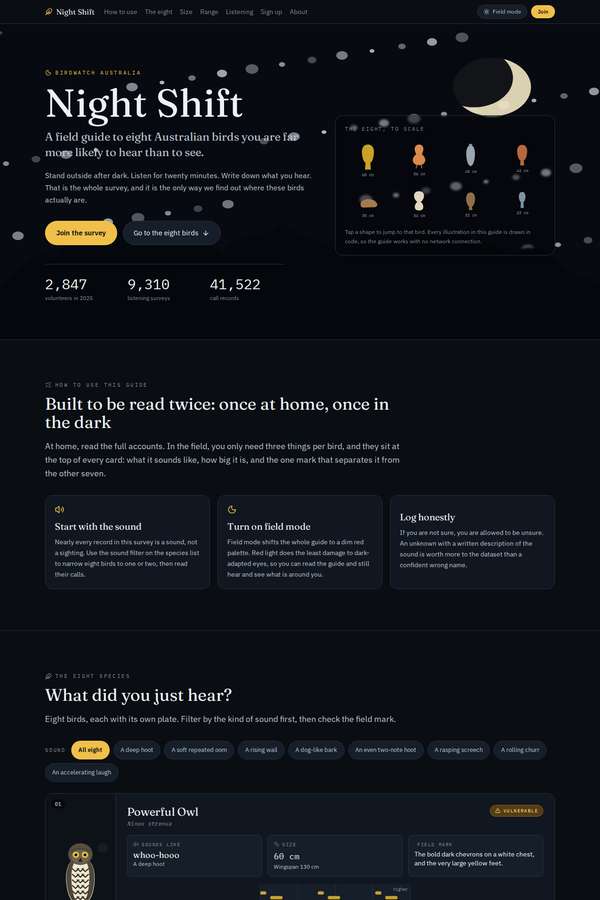
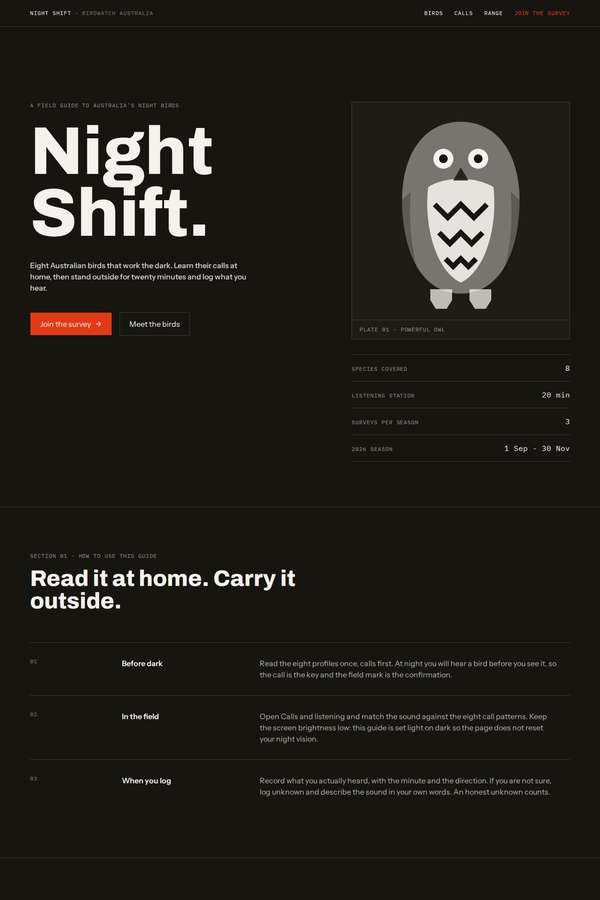
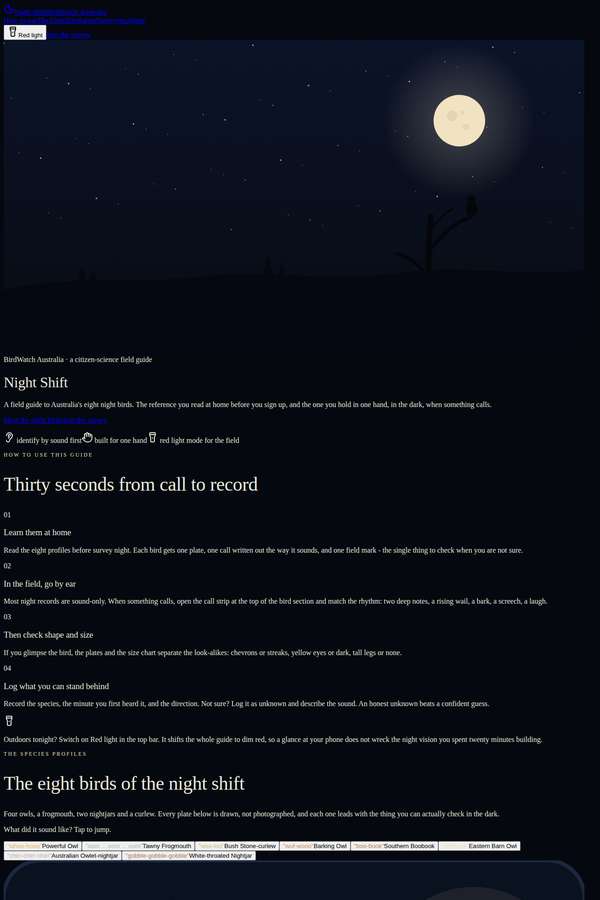
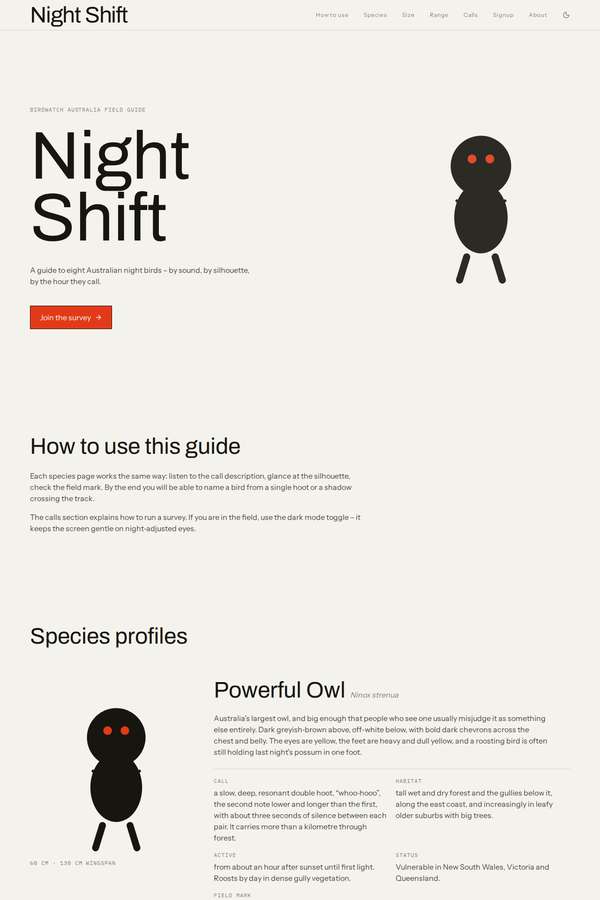
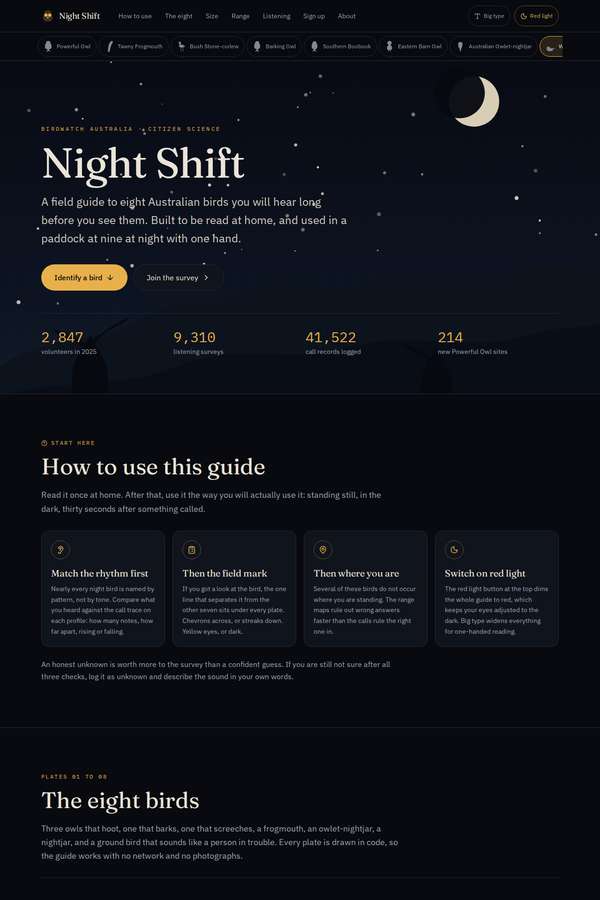
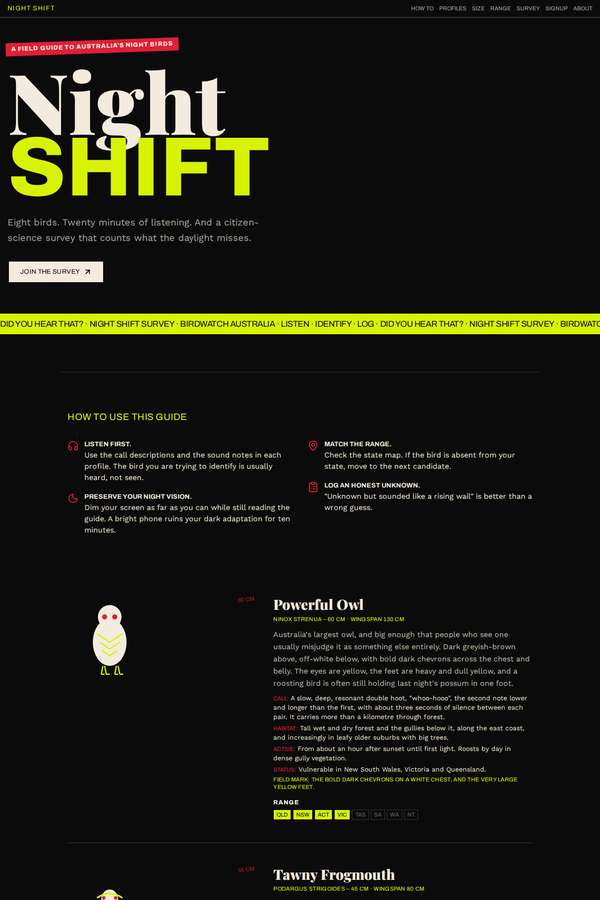
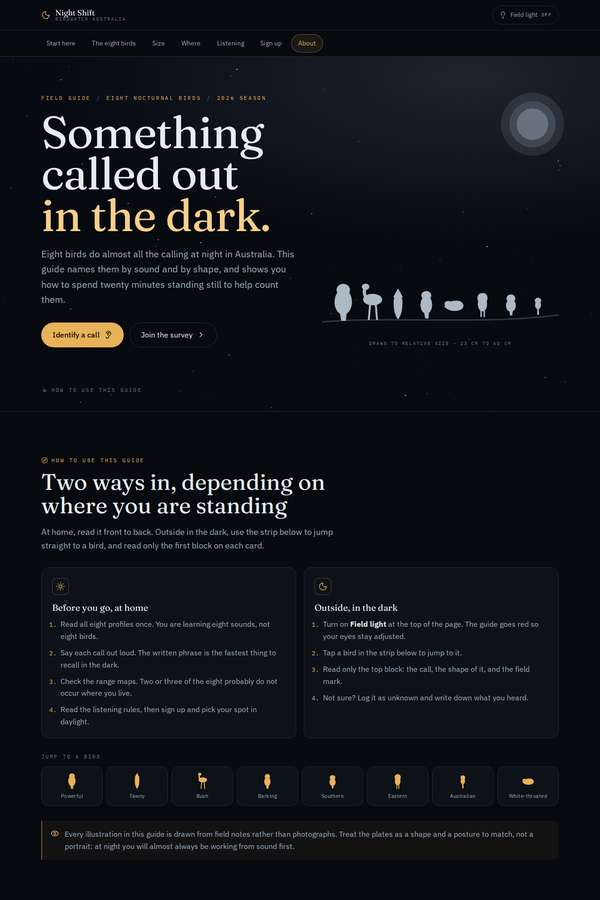
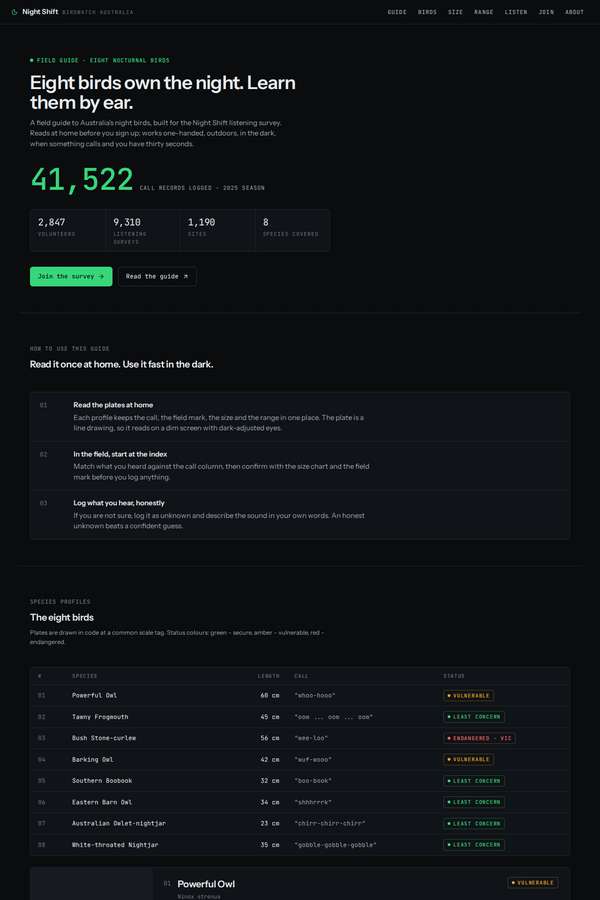
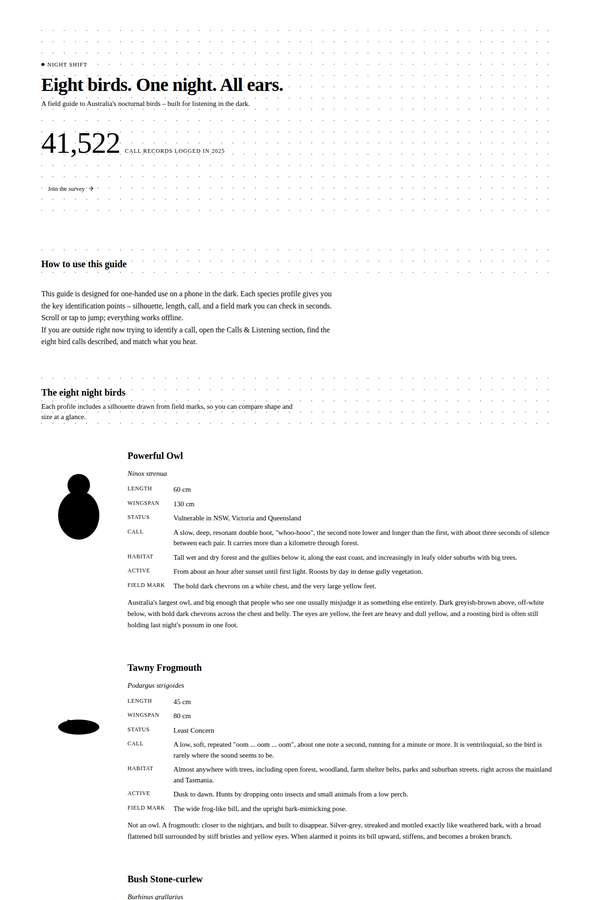
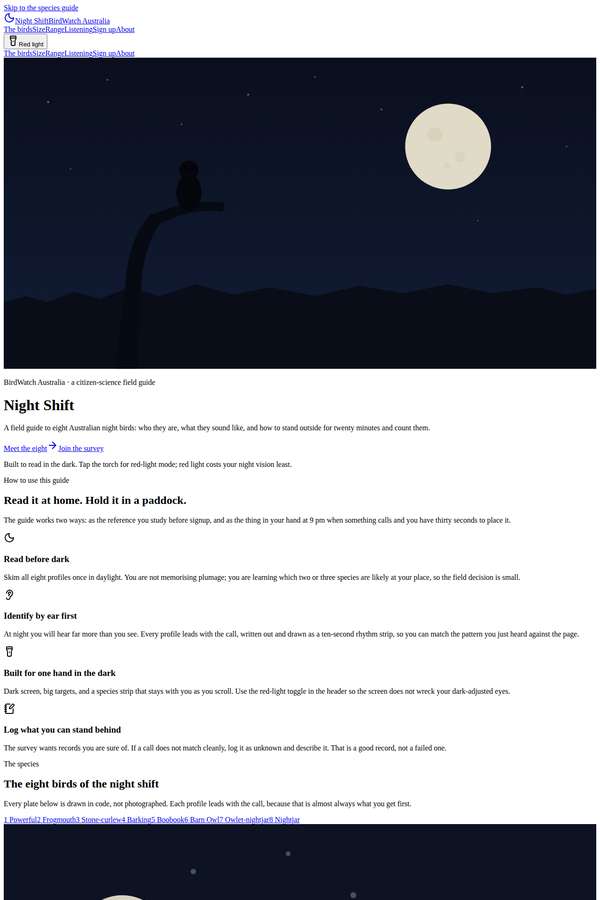
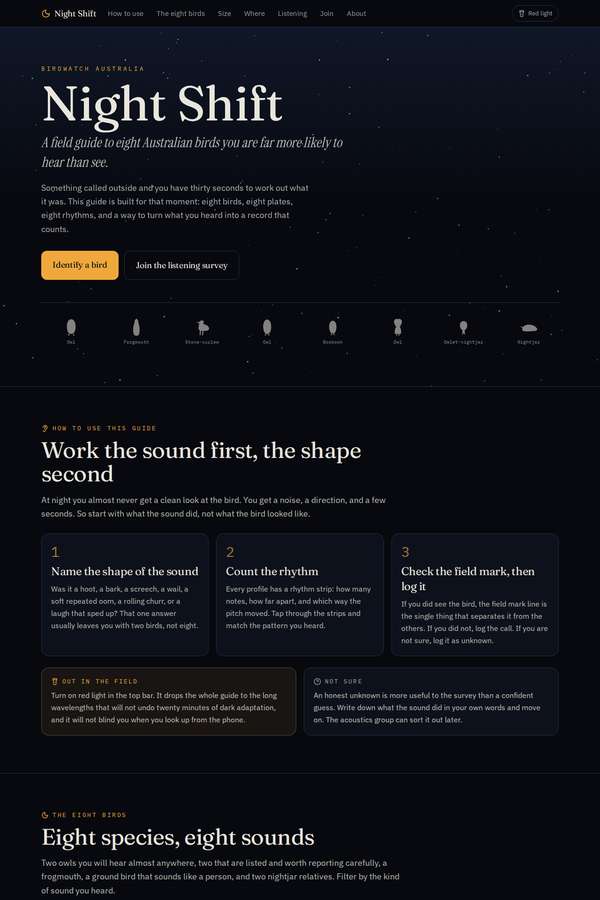
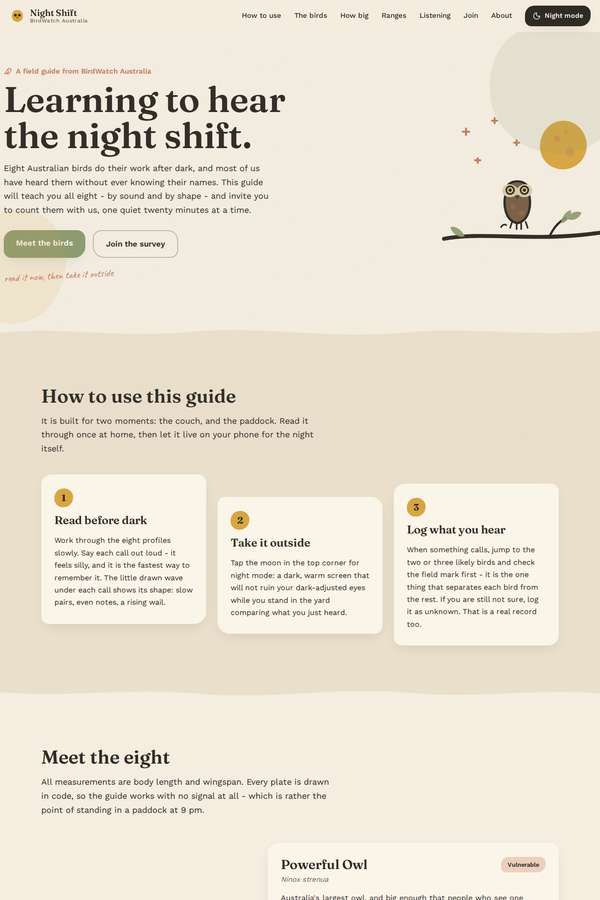
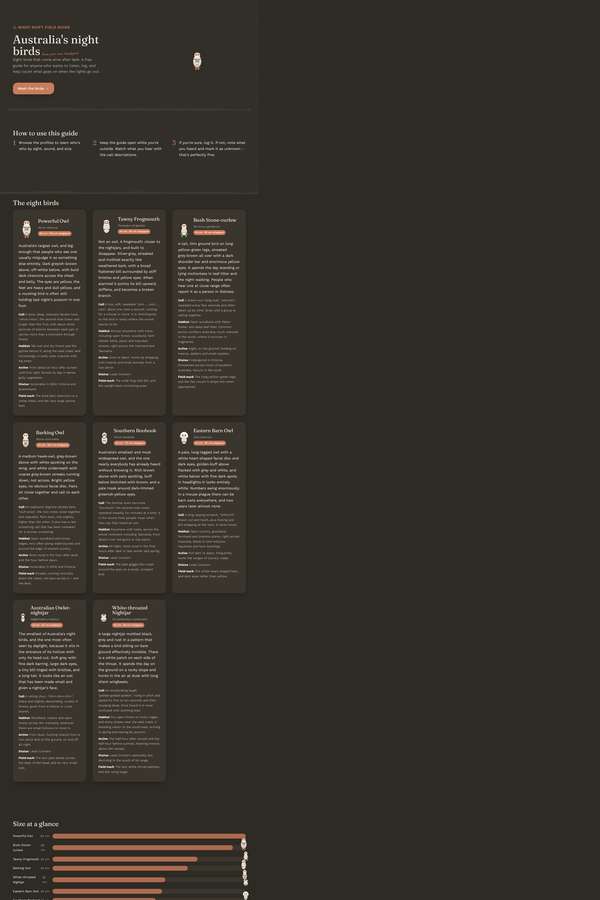
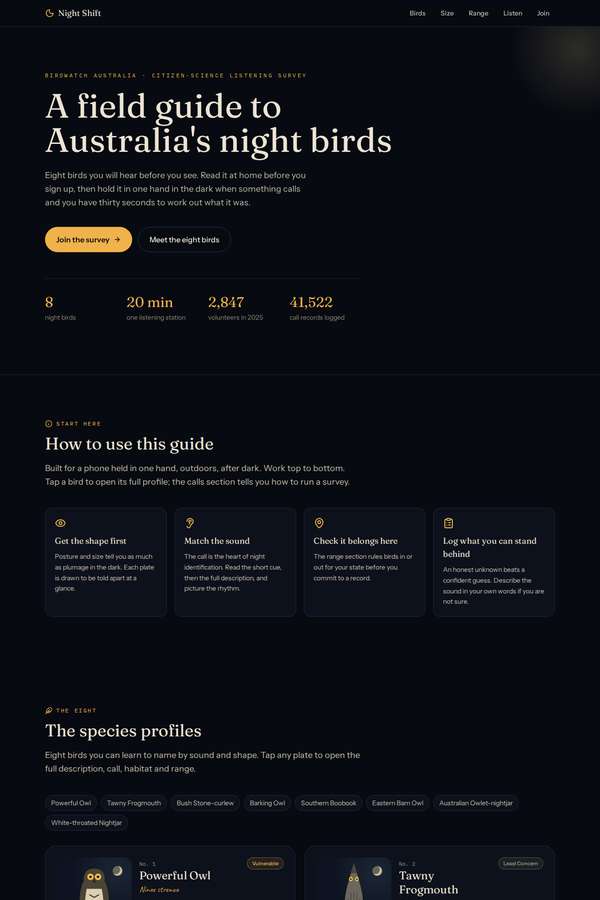
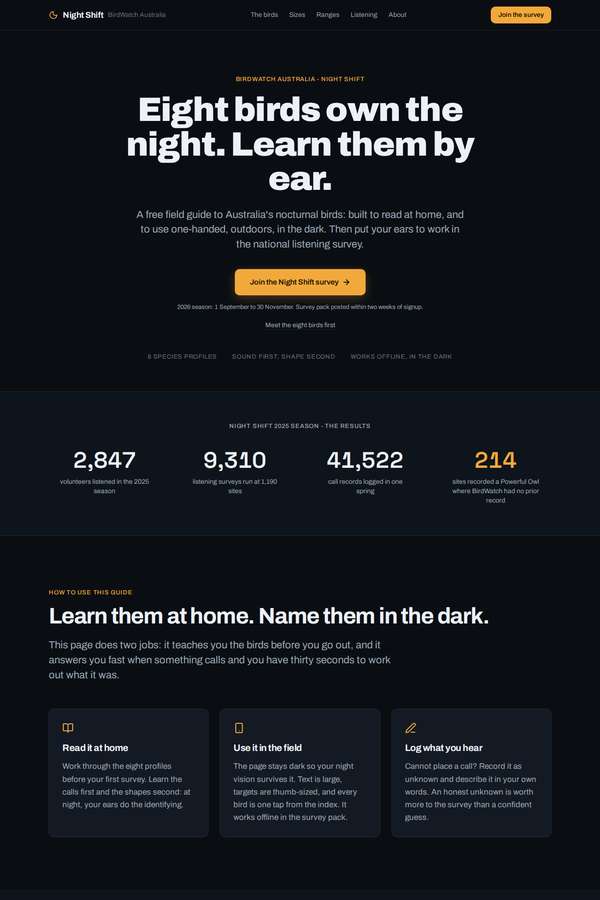
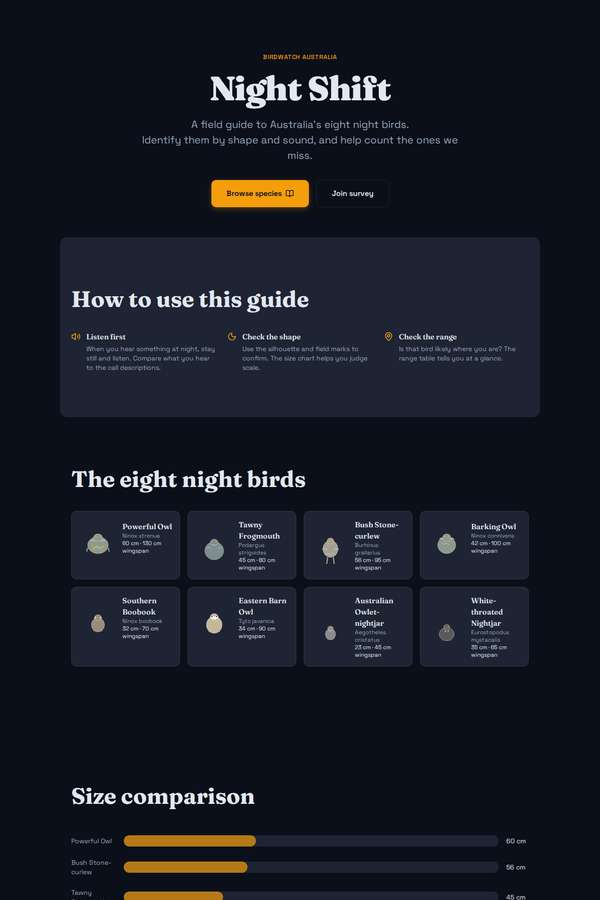
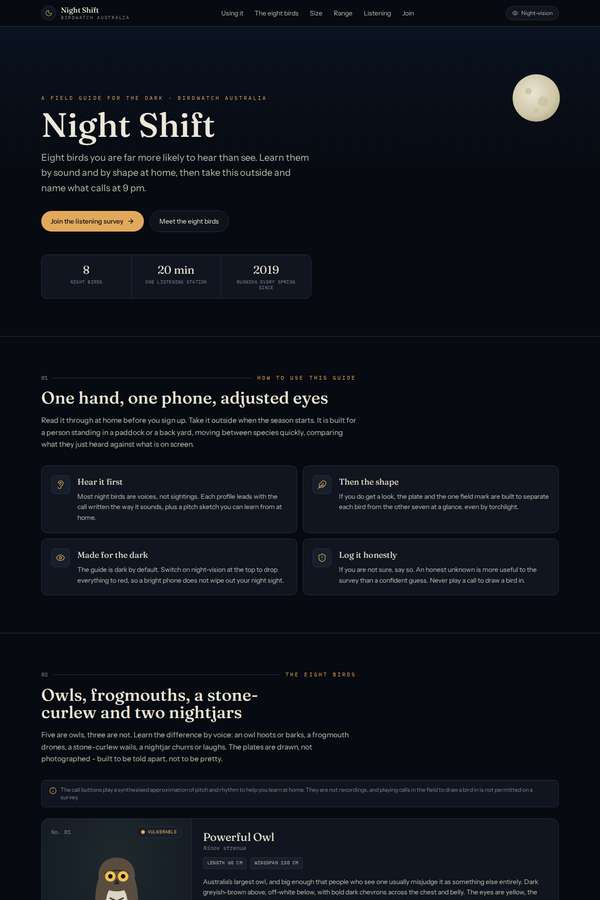
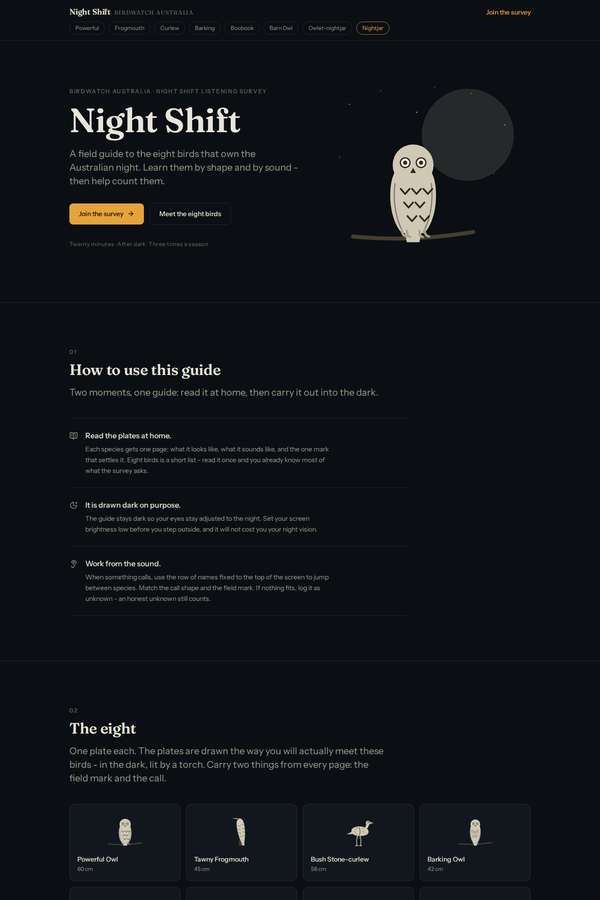
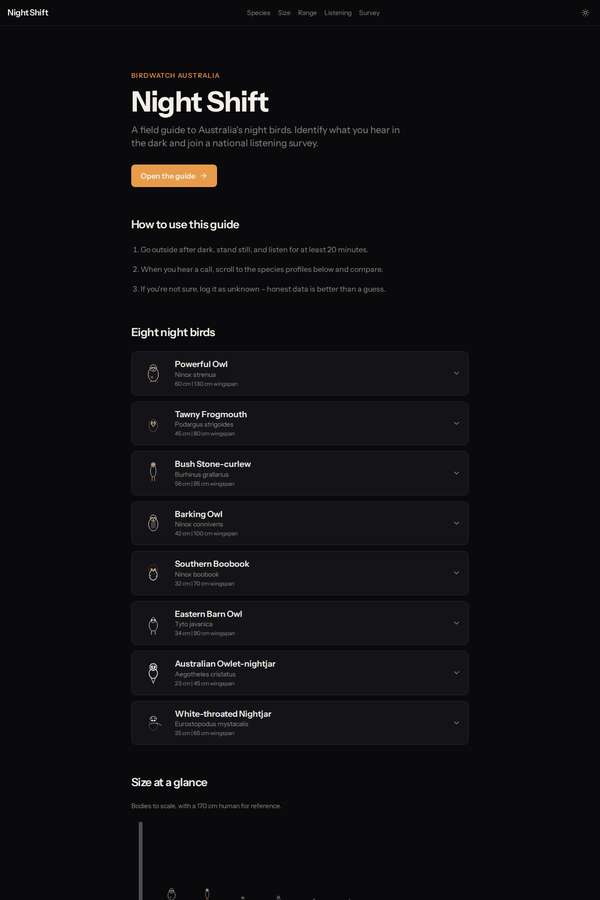
Night Shift nocturnal bird field guide
One brief, interpreted by fictional designer personas across published models. Compare the choices each makes and inspect the actual outputs.
- Task
- WDB-0006
- Design identities
- 7
- Published builds
- 28
Read the brief
# Client brief: Night Shift, a field guide to Australia's night birds You are designing and building a public field guide for a conservation nonprofit. The brief below gives you the organisation, the goals, the audience, the sections the guide must have, and the exact content to use. It gives you no visual direction on purpose. Every design decision - layout, type, colour, illustration, motion, tone - is yours to make. Read the whole brief, form a point of view on how this guide should look and work, and build it. ## The commissioning body BirdWatch Australia is a national conservation nonprofit based in Melbourne. It runs volunteer bird surveys and publishes free identification material. It is publishing this guide to eight Australian nocturnal birds to support Night Shift, its national citizen-science listening survey, which asks volunteers to stand outside after dark, listen for twenty minutes, and log what they hear. The guide has two jobs at once. It is the reference a volunteer reads at home before they sign up, and it is the thing they hold in one hand, outdoors, in the dark, when something calls and they have thirty seconds to work out what it was. ## What the guide is for 1. Let a person who knows nothing about night birds identify all eight by sound and by shape, well enough to log a record they can stand behind. 2. Recruit volunteers into the Night Shift listening survey and get them to complete the signup form. 3. Make the case for why night birds are worth counting, so the guide does something for the cause even when the reader never signs up. ## Who it is for Adults with no bird training who heard something at night and want to know what it was; existing BirdWatch volunteers who already do daytime surveys and are being asked to add a night one; and secondary-school teachers and scout and landcare groups who run the survey as a group activity. ## Two conditions that come with the commission These are practical requirements, not style instructions. **It is used in the field, at night, on a phone.** A volunteer is standing in a paddock or a back yard at 9 pm holding a phone in one hand and a torch or a notebook in the other. They are moving between species quickly and comparing what they just heard against what is on screen. Assume a phone screen first, one-handed use, and a reader whose eyes are adjusted to the dark. How you answer that is your call. **Every illustration must be drawn in code.** The guide ships offline, inside the survey pack, with no network connection, and BirdWatch has licensed no photographs for it. There is no photo library, no icon pack of birds, and no image files. Every bird plate, every silhouette, every chart, and every map on this page has to be produced in the code you write. There are eight birds, so this is a sustained drawing job, not one hero illustration. Each species needs its own plate and each one needs to be distinguishable from the other seven at a glance. One firm rule: any motion must respect a visitor's reduced-motion preference. When reduced motion is requested, the whole guide must still be completely readable and every section reachable as a calm, static page, with no information conveyed only through movement. ## What the guide must contain (all of these sections) - a hero that opens the guide, - how to use the guide, - the eight species profiles, - a size-comparison chart across all eight birds, - where to find them: the range section, - calls and listening, - the Night Shift survey signup, with the form, - about the project, and contact. ## Content to use Use the content below substantially as written, in Australian English. You may write your own section headings and any short connective microcopy (button labels, captions, form labels, chart labels), but the facts, figures, names, numbers, and descriptions are fixed. Do not drop any of the eight birds, do not invent a ninth, and do not change the measurements, the calls, the statuses, the ranges, the survey method, or the contact details. ### The eight birds **1. Powerful Owl** (*Ninox strenua*) - Body length 60 cm. Wingspan 130 cm. - Australia's largest owl, and big enough that people who see one usually misjudge it as something else entirely. Dark greyish-brown above, off-white below, with bold dark chevrons across the chest and belly. The eyes are yellow, the feet are heavy and dull yellow, and a roosting bird is often still holding last night's possum in one foot. - Call: a slow, deep, resonant double hoot, "whoo-hooo", the second note lower and longer than the first, with about three seconds of silence between each pair. It carries more than a kilometre through forest. - Habitat: tall wet and dry forest and the gullies below it, along the east coast, and increasingly in leafy older suburbs with big trees. - Active: from about an hour after sunset until first light. Roosts by day in dense gully vegetation. - Status: Vulnerable in New South Wales, Victoria and Queensland. - Field mark: the bold dark chevrons on a white chest, and the very large yellow feet. **2. Tawny Frogmouth** (*Podargus strigoides*) - Body length 45 cm. Wingspan 80 cm. - Not an owl. A frogmouth: closer to the nightjars, and built to disappear. Silver-grey, streaked and mottled exactly like weathered bark, with a broad flattened bill surrounded by stiff bristles and yellow eyes. When alarmed it points its bill upward, stiffens, and becomes a broken branch. - Call: a low, soft, repeated "oom ... oom ... oom", about one note a second, running for a minute or more. It is ventriloquial, so the bird is rarely where the sound seems to be. - Habitat: almost anywhere with trees, including open forest, woodland, farm shelter belts, parks and suburban streets, right across the mainland and Tasmania. - Active: dusk to dawn. Hunts by dropping onto insects and small animals from a low perch. - Status: Least Concern. - Field mark: the wide frog-like bill, and the upright bark-mimicking pose. **3. Bush Stone-curlew** (*Burhinus grallarius*) - Body length 56 cm. Wingspan 95 cm. - A tall, thin ground bird on long yellow-green legs, streaked grey-brown all over with a dark shoulder bar and enormous yellow eyes. It spends the day standing or lying motionless in leaf litter and the night walking. People who hear one at close range often report it as a person in distress. - Call: a drawn-out rising wail, "wee-loo", repeated every few seconds and often taken up by other birds until a group is calling together. - Habitat: open woodland with fallen timber and deep leaf litter. Common across northern Australia; much reduced in the south, where it survives in fragments. - Active: night, on the ground, feeding on insects, spiders and small reptiles. - Status: Endangered in Victoria, and threatened across much of southern Australia. Secure in the north. - Field mark: the long yellow-green legs, and the flat crouch it drops into when approached. **4. Barking Owl** (*Ninox connivens*) - Body length 42 cm. Wingspan 100 cm. - A medium hawk-owl, grey-brown above with white spotting on the wing, and white underneath with coarse grey-brown streaks running down, not across. Bright yellow eyes, no obvious facial disc. Pairs sit close together and call to each other. - Call: an explosive dog-like double bark, "wuf-wooo", the two notes close together and repeated. Pairs duet, one slightly higher than the other. It also has a rare screaming call that has been mistaken for a woman screaming. - Habitat: open woodland and forest edges, very often along watercourses and around the edge of cleared country. - Active: most vocal in the hour after dusk and the hour before dawn. - Status: Vulnerable in New South Wales and Victoria. - Field mark: streaks running vertically down the chest, not bars across it - and the bark. **5. Southern Boobook** (*Ninox boobook*) - Body length 32 cm. Wingspan 70 cm. - Australia's smallest and most widespread owl, and the one nearly everybody has already heard without knowing it. Rich brown above with pale spotting, buff below blotched with brown, and a pale mask around dark-rimmed greenish-yellow eyes. - Call: the familiar even two-note "boo-book", the second note lower, repeated steadily for minutes at a time. It is the sound most people mean when they say they heard an owl. - Habitat: anywhere with trees, across the whole continent including Tasmania, from desert river red gums to city parks. - Active: all night, most vocal in the first hours after dark in late winter and spring. - Status: Least Concern. - Field mark: the pale goggle-like mask around the eyes on a small, compact bird. **6. Eastern Barn Owl** (*Tyto javanica*) - Body length 34 cm. Wingspan 90 cm. - A pale, long-legged owl with a white heart-shaped facial disc and dark eyes, golden-buff above flecked with grey and white, and white below with fine dark spots. In headlights it looks entirely white. Numbers swing enormously: in a mouse plague there can be barn owls everywhere, and two years later almost none. - Call: a long rasping screech, "shhhrrrk", drawn out and harsh, plus hissing and bill-snapping at the nest. It never hoots. - Habitat: open country, grassland, farmland and treeless plains, right across Australia. Nests in tree hollows, haysheds and farm buildings. - Active: full dark to dawn. Frequently hunts the verges of country roads. - Status: Least Concern. - Field mark: the white heart-shaped face, and dark eyes rather than yellow. **7. Australian Owlet-nightjar** (*Aegotheles cristatus*) - Body length 23 cm. Wingspan 45 cm. - The smallest of Australia's night birds, and the one most often seen by daylight, because it sits in the entrance of its hollow with only its head out. Soft grey with fine dark barring, large dark eyes, a tiny bill ringed with bristles, and a long tail. It looks like an owl that has been made small and given a nightjar's face. - Call: a rolling churr, "chirr-chirr-chirr", sharp and slightly descending, usually in threes, given from a hollow or a low branch. - Habitat: woodland, mallee and open forest across the mainland, wherever there are small hollows to roost in. - Active: from dusk, hunting insects from a low perch and on the ground, on and off all night. - Status: Least Concern. - Field mark: the two pale bands across the back of the head, and its very small size. **8. White-throated Nightjar** (*Eurostopodus mystacalis*) - Body length 35 cm. Wingspan 65 cm. - A large nightjar mottled black, grey and rust in a pattern that makes a bird sitting on bare ground effectively invisible. There is a white patch on each side of the throat. It spends the day on the ground on a rocky slope and hunts in the air at dusk with long silent wingbeats. - Call: an accelerating laugh, "gobble-gobble-gobble", rising in pitch and speed for five to ten seconds and then stopping dead. Once heard it is never confused with anything else. - Habitat: dry open forest on rocky ridges and stony slopes near the east coast. A breeding visitor to the south-east, arriving in spring and leaving by autumn. - Active: the half hour after sunset and the half hour before sunrise, hawking insects above the canopy. - Status: Least Concern nationally, but declining in the south of its range. - Field mark: the two white throat patches, and the rising laugh. ### The size-comparison dataset Body lengths for the scale chart, in centimetres. A person is 170 cm for reference. - Powerful Owl - 60 cm - Bush Stone-curlew - 56 cm - Tawny Frogmouth - 45 cm - Barking Owl - 42 cm - White-throated Nightjar - 35 cm - Eastern Barn Owl - 34 cm - Southern Boobook - 32 cm - Australian Owlet-nightjar - 23 cm ### Where to find them: range by state and region - **Powerful Owl** - The east coast and ranges, from south-east Queensland through eastern New South Wales and the ACT to central and southern Victoria. Absent from Tasmania, South Australia, Western Australia and the Northern Territory. Strongest in the forested escarpment, and present in Sydney, Melbourne and Brisbane bushland suburbs. - **Tawny Frogmouth** - The whole of mainland Australia and Tasmania. Every state and territory. Absent only from the driest treeless interior. - **Bush Stone-curlew** - Common and widespread across the Northern Territory, northern Western Australia and Queensland. Scattered and declining in New South Wales, rare in Victoria and south-eastern South Australia. Absent from Tasmania. - **Barking Owl** - Scattered across northern and eastern Australia: the Top End, the Kimberley, Queensland, inland and coastal New South Wales, and northern Victoria along the Murray. Thin and patchy in the south. Absent from Tasmania. - **Southern Boobook** - Every state and territory, including Tasmania. The most widely distributed owl on the continent. - **Eastern Barn Owl** - Every state and territory, most numerous in open farming country and the inland. Numbers rise and fall sharply with rodent numbers. - **Australian Owlet-nightjar** - Right across mainland Australia in wooded country, including the arid zone. Rare in Tasmania. - **White-throated Nightjar** - The east: coastal and near-coastal Queensland and New South Wales, extending to eastern Victoria in summer. Birds leave southern Australia over winter. Absent from Western Australia, the Northern Territory and Tasmania. ### Calls and listening: how to run a survey A Night Shift survey is one twenty-minute listening station, done three times across the season at the same spot. - **When.** Start twenty minutes after sunset. Do not survey in rain, or when wind is strong enough to move the branches of a small tree, because you will not hear anything beyond about thirty metres. - **Where.** Pick one spot you can get to safely in the dark and return to. If you are doing more than one station, keep them at least 500 metres apart. Record the location once and use it every time. - **How long.** Twenty minutes. Stand still and stay quiet for the whole twenty. Most volunteers hear nothing for the first eight to ten minutes, and that is normal. - **What to record.** For every bird you hear: the species, the minute of the survey you first heard it, and roughly which direction it came from. Also record the date, the start time, cloud cover, wind, and the moon phase. - **If you are not sure.** Log it as unknown and describe the sound in your own words. An honest unknown is more useful to the survey than a confident guess. - **Do not use call playback.** Playing recorded calls to draw a bird in is not permitted on a Night Shift survey and makes the record unusable. ### The survey signup form The form collects exactly these five fields: - Full name - Email address - Postcode - Nights available this season - one of: 3 nights, 4 to 6 nights, 7 or more nights - Experience - one of: first time, some birding experience, confident by ear The submit action is "Join the survey". Below the form: the 2026 season runs from 1 September to 30 November. Survey packs are posted within two weeks of signup. ### About the project, and contact Night Shift has run every spring since 2019. Nocturnal birds are undercounted in almost every Australian bird dataset, because standard surveys are done in daylight by people who go home at dark. The survey exists to close that gap: enough listeners, in enough places, on enough nights, to show where these eight species actually are and whether they are holding on. In the 2025 season, 2,847 volunteers ran 9,310 listening surveys at 1,190 sites and logged 41,522 call records. The Powerful Owl was recorded at 214 sites where BirdWatch had no prior record. Night Shift is run by BirdWatch Australia with two university partners: Barrandale University, which holds and analyses the call data, and Marrindal University, whose acoustics group verifies uncertain records from volunteer recordings. Contact: BirdWatch Australia, Level 2, 118 Sturt Street, Southbank VIC 3006. Phone (03) 9440 2187. Email nightshift@birdwatch.org.au. The project is coordinated by Dr Prisha Naidu; volunteer enquiries go to Fiona Marchetti at volunteers@birdwatch.org.au. ## Output contract (React, single page) Build one single-page site. Output exactly two files: - `App.tsx` - a default-exported React component. Define any subcomponents in this same file. This is the whole page. - `theme.css` - a Tailwind v4 `@theme` token block, your `font-family` choices from the shared font menu below, and any custom CSS you need. The only imports allowed in `App.tsx` are `react`, `framer-motion`, `lucide-react` (never the Sparkles icon), and, for 3D, `three`, `@react-three/fiber`, and `@react-three/drei`. No other packages, no network requests, and no external assets: all imagery must be inline SVG, CSS, drawn in code on a canvas, or rendered with WebGL. The fonts are bundled offline, so use only the shared menu: Archivo (including Archivo Expanded), Instrument Sans, Space Grotesk, Work Sans, IBM Plex Sans, IBM Plex Mono, JetBrains Mono, Fraunces, Instrument Serif, Playfair Display, Lora, Caveat. Make it responsive across mobile, tablet, and desktop. The page must also remain fully readable and usable if WebGL is unavailable: never leave a visitor with a blank screen or a missing section because a 3D canvas failed to start.