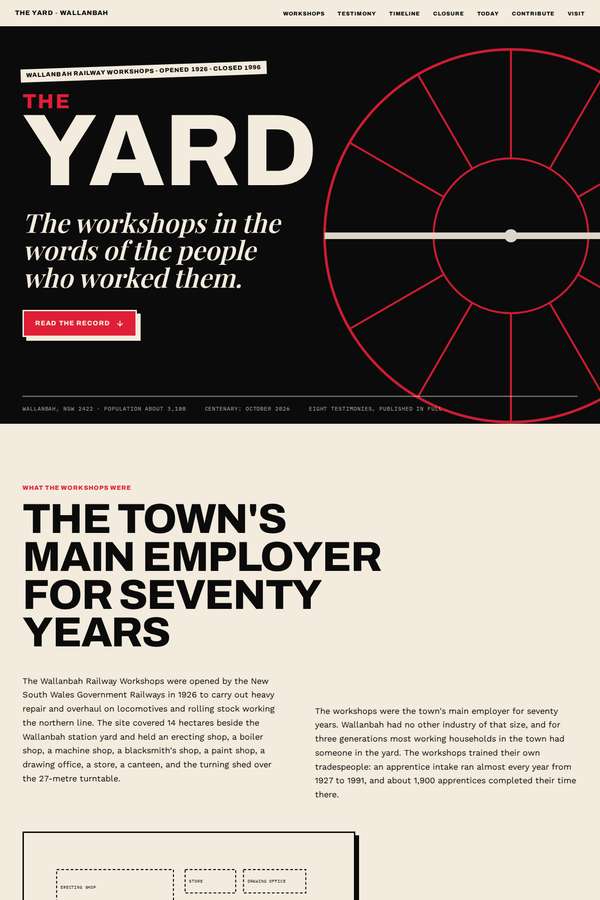
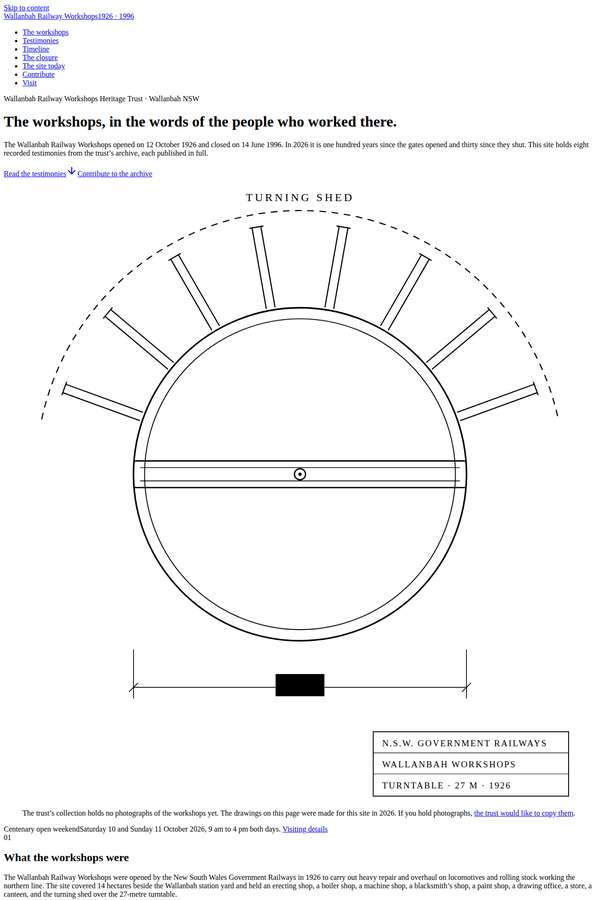
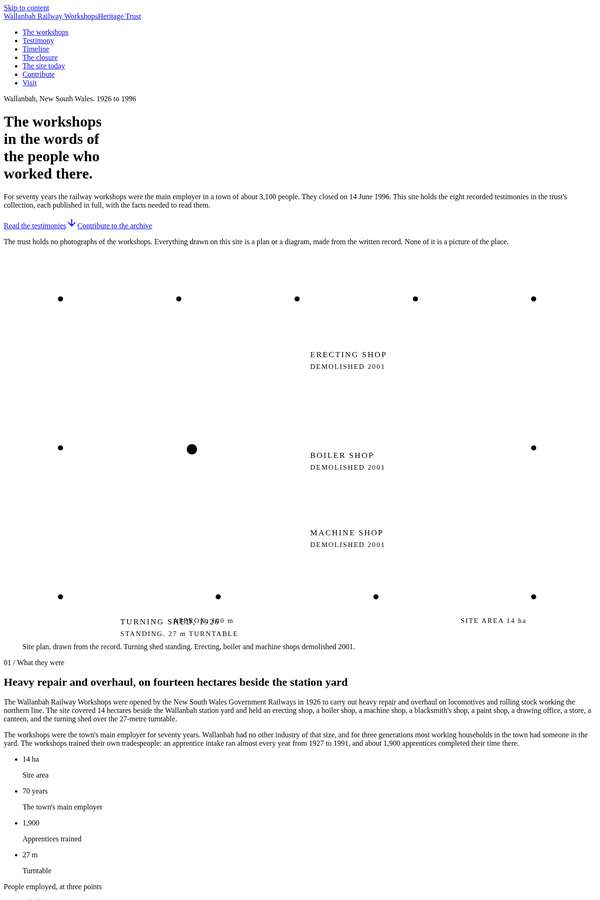
The Yard - Wallanbah Railway Workshops centenary oral history
One brief, interpreted by fictional designer personas across published models. Compare the choices each makes and inspect the actual outputs.
- Task
- WDB-0005
- Design identities
- 7
- Published builds
- 28
Read the brief
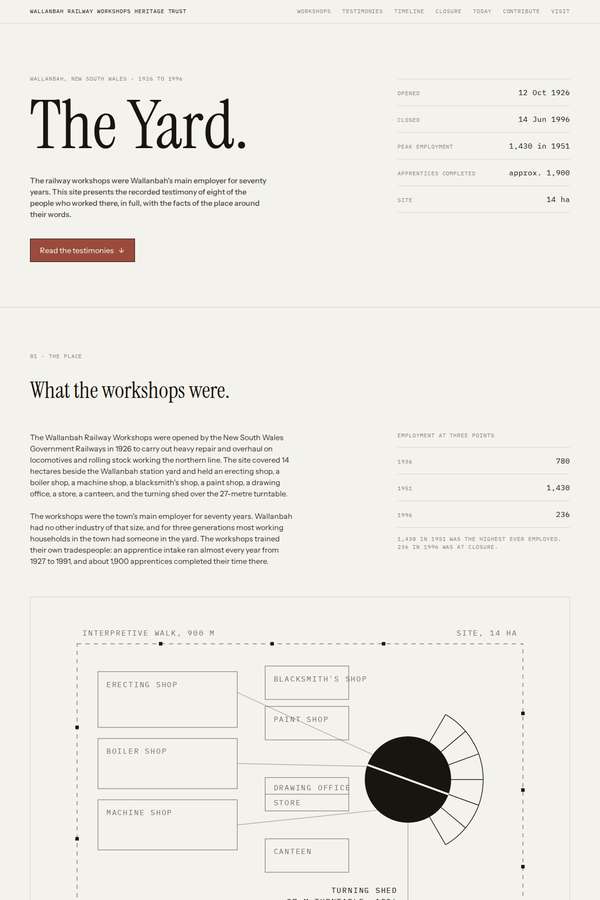
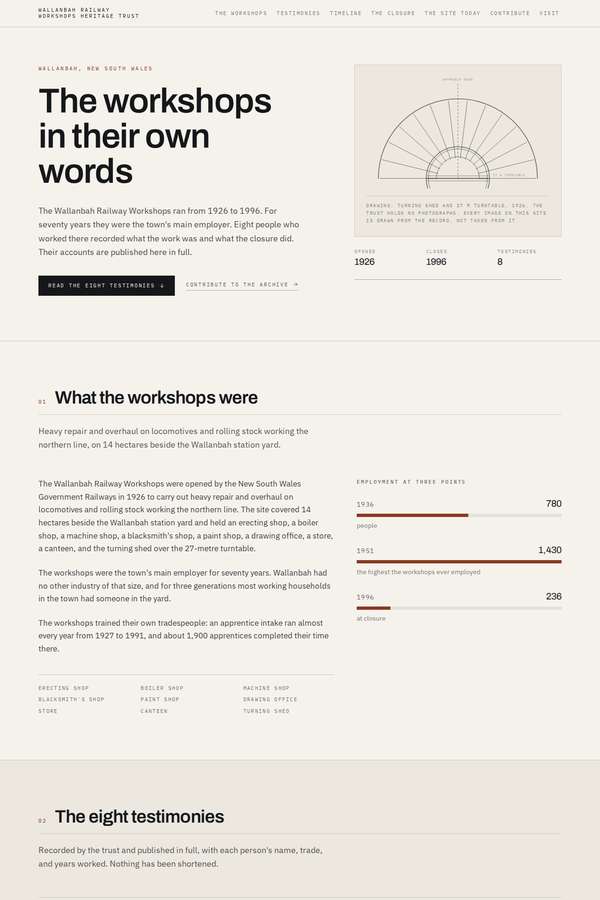
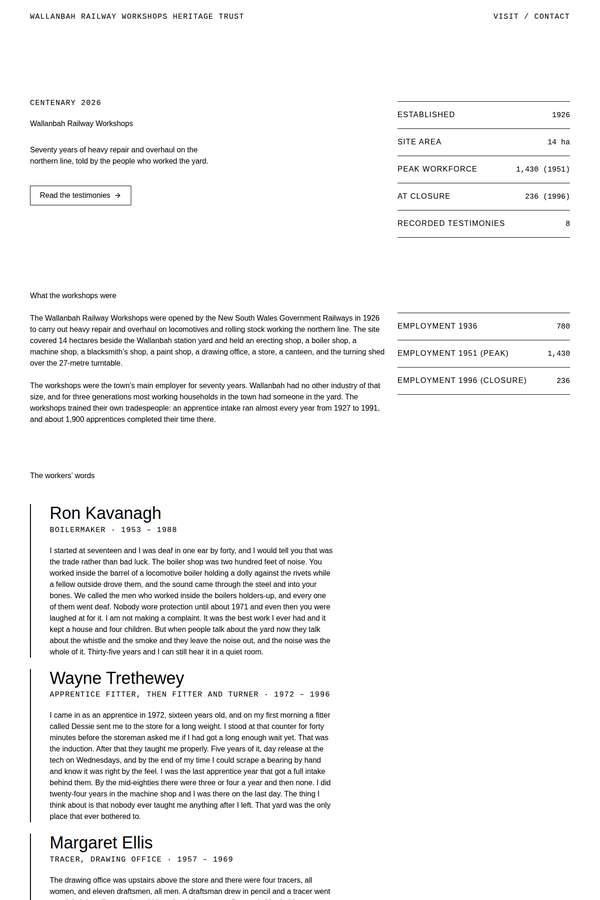
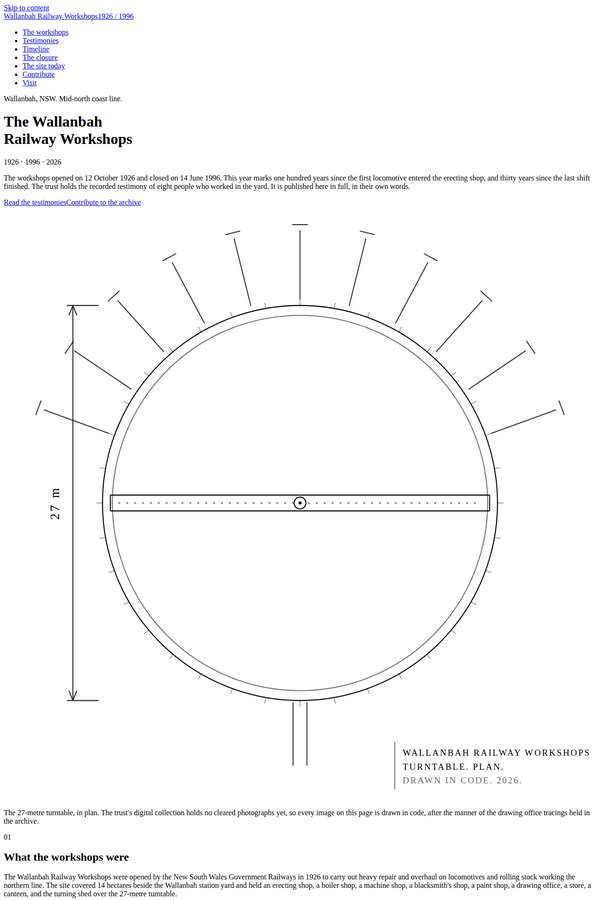
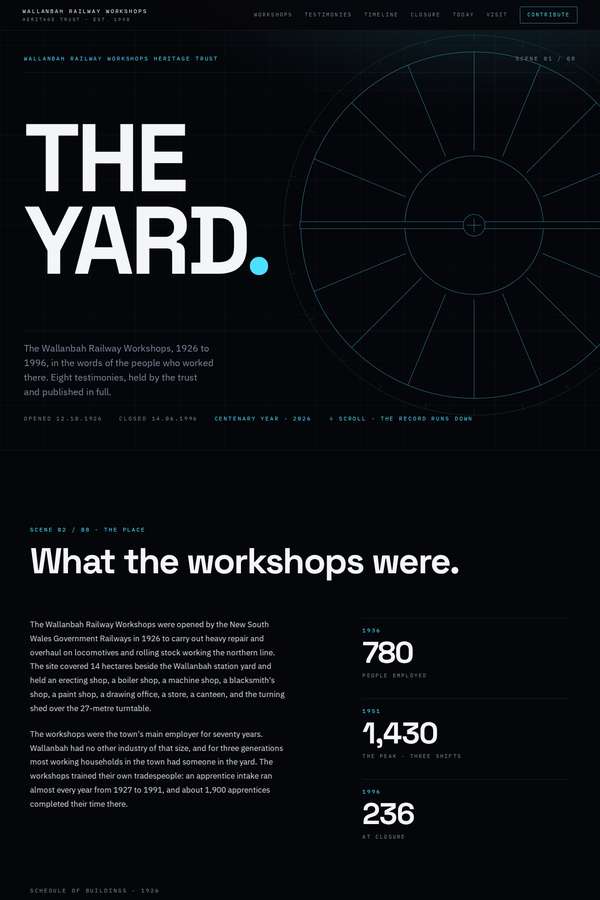
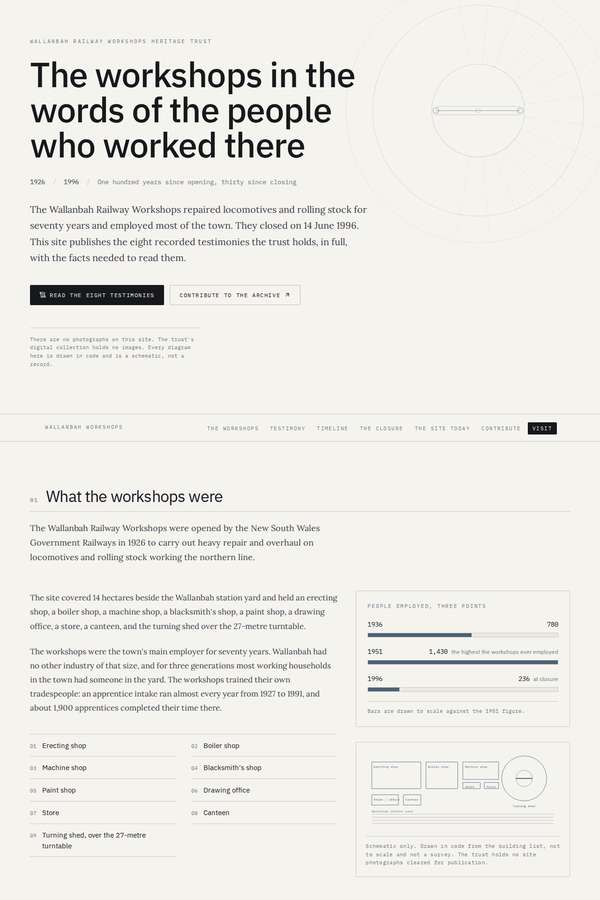
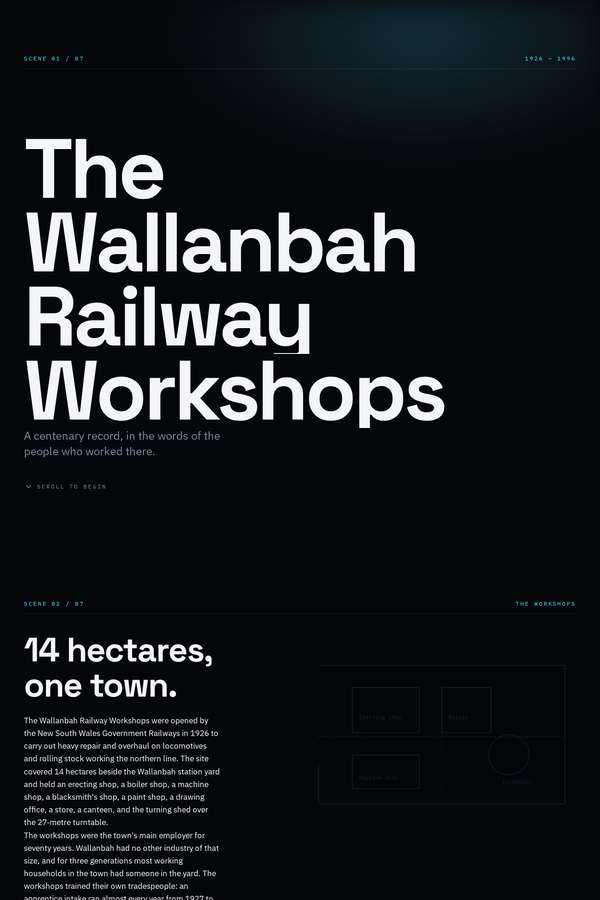
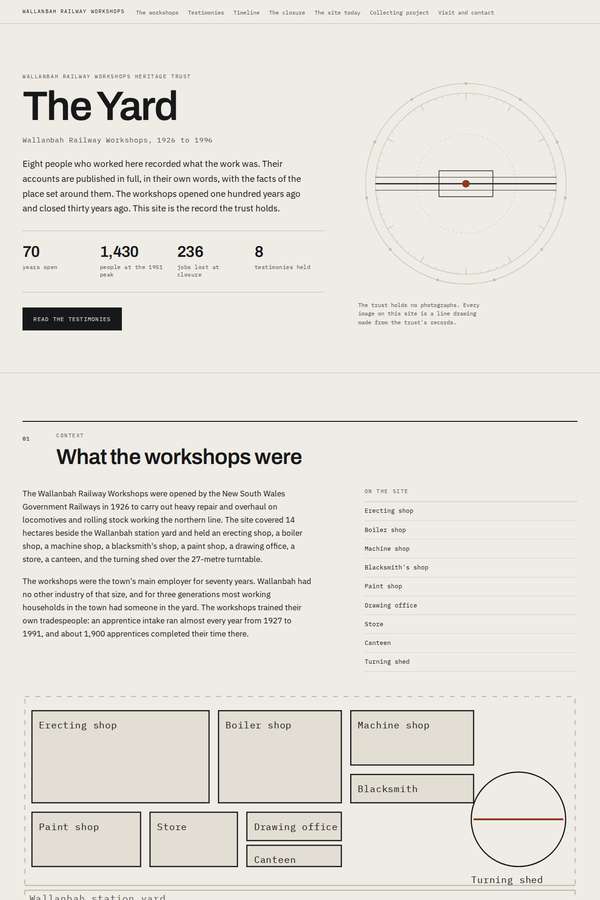
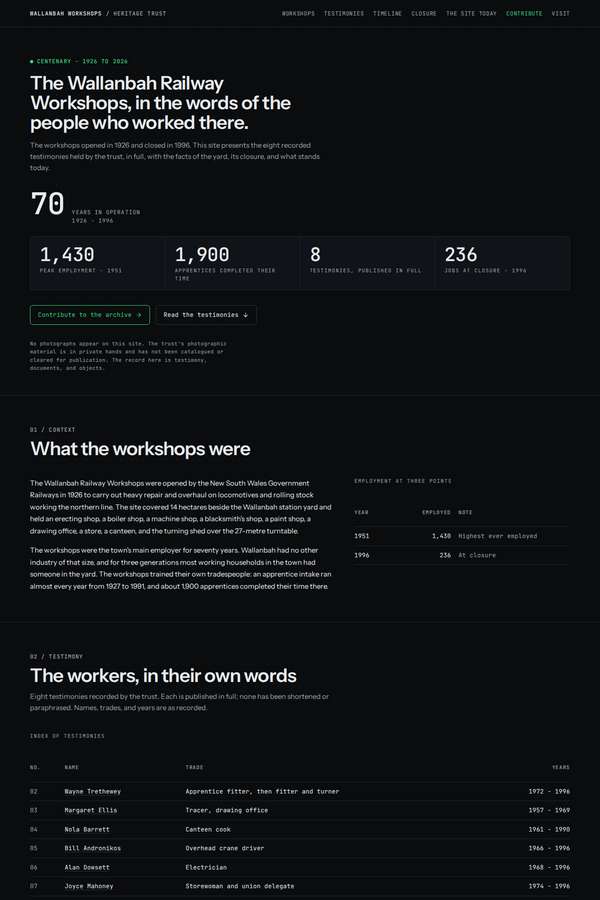
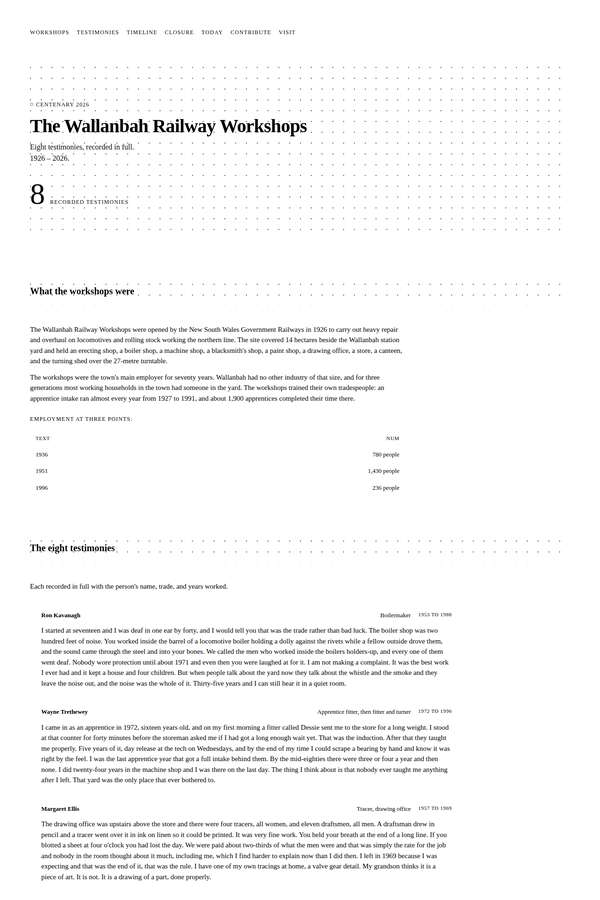
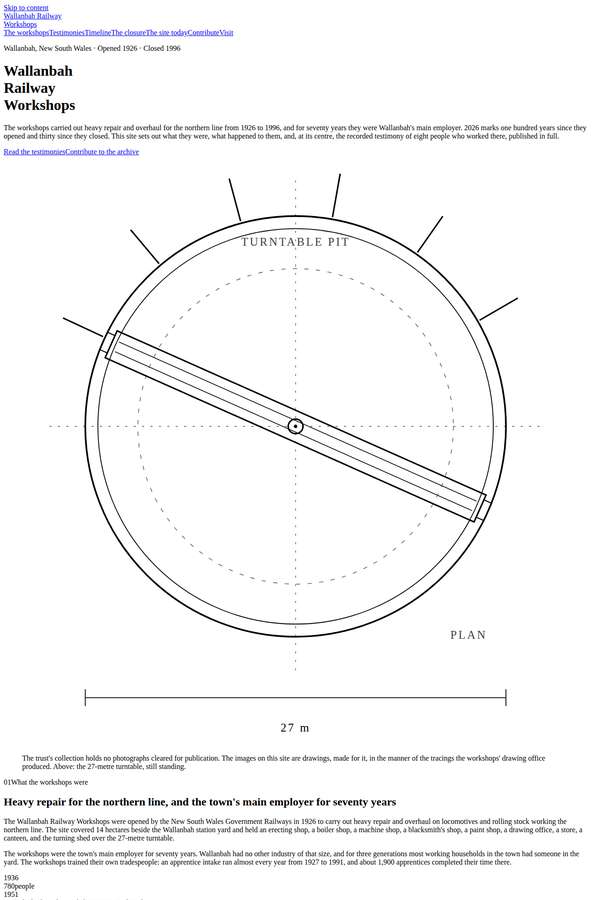
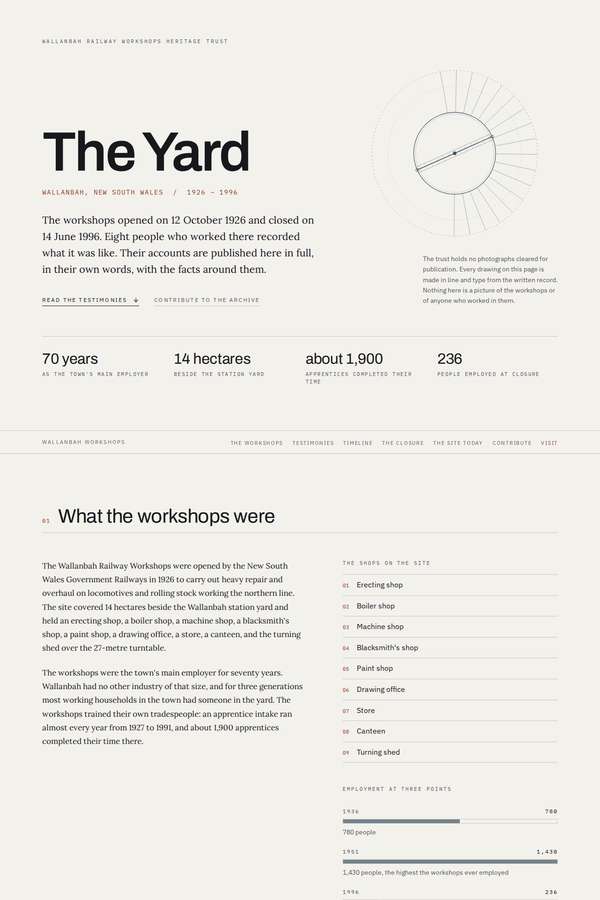
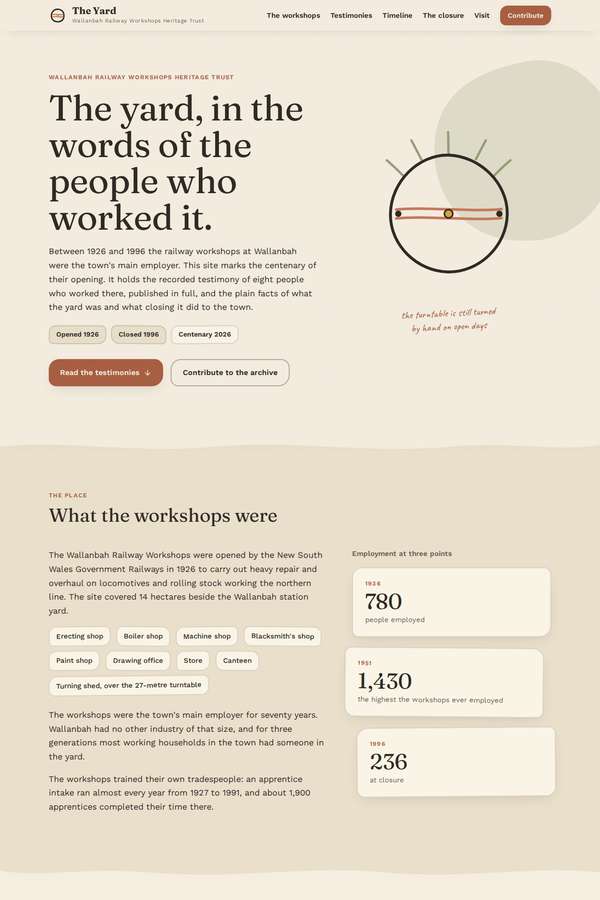
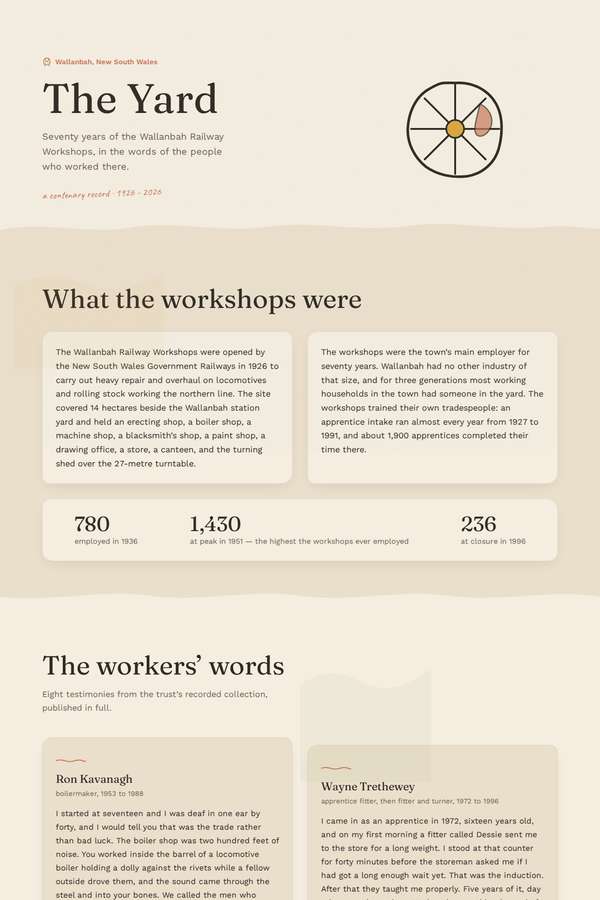
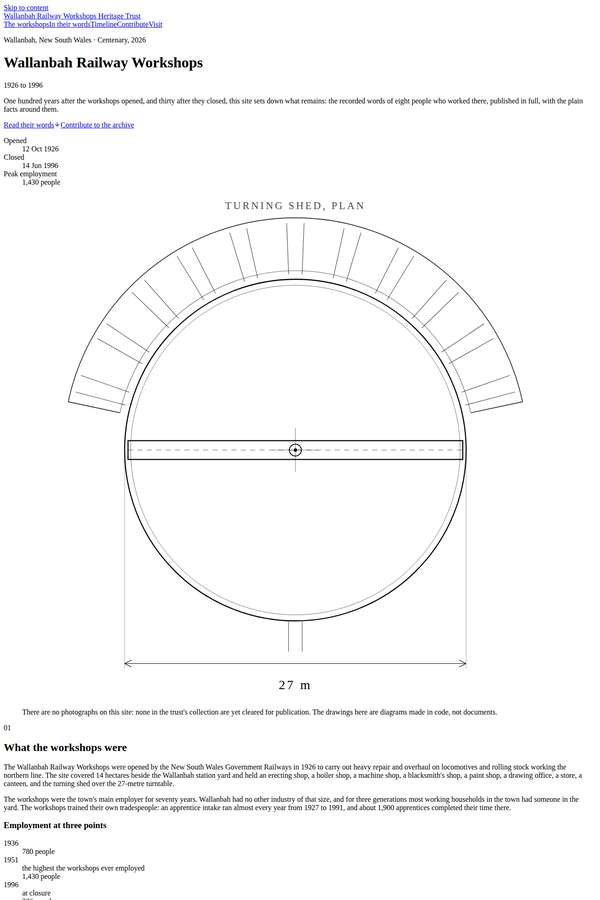
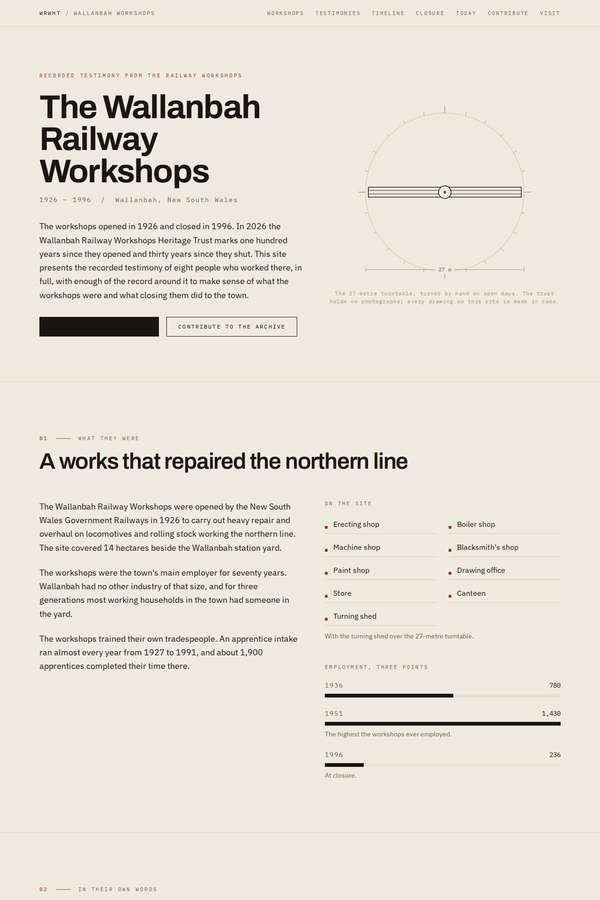
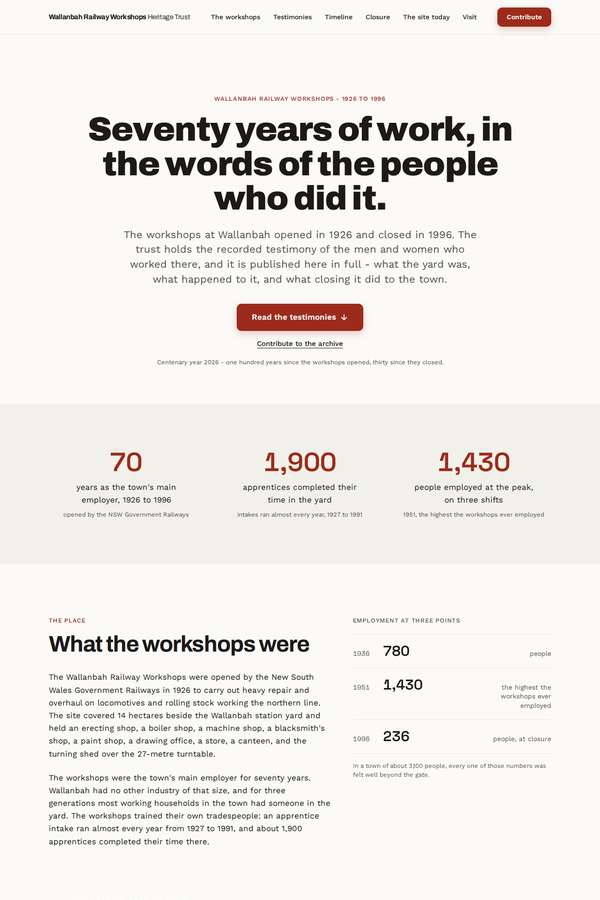
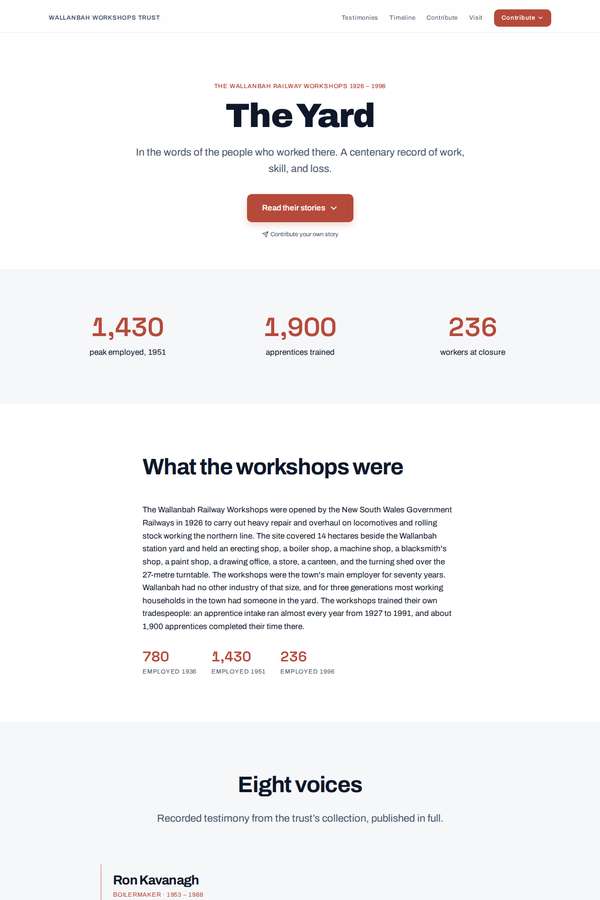
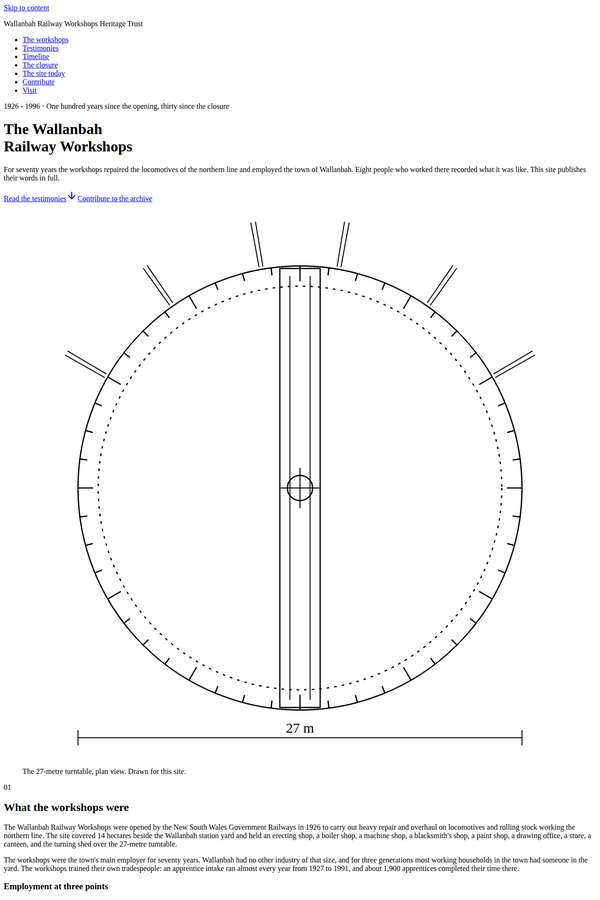
# Client brief: The Yard You are designing and building a single-page site for a real heritage trust. The brief below gives you the commissioning body, the goals, the audience, the sections the site must have, and the exact content to use. It gives you no visual direction on purpose. Every design decision - layout, type, colour, imagery, motion, tone - is yours to make. Read the whole brief, form a point of view on how this material should be presented, and build it. ## The commissioning body The Wallanbah Railway Workshops Heritage Trust is a volunteer trust in Wallanbah, a town of about 3,100 people on the mid-north coast railway line in New South Wales. The workshops opened in 1926 and closed in 1996. 2026 is therefore both the centenary of the opening and thirty years since the closure, and the trust is marking it with this site. The trust holds the workers' recorded testimony. Its position is that the site should present the workers' own words, in full, and let them carry the story. The trust is not selling anything and is not promoting the town. ## What the site is for 1. Present the eight recorded testimonies in full, so a visitor reads the workshops in the words of the people who worked there. 2. Set the testimony in enough factual context - what the workshops were, what happened to them, and what closing them did to the town - that a visitor with no connection to Wallanbah understands it. 3. Ask former workers and their families to contribute recordings, documents, and objects to the trust's collecting project, and get them to fill in the contribution form. 4. Tell people how to visit the site and contact the trust. ## Who it is for Former workers and their families, most of them now over sixty; local school and university students researching the district; and general visitors and railway historians who have never been to Wallanbah. ## Two constraints that come from the trust **There are no photographs.** The trust's digital collection holds no images at all yet. The photographic material that exists is in private hands, uncatalogued, and not cleared for publication. So the site cannot rely on photography, and you must not use, imply, or fake photographs of the workshops or the people in it. Whatever visual language you build has to be made in code, and it has to carry the material honestly rather than decorate it. **The register is plain and respectful.** These are real working lives and a real closure that damaged a town. The site must not be sentimental, nostalgic in a greeting-card way, or promotional. No triumphal language, no elegiac overwriting, no "heroes of industry". Present the facts and the words plainly and let them do the work. The trust would rather the site read as too restrained than as too moved. A firm rule that comes with this: any motion must respect a visitor's reduced-motion preference. When reduced motion is requested, the whole site must still be completely readable and every section reachable as a calm, static page, with no information conveyed only through movement. ## What the site must contain (all of these sections) - a hero that opens the site, - what the workshops were, - the eight worker testimonies, each presented in full, - the timeline, all ten events, - the closure and what it did to the town, - what stands on the site today, - the trust's collecting project, with the contribution form, - visit and contact. ## Content to use Use the content below substantially as written, in Australian English. You may write your own section headings and any short connective microcopy (button labels, captions, form labels), but the facts, figures, names, dates, and the testimony text are fixed. Do not invent extra people or events, do not drop any of the eight testimonies or any of the ten timeline entries, and do not shorten, paraphrase, or truncate a testimony: each one is published in full. ### What the workshops were The Wallanbah Railway Workshops were opened by the New South Wales Government Railways in 1926 to carry out heavy repair and overhaul on locomotives and rolling stock working the northern line. The site covered 14 hectares beside the Wallanbah station yard and held an erecting shop, a boiler shop, a machine shop, a blacksmith's shop, a paint shop, a drawing office, a store, a canteen, and the turning shed over the 27-metre turntable. The workshops were the town's main employer for seventy years. Wallanbah had no other industry of that size, and for three generations most working households in the town had someone in the yard. The workshops trained their own tradespeople: an apprentice intake ran almost every year from 1927 to 1991, and about 1,900 apprentices completed their time there. Employment at three points: - 1936: 780 people. - 1951: 1,430 people, the highest the workshops ever employed. - 1996: 236 people, at closure. ### The eight testimonies These are the eight recorded testimonies held by the trust. Each is published in full, with the person's name, trade, and years worked. **Ron Kavanagh, boilermaker, 1953 to 1988** I started at seventeen and I was deaf in one ear by forty, and I would tell you that was the trade rather than bad luck. The boiler shop was two hundred feet of noise. You worked inside the barrel of a locomotive boiler holding a dolly against the rivets while a fellow outside drove them, and the sound came through the steel and into your bones. We called the men who worked inside the boilers holders-up, and every one of them went deaf. Nobody wore protection until about 1971 and even then you were laughed at for it. I am not making a complaint. It was the best work I ever had and it kept a house and four children. But when people talk about the yard now they talk about the whistle and the smoke and they leave the noise out, and the noise was the whole of it. Thirty-five years and I can still hear it in a quiet room. **Wayne Trethewey, apprentice fitter, then fitter and turner, 1972 to 1996** I came in as an apprentice in 1972, sixteen years old, and on my first morning a fitter called Dessie sent me to the store for a long weight. I stood at that counter for forty minutes before the storeman asked me if I had got a long enough wait yet. That was the induction. After that they taught me properly. Five years of it, day release at the tech on Wednesdays, and by the end of my time I could scrape a bearing by hand and know it was right by the feel. I was the last apprentice year that got a full intake behind them. By the mid-eighties there were three or four a year and then none. I did twenty-four years in the machine shop and I was there on the last day. The thing I think about is that nobody ever taught me anything after I left. That yard was the only place that ever bothered to. **Margaret Ellis, tracer, drawing office, 1957 to 1969** The drawing office was upstairs above the store and there were four tracers, all women, and eleven draftsmen, all men. A draftsman drew in pencil and a tracer went over it in ink on linen so it could be printed. It was very fine work. You held your breath at the end of a long line. If you blotted a sheet at four o'clock you had lost the day. We were paid about two-thirds of what the men were and that was simply the rate for the job and nobody in the room thought about it much, including me, which I find harder to explain now than I did then. I left in 1969 because I was expecting and that was the end of it, that was the rule. I have one of my own tracings at home, a valve gear detail. My grandson thinks it is a piece of art. It is not. It is a drawing of a part, done properly. **Nola Barrett, canteen cook, 1961 to 1990** Six hundred dinners a day at the peak and I knew what nearly all of them wanted before they asked. Corned beef Tuesday, sausages Thursday, fish on Friday for the Catholics and a good many others. The canteen opened at half past five in the morning for the early shift and I was in at four. You learn a lot about a workplace from behind a counter. I could tell you which men were on the drink and which ones were sending money home and which ones had a boy in the yard and were watching him. When there was an accident the canteen would go quiet, everybody eating and not talking, and you would know before the notice went up. In 1978 a young dogman was killed in the erecting shop and I served lunch to two hundred men who did not say a word. I fed that yard for twenty-nine years and they were decent to me every one of them. **Bill Andronikos, overhead crane driver, 1966 to 1996** My father came from Kythera in 1953 and I was born here, and I got in the yard at eighteen. Thirty years in the cab of a fifty-ton overhead crane in the erecting shop. You are up there on your own all day, forty feet above everybody, and you learn to read hands. The dogman on the floor gives you the signals and you never hear a word he says, you only see his hands, and after a while you know a man by the way he signals the same way you know him by his voice. I lifted locomotive boilers out of frames for thirty years and never dropped anything and never touched anybody, and I want that written down because it was the only thing I was ever proud of at work. There were four Greek families and two Italian in the yard when I started and nobody gave us any trouble. The railway was fair like that. It was fairer than the town was. **Alan Dowsett, electrician, 1968 to 1996** I came in when they were still overhauling steam and I went out when the place shut, so I saw the whole change. In 1968 the electrical gang was mostly lighting, motors and the shop machinery. By 1985 I was on diesel-electric control gear and traction motors and I had to learn it twice over, once off the books and once off the men who knew. The management never spent a dollar on training us after about 1980. They would send the hard work to Chullora and leave us the running repairs, and every year there was a bit less of it. You could see it going. We all could. A yard tells you what is coming: the store gets thinner, they stop replacing the fellows who retire, the paint shop goes quiet. I had eight years of watching it before anyone in Sydney said the word. When they finally announced it, the only thing anybody was surprised about was that it took them so long. **Joyce Mahoney, storewoman and union delegate, 1974 to 1996** I was elected delegate in 1983 and I held it until the gates shut. In the last two years it stopped being about wages and started being about who was going to be all right. We had men of fifty-eight in the machine shop who had never applied for a job in their lives because they came straight from school into the yard and never left it. I sat with a lot of them and helped them write down what they could do, and it is a hard thing to explain to a man that he has to prove a trade he has done for forty years. We fought the closure properly, we had the meetings and the rally and the petition with four thousand names on it, and we lost. I do not think we were ever going to win it. What we did get was redundancy paid properly and the apprentices placed, all nine of them. That was the win. It is a small one to carry for thirteen years but I carry it. **Helen Sowden, pay office clerk, daughter of erecting shop foreman Keith Sowden, 1971 to 1976** My father was foreman of the erecting shop from 1948 to 1979 and I grew up on the yard's hours. The whistle went at ten to seven, half past twelve and twenty past four, and the whole town ran on it. My mother put dinner on when she heard it. When I started in the pay office in 1971 I found out something that changed how I saw him: I was making up the pay packets and I could see that he had put through overtime for men who had not worked it, in the winter of 1972, when there was no work in the boiler shop and three of them had new babies. He never mentioned it to me and I never asked. He was a hard man at home and a hard foreman, and I had no idea until then that he had another side to him. He died in 1994, two years before it closed, and I have always been glad of the order of those two things. ### The timeline - 12 October 1926 - the workshops open. The first locomotive into the erecting shop is a C32 class for heavy overhaul. - 3 March 1931 - the workforce goes onto a three-day week through the Depression. It stays on short time for four years. - February 1942 - the workshops take on wartime production: shell casings, armoured vehicle components, and repair work for the Allied Works Council alongside the locomotive program. 190 women are employed on the site by 1943. - 1951 - employment peaks at 1,430. The workshops run three shifts. - 1962 - the last steam locomotive overhaul leaves the erecting shop. The site converts to diesel-electric work over the following six years. - 1968 - the diesel-electric traction motor shop opens, and the electrical gang doubles. - 1979 - heavy overhaul work is progressively transferred to Chullora. Wallanbah is left with running repairs and component work. - 1989 - the workforce is down to 410. The apprentice intake is suspended. - 14 June 1996 - the workshops close. The last shift finishes at 3.20 pm. - 2003 - the turning shed and turntable are added to the State Heritage Register. ### The closure and what it did to the town Write this plainly. It is the part of the site most likely to be overwritten. The closure was announced on 2 November 1995 and took effect on 14 June 1996. 236 jobs went. Wallanbah's population at the time was about 3,100, so the workshops were carrying roughly one household in six directly, and more than that through the businesses that served them. A public meeting at the Wallanbah School of Arts on 19 November 1995 drew about 900 people. A petition with 4,100 signatures went to the Legislative Assembly. There was a march to the station on 8 December 1995. None of it changed the decision. What the town did afterwards is the more useful record. A retraining scheme ran out of the School of Arts for two years and put 61 people through trade recognition and licence courses. All nine remaining apprentices were placed with other employers. Of the 236 who lost their jobs, a survey by the shire in 1999 found 84 had left the district. Four shops on Bourke Street closed within eighteen months. Enrolments at Wallanbah Central School fell by 71 students between 1996 and 2000, and have not returned to the 1995 figure. The Wallanbah Railway Workshops Heritage Trust was formed in 1998 by a group of former workers, initially to stop the turning shed being demolished. ### What stands on the site today - **The turning shed.** The 1926 roundhouse-style turning shed and its 27-metre turntable, added to the State Heritage Register in 2003. It is the only workshop building still standing. The turntable is intact and is turned by hand on open days. The erecting shop, boiler shop, and machine shop were demolished in 2001. - **The interpretive walk.** A 900-metre walk around the perimeter of the site with eleven marker posts, opened in 2011, following the line of the old workshop road. The posts mark the footprints of the demolished buildings. - **The trust's archive.** Housed in the turning shed office: 4,200 documents, 61 recorded interviews, and about 300 objects, including the erecting shop time clock, the pay office ledgers from 1926 to 1974, and a complete set of the workshops' drawing office tracings for the C32 class. ### The collecting project The trust is asking former workers and their families to contribute. The text the trust wants on the site: The trust's archive is incomplete, and the gaps are getting harder to fill each year. We are looking for recorded or written recollections, photographs, documents, pay records, union material, tools, and objects from the workshops. We will copy and return anything you do not want to part with. If you worked in the yard, or your parent or grandparent did, we would like to hear from you. The contribution form takes these fields: - Name - Relationship to the workshops (worked there, family of someone who did, researcher, other) - Years connected to the workshops - What you would like to contribute - Contact details (email or phone) ### Visit and contact The Wallanbah Railway Workshops Heritage Trust, Turning Shed, 2 Yard Road, Wallanbah NSW 2422. Open days: the first Saturday of each month, 9 am to 1 pm. Entry is free. The interpretive walk is open at all times and can be walked without a guide. Centenary open weekend: Saturday 10 and Sunday 11 October 2026, 9 am to 4 pm both days. Phone (02) 6558 0417. Email archive@wallanbahworkshops.org.au. Secretary: Dianne Halloran. ## Output contract (React, single page) Build one single-page site. Output exactly two files: - `App.tsx` - a default-exported React component. Define any subcomponents in this same file. This is the whole page. - `theme.css` - a Tailwind v4 `@theme` token block, your `font-family` choices from the shared font menu below, and any custom CSS you need. The only imports allowed in `App.tsx` are `react`, `framer-motion`, `lucide-react` (never the Sparkles icon), and, for 3D, `three`, `@react-three/fiber`, and `@react-three/drei`. No other packages, no network requests, and no external assets: all imagery must be inline SVG, CSS, drawn in code on a canvas, or rendered with WebGL. The fonts are bundled offline, so use only the shared menu: Archivo (including Archivo Expanded), Instrument Sans, Space Grotesk, Work Sans, IBM Plex Sans, IBM Plex Mono, JetBrains Mono, Fraunces, Instrument Serif, Playfair Display, Lora, Caveat. Make it responsive across mobile, tablet, and desktop. The page must also remain fully readable and usable if WebGL is unavailable: never leave a visitor with a blank screen or a missing section because a 3D canvas failed to start.