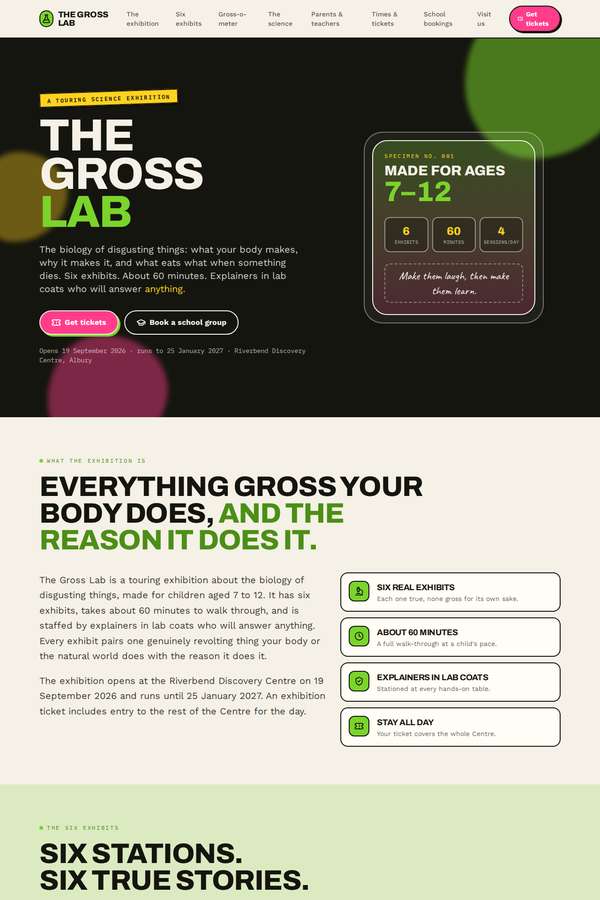
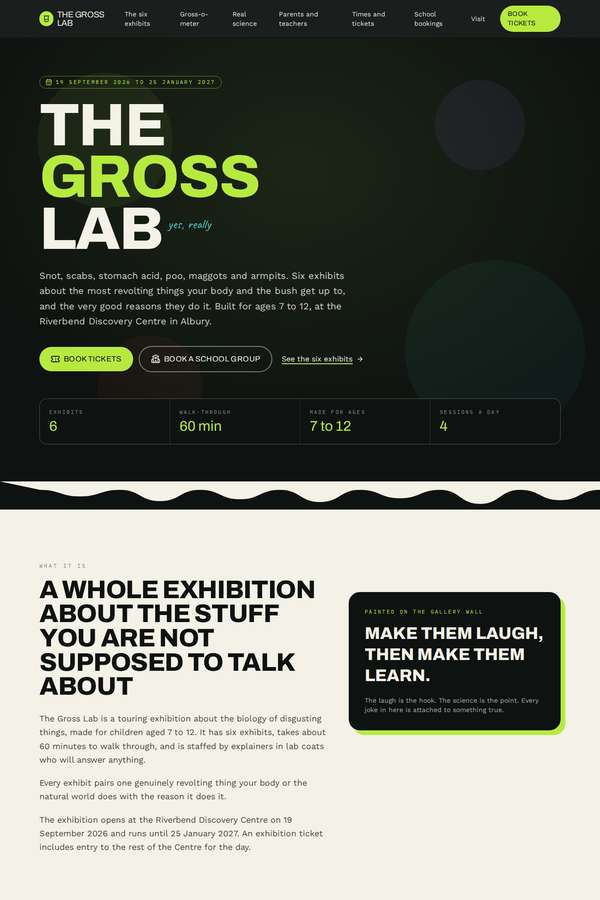
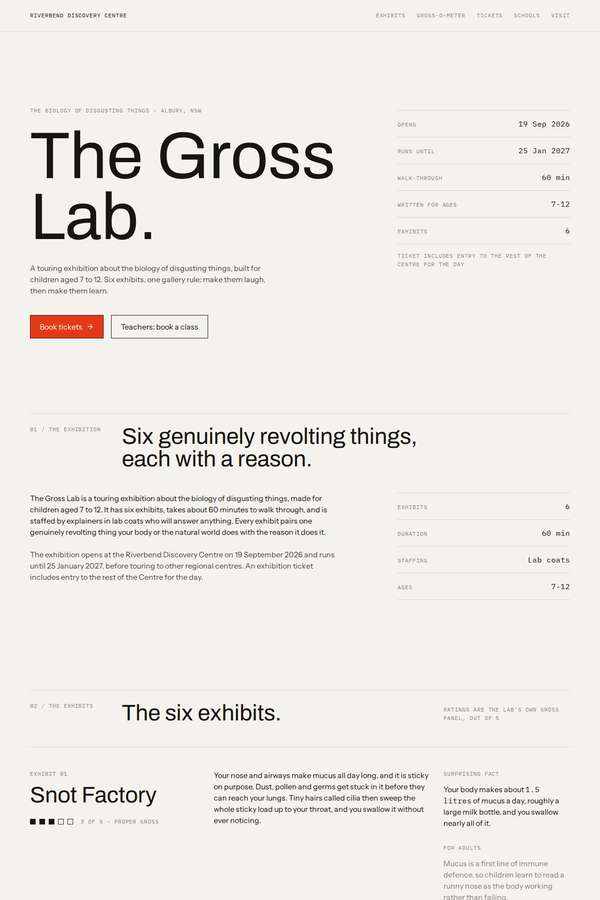
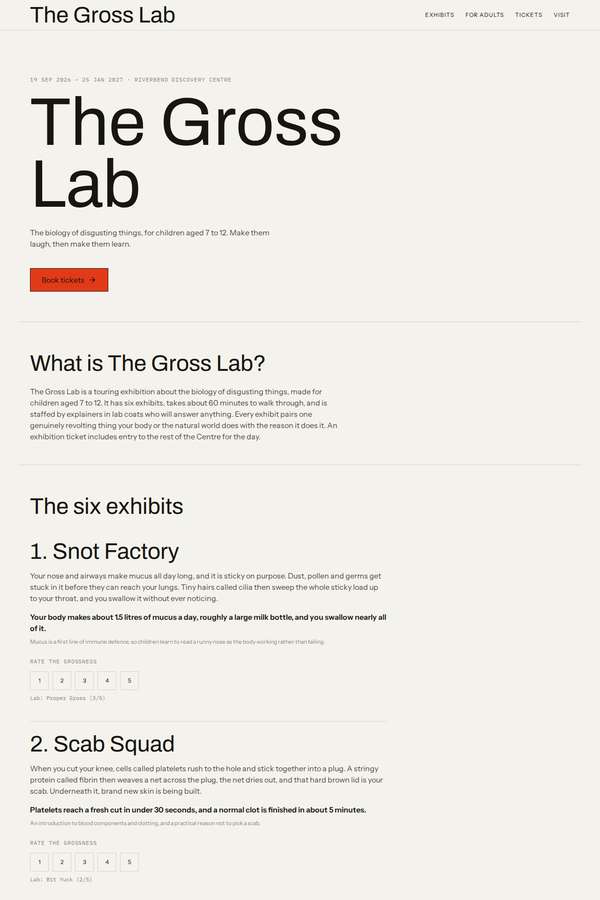
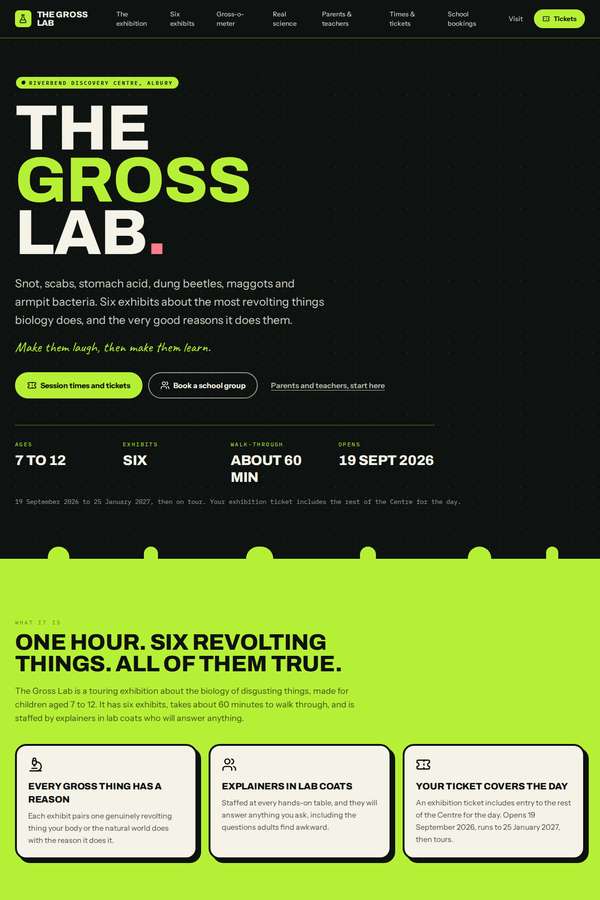
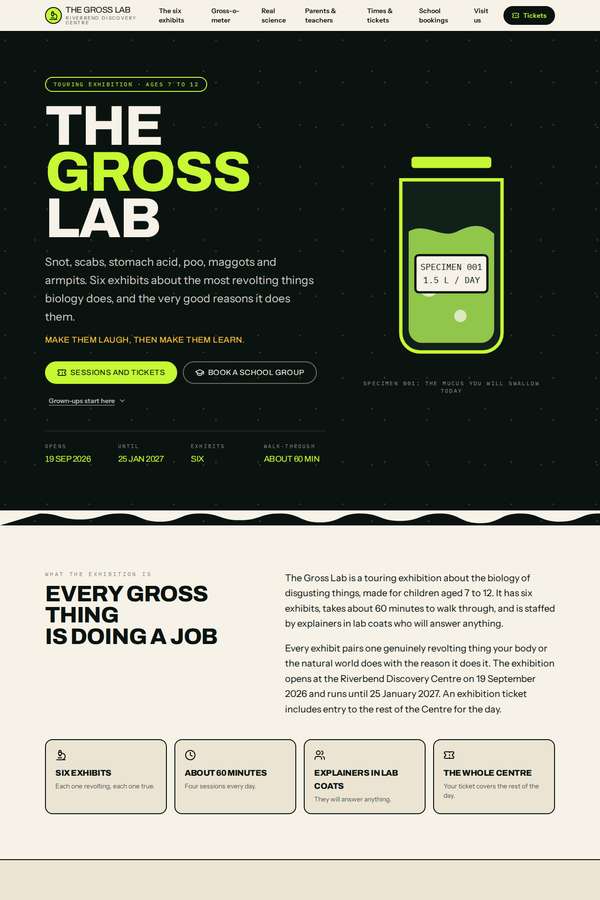
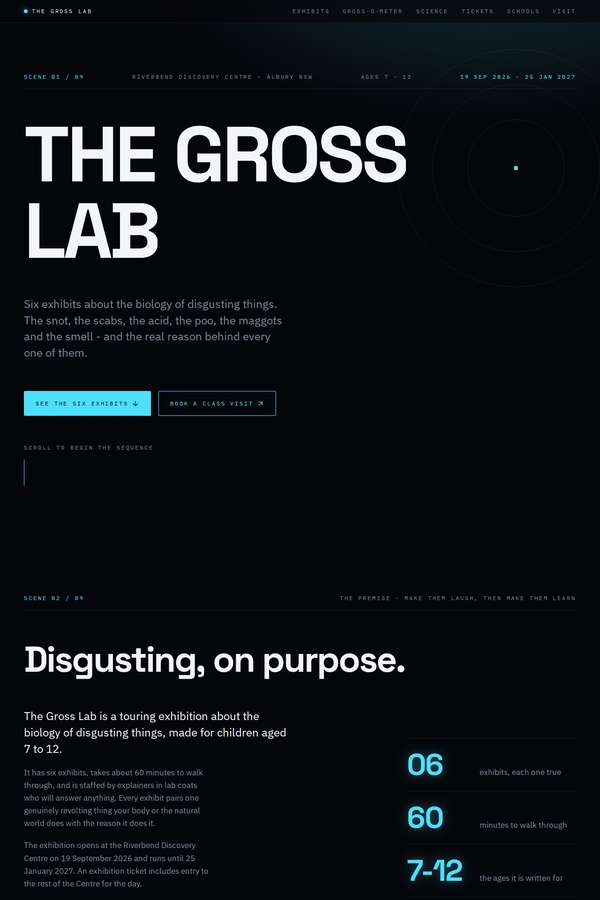
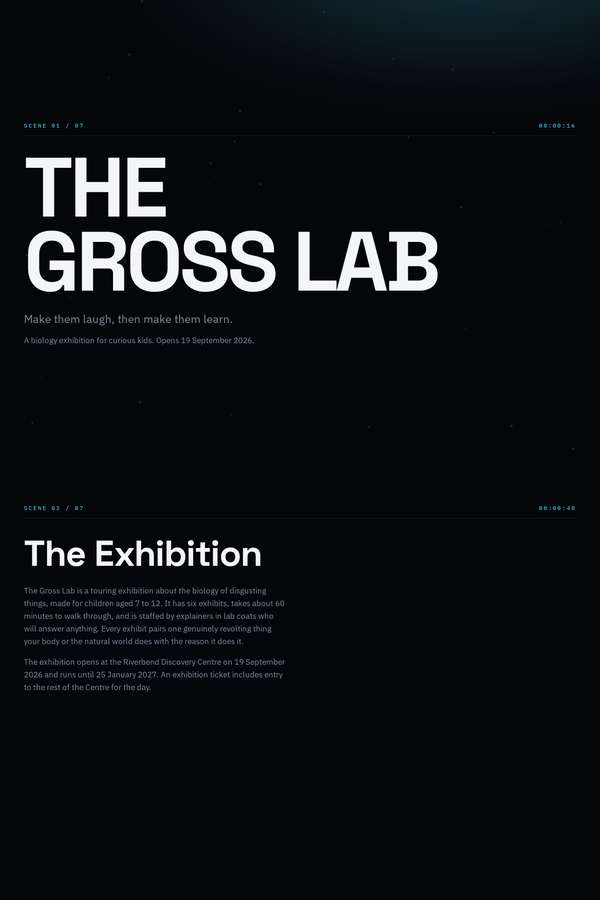
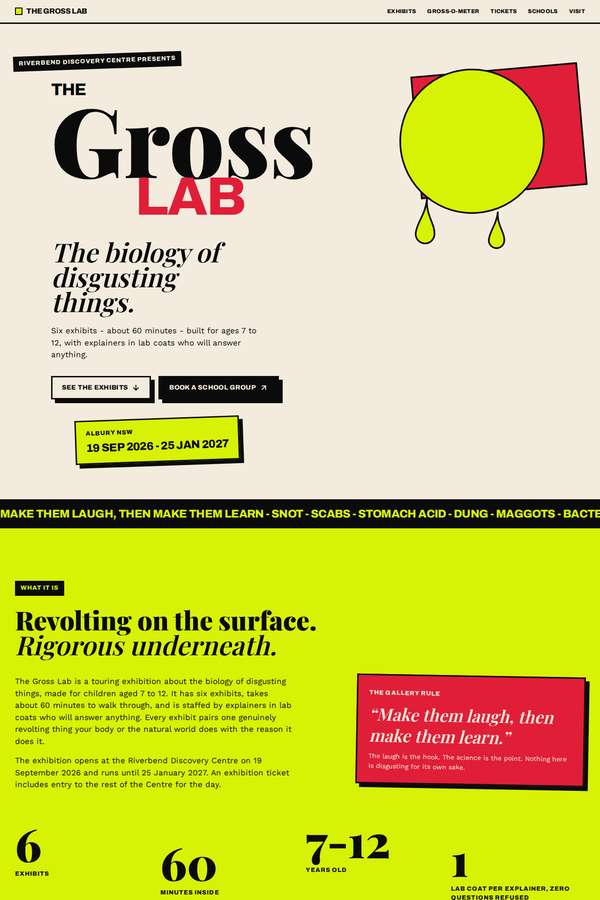
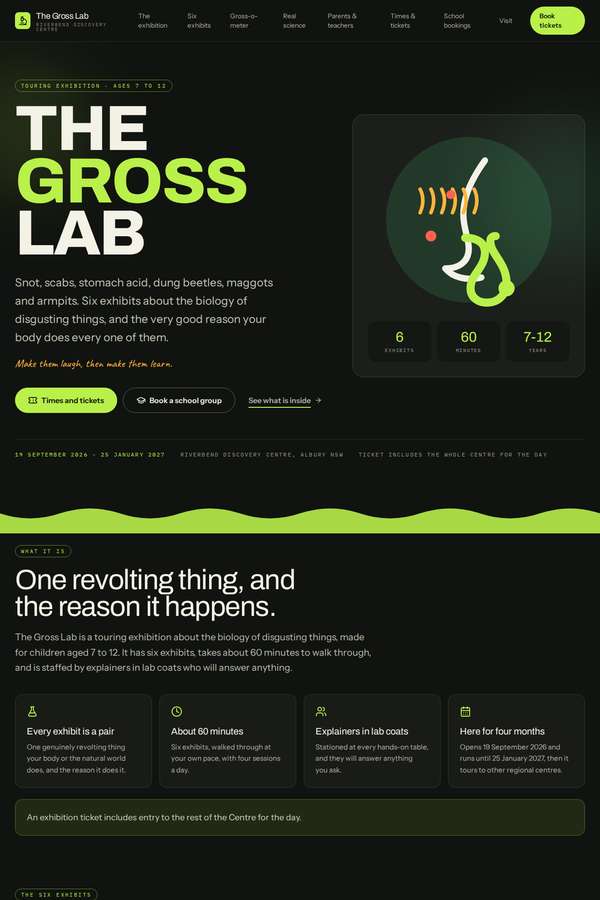
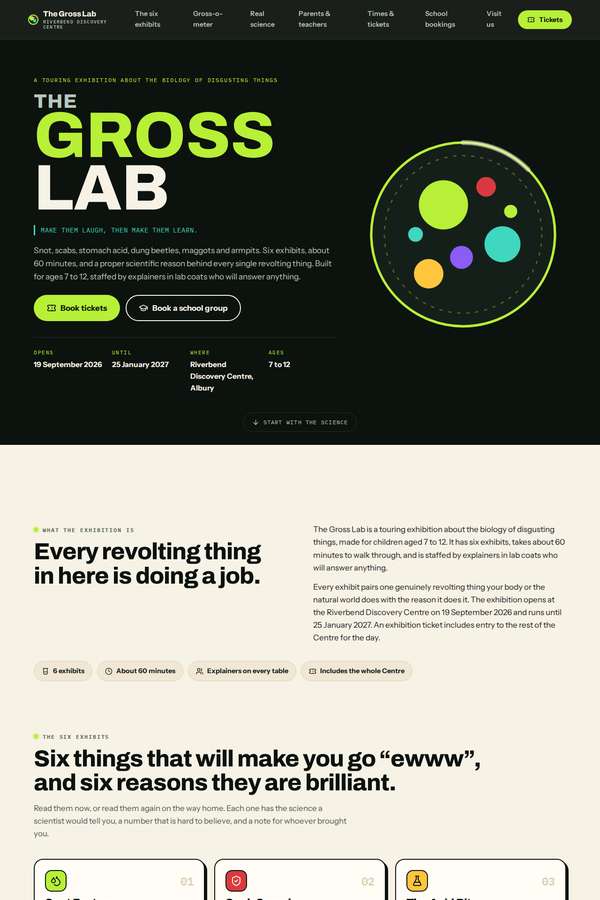
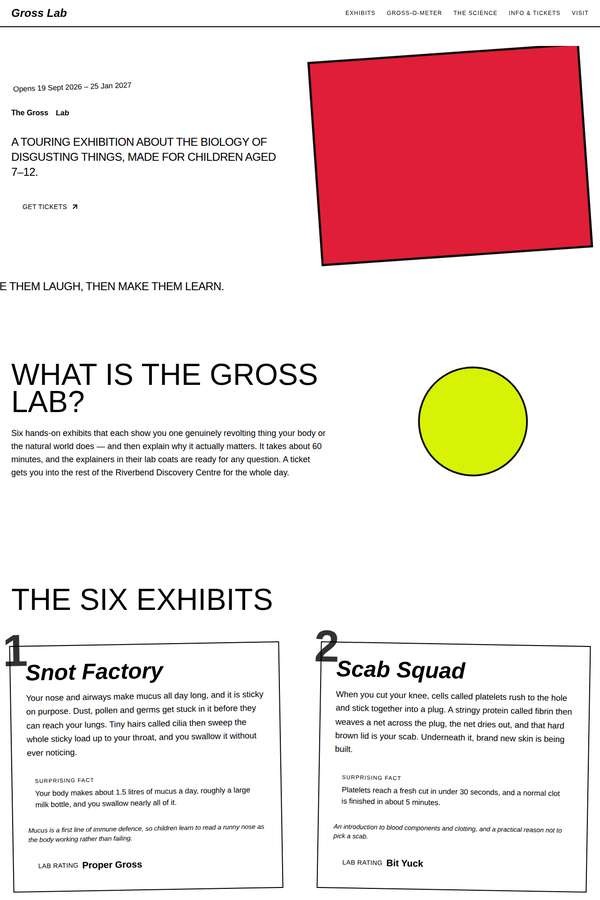
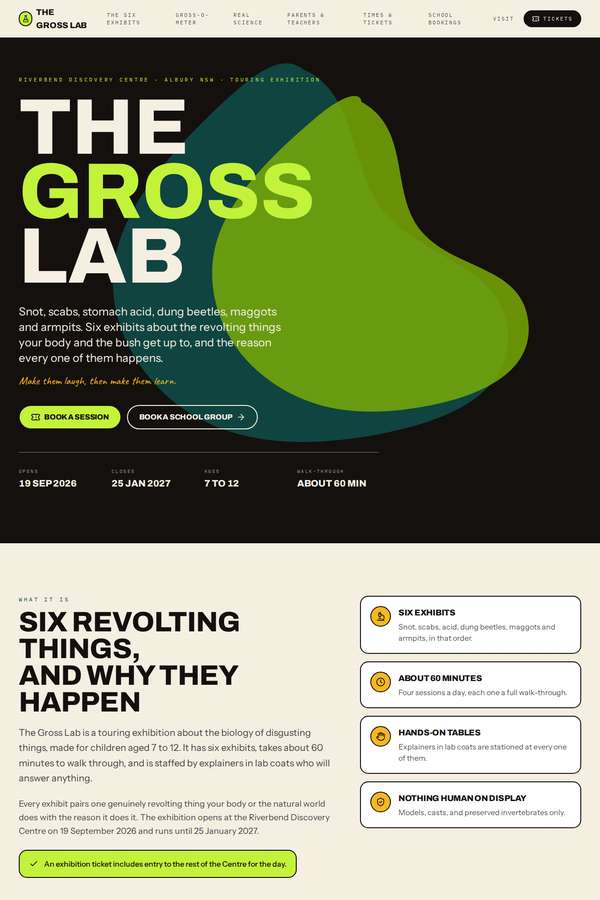
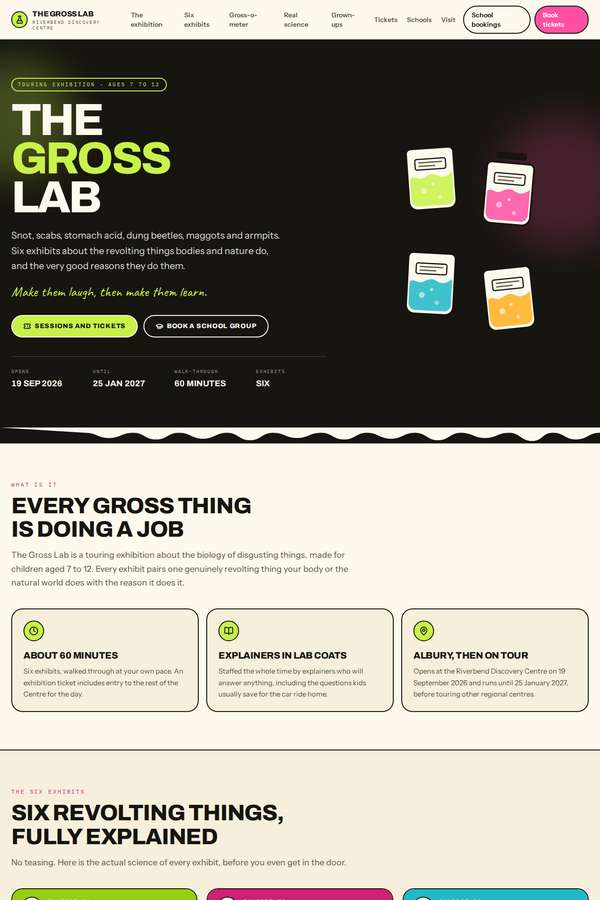
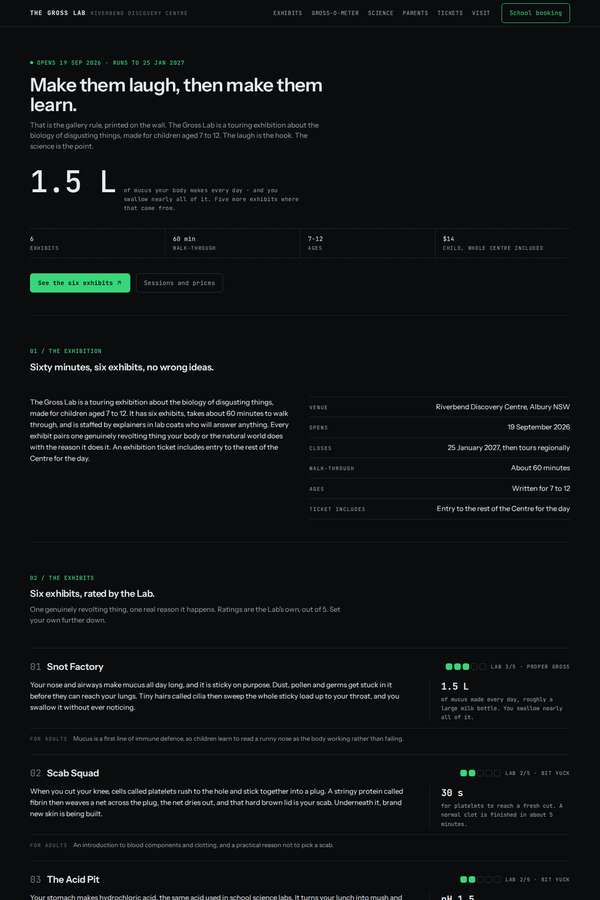
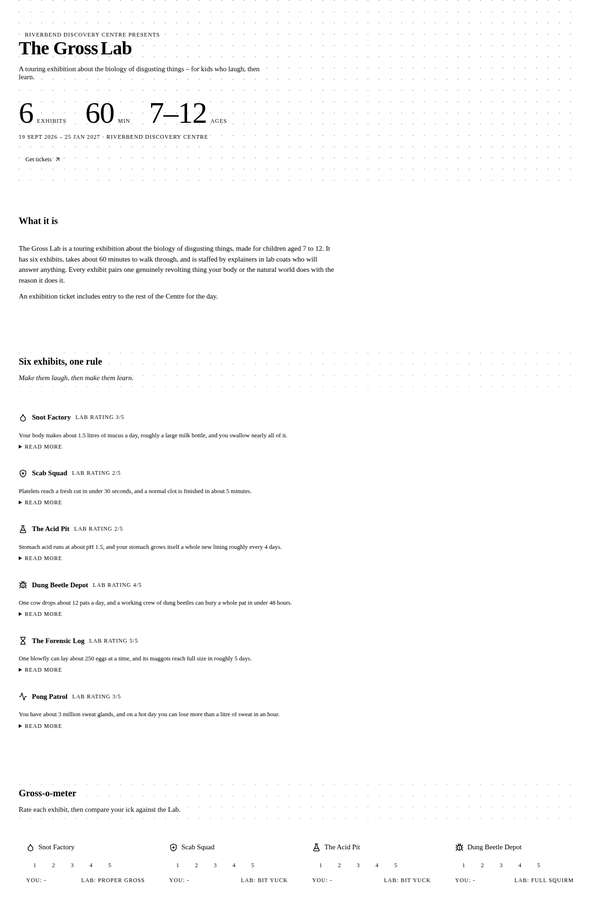
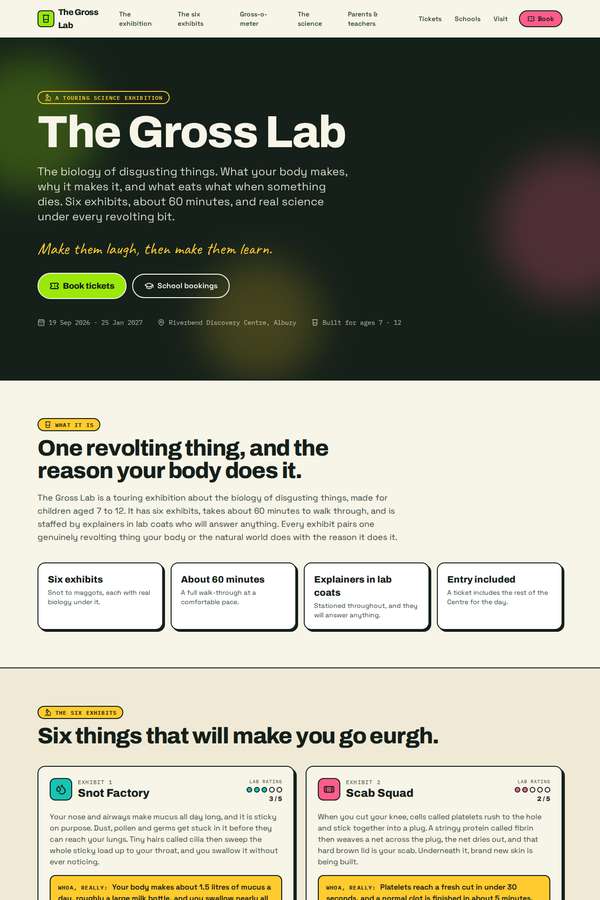
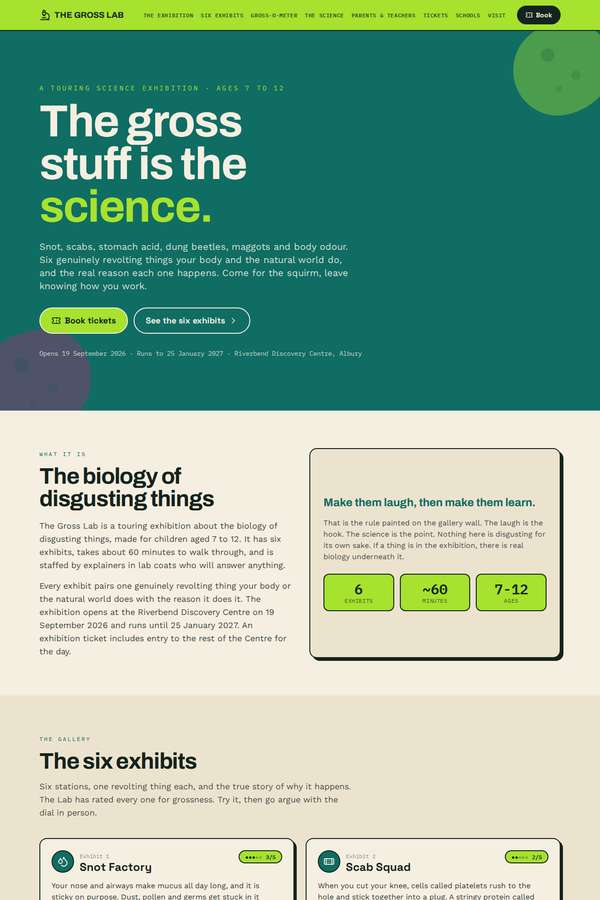
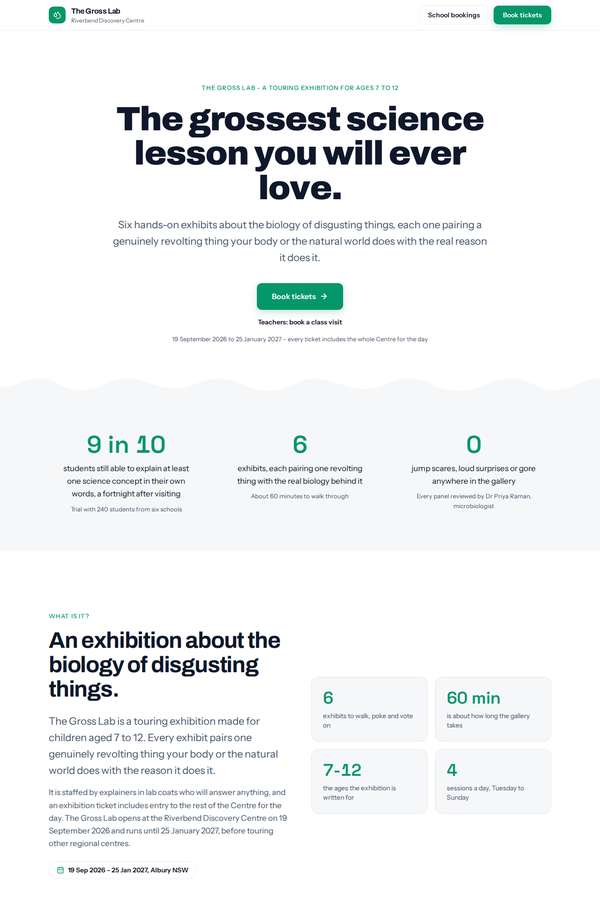
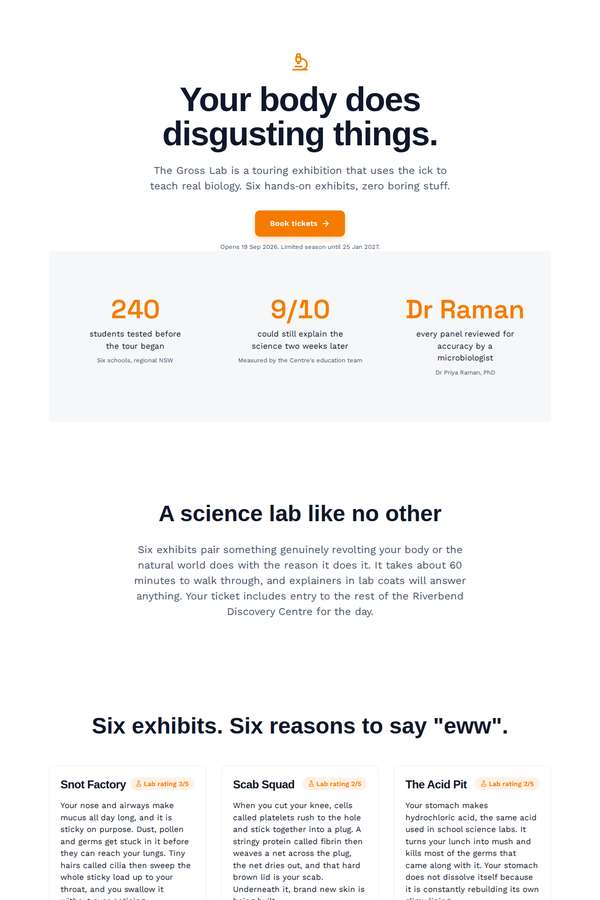
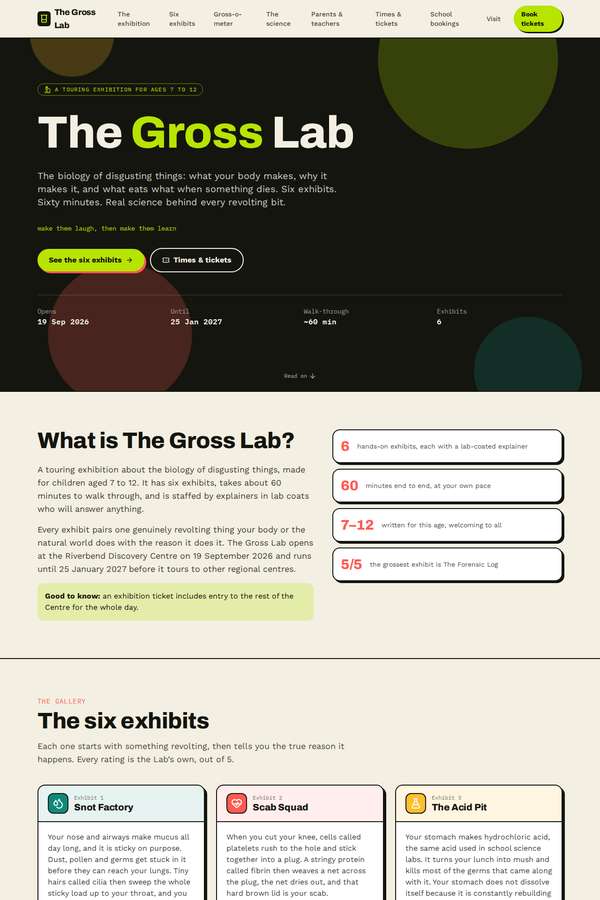
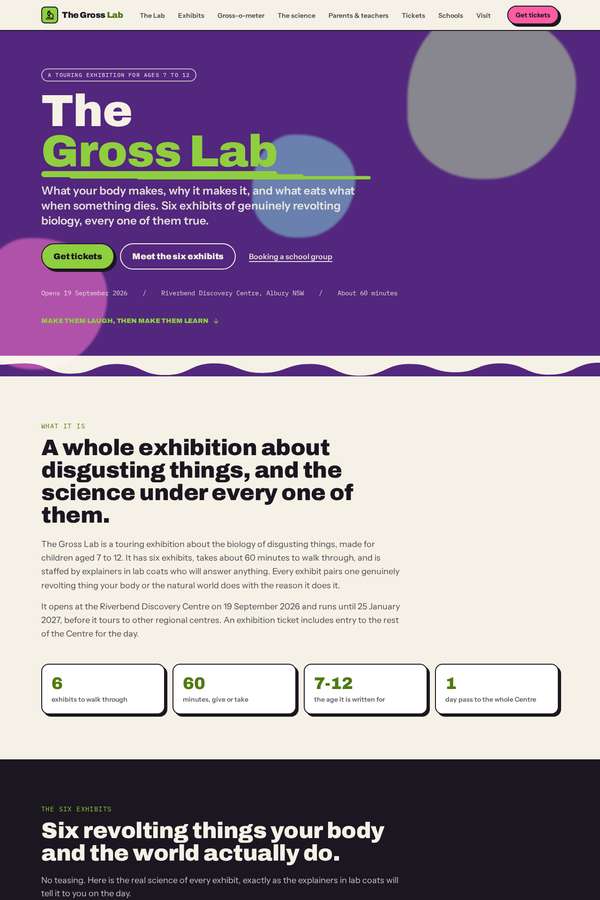
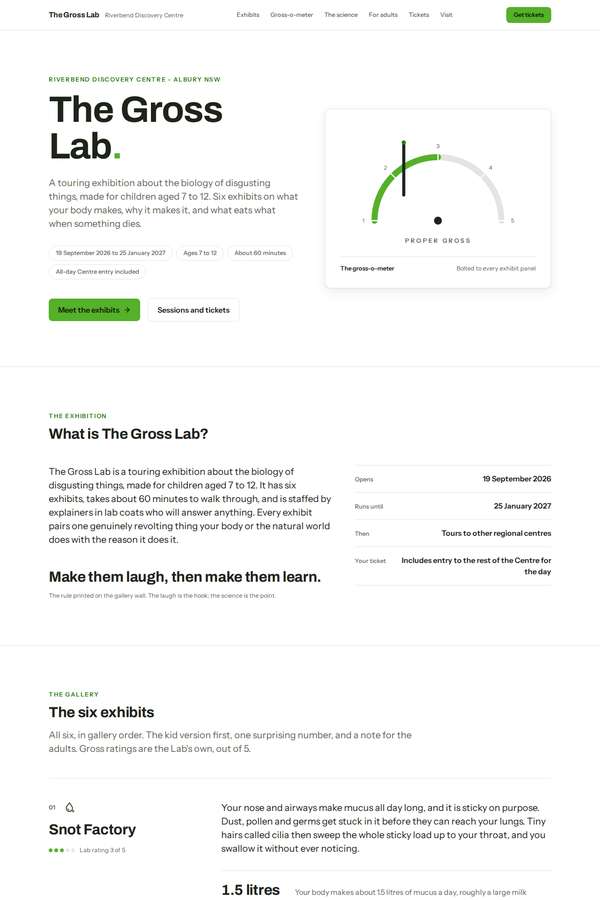
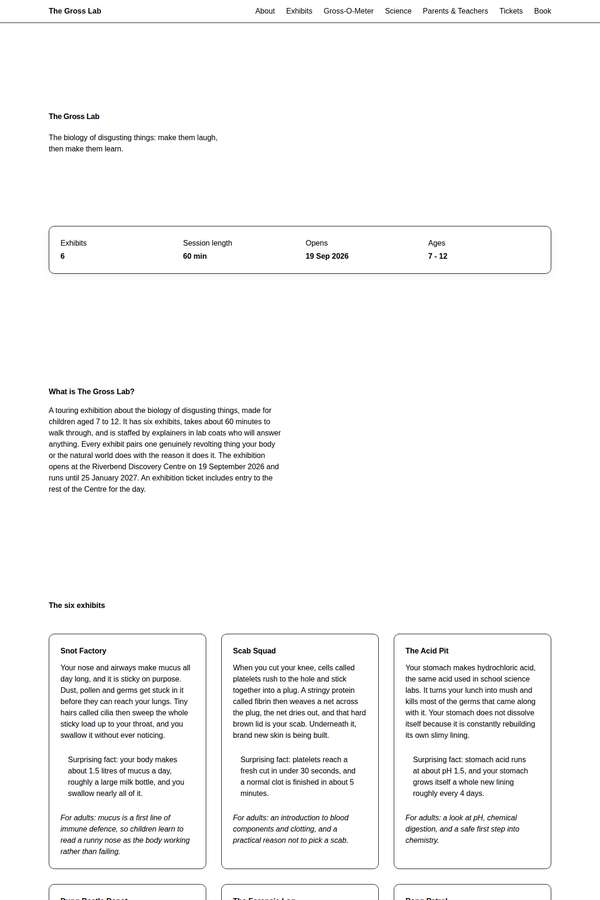
The Gross Lab children's museum exhibition companion site
One brief, interpreted by fictional designer personas across published models. Compare the choices each makes and inspect the actual outputs.
- Task
- WDB-0004
- Design identities
- 7
- Published builds
- 28
Read the brief
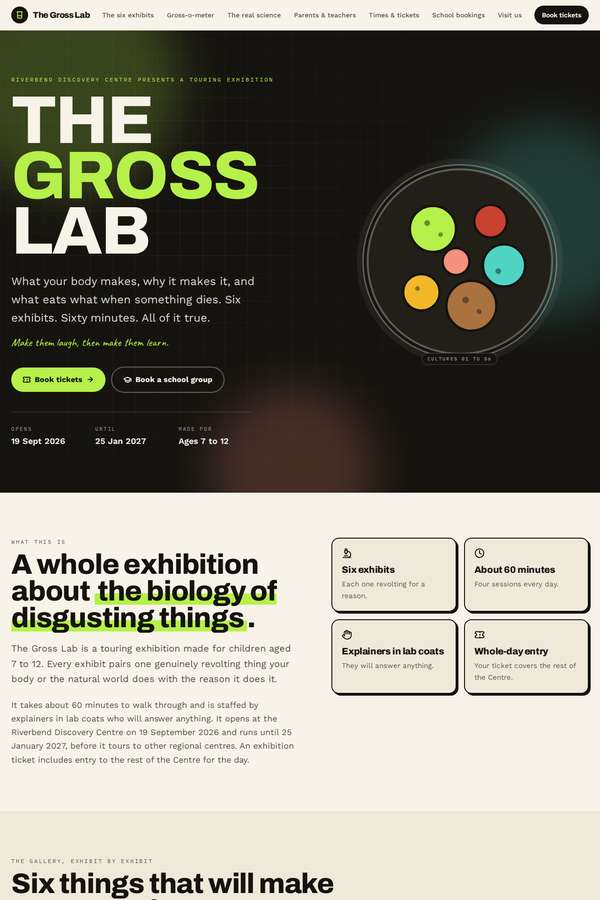
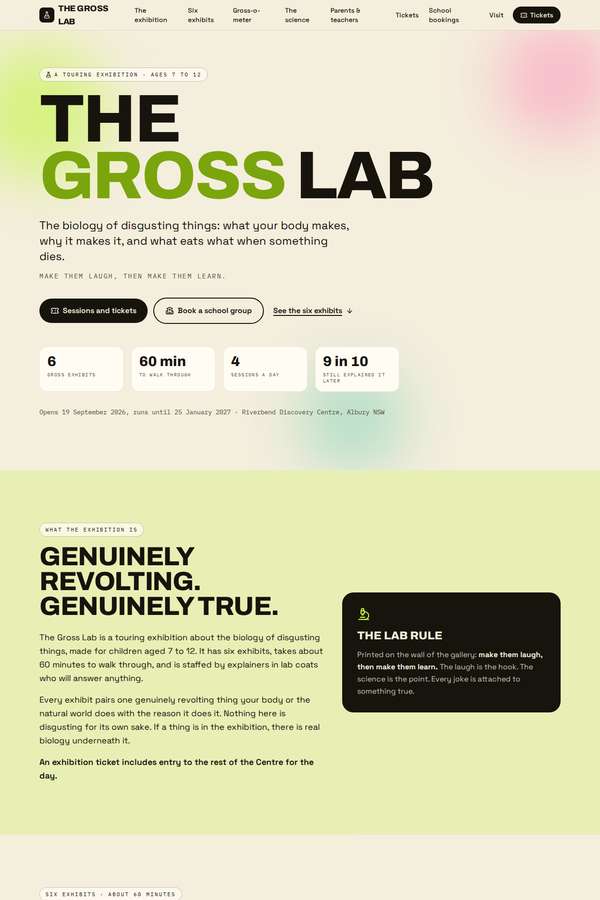
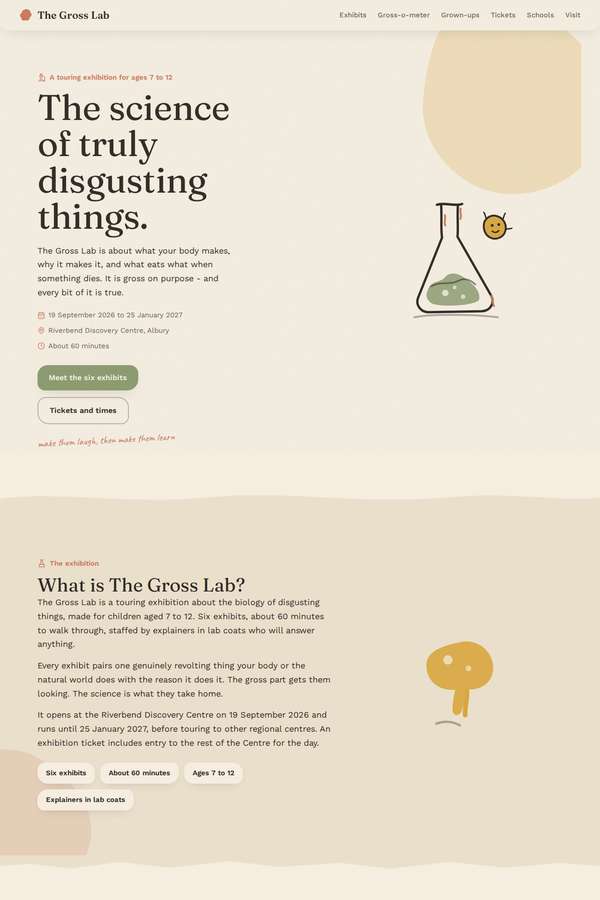
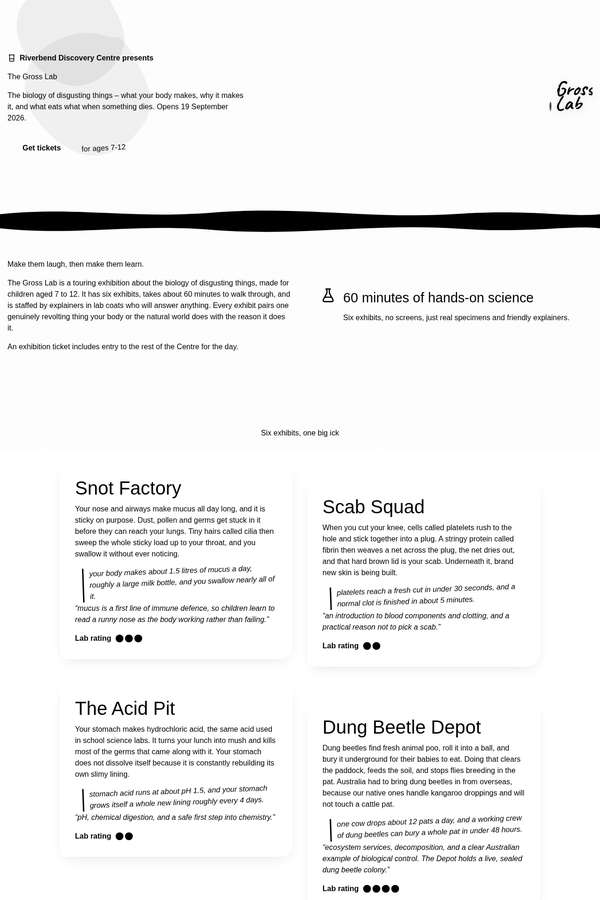
# Client brief: The Gross Lab You are designing and building the companion website for a real touring museum exhibition. The brief below gives you the business facts, the goals, the audiences, the sections the site must have, and the exact content to use. It gives you no visual direction on purpose. Every design decision - layout, type, colour, imagery, motion, tone - is yours to make. Read the whole brief, form a point of view on how this exhibition should look and feel, and build it. ## The commissioning body The Riverbend Discovery Centre is a regional children's science museum in Albury, New South Wales. It runs hands-on galleries for primary-school-aged visitors and takes bookings from schools across the Riverina and north-east Victoria. Its touring exhibition, The Gross Lab, is about the biology of disgusting things: what your body makes, why it makes it, and what eats what when something dies. The exhibition is built for children aged 7 to 12 and opens at the Centre on 19 September 2026, running until 25 January 2027 before it tours to other regional centres. This site is the exhibition's companion: it is where a child gets excited before or after a visit, and where a parent or a teacher decides the exhibition is worth the trip and books it. ## What the site is for 1. Make a 7 to 12 year old want to come, by telling them the actual science of the six exhibits rather than teasing them with it. 2. Convince a parent or a teacher that this is a serious, safe, curriculum-linked science exhibition and not a shock show. 3. Bring in bookings: sell general tickets for the four daily sessions, and get teachers to submit the school group booking form. ## Who it is for Two audiences on one page, and both must be served properly: - Children aged 7 to 12, many of whom will read the site themselves on a phone or a school laptop. - The adults who bring them: parents, grandparents, carers, and primary-school teachers booking a class of twenty-five. ## The experience the Centre wants The Centre has one request about the experience, not about the look. Their exhibition rule, printed on the wall of the gallery, is: **make them laugh, then make them learn.** The laugh is the hook; the science is the point. Nothing in the exhibition is disgusting for its own sake, and the Centre is firm that the site must not be either. Every joke should be attached to something true, and no child should leave the page with a wrong idea about how their body works. This is a note about content and tone, not a style instruction. The site must also carry an interactive element - the gross-o-meter - described in the content below. How it behaves is your call. One firm rule: any motion must respect a visitor's reduced-motion preference. When reduced motion is requested, the whole site must still be completely readable, every section reachable, and the gross-o-meter still usable as a calm, static control, with no information conveyed only through movement. ## What the site must contain (all of these sections) - a hero that opens the exhibition, - what the exhibition is, - the six exhibits, - the gross-o-meter, an interactive element where a visitor rates or reveals how gross each exhibit is, - the real science explainer, - a parents and teachers section covering safety, curriculum links, and accessibility, - session times and ticket prices, - school bookings, with the booking form, - visit and contact details. ## Content to use Use the content below substantially as written, in Australian English. You may write your own section headings and any short connective microcopy (button labels, captions, form labels, gross-o-meter prompts), but the facts, figures, names, numbers, prices, and descriptions are fixed. Do not invent extra exhibits, drop any of the six, or change the science, the ratings, the prices, the session times, the curriculum links, the accessibility notes, or the contact details. ### The exhibition The Gross Lab is a touring exhibition about the biology of disgusting things, made for children aged 7 to 12. It has six exhibits, takes about 60 minutes to walk through, and is staffed by explainers in lab coats who will answer anything. Every exhibit pairs one genuinely revolting thing your body or the natural world does with the reason it does it. The exhibition opens at the Riverbend Discovery Centre on 19 September 2026 and runs until 25 January 2027. An exhibition ticket includes entry to the rest of the Centre for the day. ### The six exhibits Present all six. Each has a kid-facing explanation, one surprising fact with a number, a one-line note for adults, and the Lab's own gross rating out of 5. **1. Snot Factory** - Lab rating 3 out of 5. Kid-facing: Your nose and airways make mucus all day long, and it is sticky on purpose. Dust, pollen and germs get stuck in it before they can reach your lungs. Tiny hairs called cilia then sweep the whole sticky load up to your throat, and you swallow it without ever noticing. Surprising fact: your body makes about 1.5 litres of mucus a day, roughly a large milk bottle, and you swallow nearly all of it. For adults: mucus is a first line of immune defence, so children learn to read a runny nose as the body working rather than failing. **2. Scab Squad** - Lab rating 2 out of 5. Kid-facing: When you cut your knee, cells called platelets rush to the hole and stick together into a plug. A stringy protein called fibrin then weaves a net across the plug, the net dries out, and that hard brown lid is your scab. Underneath it, brand new skin is being built. Surprising fact: platelets reach a fresh cut in under 30 seconds, and a normal clot is finished in about 5 minutes. For adults: an introduction to blood components and clotting, and a practical reason not to pick a scab. **3. The Acid Pit** - Lab rating 2 out of 5. Kid-facing: Your stomach makes hydrochloric acid, the same acid used in school science labs. It turns your lunch into mush and kills most of the germs that came along with it. Your stomach does not dissolve itself because it is constantly rebuilding its own slimy lining. Surprising fact: stomach acid runs at about pH 1.5, and your stomach grows itself a whole new lining roughly every 4 days. For adults: pH, chemical digestion, and a safe first step into chemistry. **4. Dung Beetle Depot** - Lab rating 4 out of 5. Kid-facing: Dung beetles find fresh animal poo, roll it into a ball, and bury it underground for their babies to eat. Doing that clears the paddock, feeds the soil, and stops flies breeding in the pat. Australia had to bring dung beetles in from overseas, because our native ones handle kangaroo droppings and will not touch a cattle pat. Surprising fact: one cow drops about 12 pats a day, and a working crew of dung beetles can bury a whole pat in under 48 hours. For adults: ecosystem services, decomposition, and a clear Australian example of biological control. The Depot holds a live, sealed dung beetle colony. **5. The Forensic Log** - Lab rating 5 out of 5. Kid-facing: When an animal dies, blowflies find it within minutes and lay their eggs. The eggs hatch into maggots that eat the soft parts and grow astonishingly fast, and a scientist can measure a maggot to work out how long the animal has been dead. Nothing in nature is wasted, because decomposers return every dead thing to the soil. Surprising fact: one blowfly can lay about 250 eggs at a time, and its maggots reach full size in roughly 5 days. For adults: decomposition, food webs and nutrient cycling, taught with models and a time-lapse of a fallen log. There are no human remains and no photographs of real bodies. **6. Pong Patrol** - Lab rating 3 out of 5. Kid-facing: Sweat is almost entirely water and salt, and on its own it does not smell at all. The smell comes from bacteria that live on your skin, especially in warm spots like armpits, feeding on your sweat and giving off waste gases. So body odour is really just bacteria burps. Surprising fact: you have about 3 million sweat glands, and on a hot day you can lose more than a litre of sweat in an hour. For adults: thermoregulation and the skin microbiome, and a gentle way into a hygiene conversation before high school. ### The gross-o-meter Every exhibit in the gallery has a gross-o-meter dial on its panel, and visitors vote on the way out. The scale has five named levels, and the site must use these names: 1. Barely Icky 2. Bit Yuck 3. Proper Gross 4. Full Squirm 5. Absolutely Revolting The site must carry the gross-o-meter as a working interactive element: a visitor rates or reveals how gross each of the six exhibits is, and can compare their rating against the Lab's own rating for that exhibit (Snot Factory 3, Scab Squad 2, The Acid Pit 2, Dung Beetle Depot 4, The Forensic Log 5, Pong Patrol 3). Design the behaviour yourself. It must work with a keyboard and on a touchscreen, and nothing is submitted anywhere: the ratings stay in the page. ### The real science explainer Use this content for the explainer: Disgust is not a joke to scientists. It is a studied human emotion that evolved to keep us away from things that make us sick, which is why a rotten smell turns your stomach before you have decided anything about it. The Gross Lab uses that reaction as a hook, then explains the biology behind it. Every panel in the exhibition was written by the Centre's education team and reviewed for accuracy by Dr Priya Raman, a microbiologist. The exhibition was trialled with 240 students from six schools before the tour began. A fortnight after their visit, 9 in 10 of those students could still explain at least one of the six science concepts in their own words. Nothing in The Gross Lab is disgusting for its own sake. If a thing is in the exhibition, there is real biology underneath it. ### Parents and teachers Safety and content notes: - Nothing on display is human tissue. The specimens are models, casts, and preserved invertebrates. - The dung beetle colony is live and sealed, and cannot be opened by visitors. - There are no jump scares, no loud surprises, and no gore. - The Forensic Log has a signposted bypass door for children who would rather skip the maggots, and it rejoins the gallery at the next exhibit. - There is a hand-washing station at the gallery exit, and explainers are stationed at every hands-on table. Curriculum links. The exhibition is mapped to two strands of the Australian Curriculum (Version 9) Science learning area: - Science Understanding, Biological sciences (AC9S4U01) - explain the roles and interactions of consumers, producers and decomposers within a habitat and how food chains represent feeding relationships. - Science as a Human Endeavour, Use and influence of science (AC9S6H02) - investigate how scientific knowledge is used by individuals and communities to identify problems, consider responses and make decisions. A four-page teacher pack with pre-visit and post-visit activities for each of the six exhibits is emailed with every confirmed school booking. Accessibility: - Step-free and wheelchair accessible throughout, and every hands-on table is at seated height. - A sensory-friendly session runs on the first Sunday of each month at 9:00 am, with lower lighting, sound off, and capped numbers. - A quiet room with low lighting and beanbags is open all day beside the gallery entrance, and visitors can come and go from it freely. - An Auslan-interpreted session runs on the third Saturday of each month at 11:15 am. - Companion Cards are accepted, and the companion enters free. ### Sessions and tickets The Gross Lab runs four sessions a day, each about 60 minutes: - 9:45 am - 11:15 am - 1:00 pm - 2:30 pm Ticket prices (each ticket includes entry to the rest of the Centre for the day): - Child, ages 5 to 16 - $14 - Adult - $18 - Family, 2 adults and up to 3 children - $52 School groups: $9 per student, with one teacher free for every 10 students. School sessions run Tuesday to Friday during term at 9:45 am and 11:15 am, and must be booked at least 2 weeks ahead. Children under 5 enter free but the exhibition is written for ages 7 to 12. ### School bookings Teachers book through the form on this page. The form has exactly these fields: - School name - Contact name - Email - Year level - Number of students - Preferred date The Centre's bookings officer, Marcus Ellery, replies within 2 business days to confirm a session and send the teacher pack. The form does not need a working backend: on submit, acknowledge the teacher in the page. ### Visit and contact Riverbend Discovery Centre 18 Willow Bend Road, Albury NSW 2640 Phone (02) 6021 4488 Email hello@riverbenddiscovery.org.au School bookings: schools@riverbenddiscovery.org.au Open Tuesday to Sunday, 9:30 am to 4:30 pm. Closed Mondays outside school holidays, and closed Christmas Day and Good Friday. Free parking on site, and it is a 10 minute walk from Albury station. ## Output contract (React, single page) Build one single-page site. Output exactly two files: - `App.tsx` - a default-exported React component. Define any subcomponents in this same file. This is the whole page. - `theme.css` - a Tailwind v4 `@theme` token block, your `font-family` choices from the shared font menu below, and any custom CSS you need. The only imports allowed in `App.tsx` are `react`, `framer-motion`, `lucide-react` (never the Sparkles icon), and, for 3D, `three`, `@react-three/fiber`, and `@react-three/drei`. No other packages, no network requests, and no external assets: all imagery must be inline SVG, CSS, drawn in code on a canvas, or rendered with WebGL. The fonts are bundled offline, so use only the shared menu: Archivo (including Archivo Expanded), Instrument Sans, Space Grotesk, Work Sans, IBM Plex Sans, IBM Plex Mono, JetBrains Mono, Fraunces, Instrument Serif, Playfair Display, Lora, Caveat. Make it responsive across mobile, tablet, and desktop. The page must also remain fully readable and usable if WebGL is unavailable: never leave a visitor with a blank screen or a missing section because a 3D canvas failed to start.