Banja Lab / Benchmarks / Test
WDB-0003webdesign · hard
River Pulse public water observatory
The same task, run on 28 models. Compare the outputs side by side, or open any one in a popup to inspect it.
Top result: Yuki Tanabe (Opus 4.8) (high reasoning) at 90.6% composite. Lowest: Sol Kepler (deepseek-v4-pro) at 0.0%. 28 models compared on this task.
How it ran
- Each model was given the brief below in a fresh, isolated session with no access to our tools, and returned a single self-contained index.html (inline CSS and JS, no external requests, no build step).
- The rendered output was scored 1 to 5 on brief fidelity, visual design, craft, and impact by a four-family vision panel - Anthropic (Claude Opus 4.8), OpenAI (GPT-5.5), Google (Gemini 3.1 Pro), and xAI (Grok 4.3) - using one identical prompt so the scores compare. The published judge score is leave-one-family-out: a model is never scored by a judge of its own family, so same-family self-preference is removed.
The brief
# Client brief: River Pulse, the Tandera Valley water observatory You are designing and building a public information site for a real government water authority. The brief below gives you the organisation, the goals, the audiences, the sections the site must have, and the exact data and copy to use. It gives you no visual direction on purpose. Every design decision - layout, type, colour, charting, imagery, motion, tone - is yours to make. Read the whole brief, form a point of view on how a public river record should look and behave, and build it. ## The commissioning body The Tandera Valley Water Authority is a public body that monitors and reports on the Tandera and its connected reaches for the community. It runs a telemetered gauge network of twelve monitoring stations from the upper Tandera down to the South Australian border reach, it publishes storage levels for four major storages, it runs the blue-green algae alert program for the river, and it publishes the seasonal water allocation and restriction stage that licence holders operate under. Its data already exists as spreadsheets and a machine-readable feed. What it does not have is a public face for that data. The site is called River Pulse. It is the authority's public record of the state of the river, and it is the page people will open when something is happening on the river. ## What the site is for 1. Let a water user find an exact number fast: the height at their gauge, the flow, the change since yesterday, the algae level at their reach, their allocation, and the restriction stage they are operating under. 2. Let a general reader who has never thought about a river gauge come away understanding how the system works and how healthy it is right now. 3. Make the current alerts unmissable and unambiguous, so nobody swims, pumps, or waters stock somewhere they should not. 4. Get people onto the alerts list so they are told when something changes. ## Who it is for Two audiences, both first class, neither one an afterthought: - **Irrigators, graziers, and river operators.** They are checking a number, often on a phone, often outdoors, often in a hurry. They know what a megalitre per day is. They want density, precision, units, the time of the reading, and no hunting. - **General and city visitors.** School students, travellers, people who saw the river in the news. They do not know what a gauge height means, they do not know why a low flow matters, and they should not have to. They should leave with an honest sense of how the system is going. ## Two firm rules that come with the brief - **It must work on a phone in a paddock.** The site has to stay fully usable and legible at small sizes, in one hand, in daylight. No number a water user needs may be hidden behind hover, and nothing important may depend on a wide screen. - **The data must be readable by someone who is not a hydrologist.** Every unit, abbreviation, and status word used anywhere on the page has to be explained somewhere on the page in plain words. If motion is used anywhere, it must respect a visitor's reduced-motion preference, and the page must remain complete and readable as a static page with no information conveyed by movement alone. ## What the site must contain (all of these sections) - a hero carrying the current system snapshot, - a live station board covering all twelve monitoring stations, - a river-health explainer written for the general reader, - storage and dam levels for the four storages, - the blue-green algae alert system, its five levels, and which stations sit at which level right now, - allocation and restriction status for water users, - a data-quality and methodology note, - subscribe to alerts, plus the authority's contact details. ## Content and data to use Use the content below substantially as written, in Australian English. You may write your own section headings and short connective microcopy (button labels, axis labels, captions, form labels), but the figures, names, units, dates, statuses, and definitions are fixed. Do not drop stations, invent extra stations or storages, change the alert scale, or change any number. ### The current system snapshot All readings current as at 6:45 am, 22 July 2026 (Australian Central Standard Time). - System storage across the four major storages: 68 per cent of capacity, down 0.3 percentage points on the same time last week. - Twelve monitoring stations reporting. Eleven are on primary telemetry; Pridham Landing is running on backup telemetry and its readings are hourly rather than every 15 minutes. - One station is at the highest algae alert level (Red) and two are at Amber. - Restriction stage in force: Stage 2 of 4. - Total flow past the South Australian border reach over the last 24 hours: 7,410 megalitres per day. ### The twelve monitoring stations Each station has a name, its nearest town, the river reach it sits on, its current gauge height in metres, its change over the last 24 hours in metres, its flow in megalitres per day (ML/day), and its status. All twelve must appear. 1. Kelvindale Weir Downstream - Kelvindale, Victoria - Upper Tandera - 3.42 m - +0.06 m - 9,850 ML/day - Normal 2. Tolliver Bridge - Tolliver, New South Wales - Upper Tandera - 2.18 m - +0.04 m - 9,120 ML/day - Normal 3. Corella Punt - Corella, New South Wales - Central Tandera - 4.05 m - -0.02 m - 8,470 ML/day - Normal 4. Nyalong Wharf - Nyalong, Victoria - Central Tandera - 2.61 m - +0.11 m - 8,930 ML/day - Watch 5. Sawyers Rest Pumping Station - Sawyers Rest, Victoria - Central Tandera - 1.94 m - -0.05 m - 7,640 ML/day - Normal 6. Deepwater Island - Deepwater, New South Wales - Kerrigan reach - 1.37 m - -0.08 m - 1,180 ML/day - Low flow 7. Warrock Weir - Warrock, New South Wales - Barrenjoey reach - 1.02 m - -0.12 m - 640 ML/day - Low flow 8. Wallan Bridge - Wallan, New South Wales - Barrenjoey reach - 1.88 m - -0.03 m - 1,420 ML/day - Normal 9. Coolaman Main Weir - Coolaman, New South Wales - Mullawong reach - 2.74 m - -0.15 m - 310 ML/day - Alert 10. Pridham Landing - Pridham, New South Wales - Mullawong reach - 1.46 m - -0.09 m - 240 ML/day - Alert 11. Yarrowee Lock 10 - Yarrowee, New South Wales - Lower Tandera - 3.11 m - +0.02 m - 7,980 ML/day - Normal 12. Mirrengai Town Wharf - Mirrengai, South Australia - Lower Tandera - 3.28 m - +0.05 m - 7,410 ML/day - Normal The four station statuses mean: - **Normal** - height and flow are within the expected range for this reach at this time of year. - **Watch** - the reading is moving quickly enough that the authority is checking it more often. No action is required by water users. - **Low flow** - flow has fallen below the threshold set for that reach. Pumping may be restricted at short notice. - **Alert** - flow or water quality at this station is a current problem and the authority has published advice for the reach. ### The seven-day trend series Seven daily readings for each of four stations, oldest first, covering 16 July 2026 to 22 July 2026. Present these as charts drawn in code. Nyalong Wharf, gauge height in metres: 2.15, 2.24, 2.31, 2.36, 2.42, 2.50, 2.61 Nyalong Wharf, flow in ML/day: 8,410, 8,480, 8,560, 8,620, 8,700, 8,780, 8,930 Coolaman Main Weir, gauge height in metres: 3.11, 3.07, 3.03, 2.98, 2.94, 2.89, 2.74 Coolaman Main Weir, flow in ML/day: 520, 470, 430, 400, 370, 340, 310 Warrock Weir, gauge height in metres: 1.36, 1.32, 1.28, 1.24, 1.20, 1.14, 1.02 Warrock Weir, flow in ML/day: 780, 740, 710, 690, 670, 655, 640 Mirrengai Town Wharf, gauge height in metres: 3.08, 3.11, 3.14, 3.17, 3.19, 3.23, 3.28 Mirrengai Town Wharf, flow in ML/day: 7,050, 7,120, 7,190, 7,240, 7,310, 7,360, 7,410 ### The four storages Storage volumes are read at 9:00 am each day. Capacity is the full supply volume in gigalitres (GL). - Kalyndra Dam - capacity 3,856 GL - currently 84 per cent full - 3,239 GL held - up 1.1 percentage points on last week. - Berrigal Reservoir - capacity 3,005 GL - currently 71 per cent full - 2,134 GL held - down 0.6 percentage points on last week. - Lake Mirrengai - capacity 677 GL - currently 62 per cent full - 420 GL held - down 2.3 percentage points on last week. - Coolaman Lakes - capacity 1,731 GL - currently 28 per cent full - 485 GL held - down 1.9 percentage points on last week. The authority's plain-language note on storages: "Storages are the system's savings account. Water is held in Kalyndra and Berrigal in the wet months and released down the river in the dry ones, both for towns and irrigators and to keep the river itself alive. Lake Mirrengai is the working balance near the South Australian border. Coolaman Lakes fill from the Mullawong and are shallow, so they lose a great deal of water to evaporation and fall fast in a dry run." ### The blue-green algae alert scale Five levels. Present the whole scale, what each level means, and which stations sit at which level right now. - **Level 0, Clear.** No blue-green algae detected above the reporting threshold in the last sample. Normal use of the water. - **Level 1, Surveillance.** Low cell counts detected. Sampling moves from fortnightly to weekly. No health advice applies and the water can be used normally. - **Level 2, Watch.** Cell counts are rising and a bloom is possible. Do not swallow river water. Rinse with clean water after swimming and keep an eye out for scum. - **Level 3, Amber.** A bloom is present and may be visible as a green tinge or scum. Avoid contact with the water. Do not use untreated river water for drinking, food preparation, or filling stock troughs without advice. - **Level 4, Red.** High cell counts and toxins confirmed. No contact with the water. Do not swim, ski, or use the water for drinking or cooking, and keep pets and stock away. Fish caught in the reach should not be eaten. Current levels, as at 22 July 2026: - Level 0, Clear: Kelvindale Weir Downstream, Tolliver Bridge, Corella Punt, Wallan Bridge. - Level 1, Surveillance: Nyalong Wharf, Sawyers Rest Pumping Station, Yarrowee Lock 10. - Level 2, Watch: Deepwater Island, Mirrengai Town Wharf. - Level 3, Amber: Warrock Weir, Pridham Landing. - Level 4, Red: Coolaman Main Weir. The authority's current advice for the Coolaman reach: "A Red alert is in force on the Mullawong at Coolaman Main Weir. Do not enter the water, do not use the water for drinking, cooking, or stock, and keep dogs out of the water. The alert was raised on 19 July 2026 and will be reviewed after the sample taken on 28 July 2026." ### Allocation and restrictions for water users Seasonal water allocations for the 2026 to 2027 water year, as at 22 July 2026: - **High security licences: 97 per cent of entitlement.** Unchanged since 1 July 2026. - **General security licences: 38 per cent of entitlement.** Increased from 31 per cent on 15 July 2026. The next allocation review is 1 August 2026. Restriction stage in force: **Stage 2 of 4**, in place since 1 July 2026. The four stages: - **Stage 1, Normal.** No restrictions. Pump to your licence conditions. - **Stage 2, Conserve.** In force now. Pumping for irrigation is permitted between 6:00 pm and 8:00 am only. Non-essential town water use, including watering lawns and washing vehicles at home, is not permitted. - **Stage 3, Restrict.** Irrigation pumping is permitted on alternate days by licence number, odd numbers on odd dates. Stock and domestic use continues. - **Stage 4, Critical.** Irrigation pumping is suspended. Only critical human needs and stock and domestic use continue. Water users must record every extraction in their metering return within seven days. Returns are lodged through the authority's licence portal. ### Data quality and methodology The authority publishes this note in full and asks that it be shown, not buried: - Gauge heights are measured to plus or minus 10 millimetres. They are heights on the local gauge datum, not depths of water, and not heights above sea level. - Flows are not measured directly. They are calculated from gauge height using a rating curve for each station, and carry an uncertainty of about plus or minus 8 per cent. At very low flows the uncertainty is larger. - Telemetered stations report every 15 minutes and the site publishes every 30 minutes, so a reading can be up to 45 minutes old. Pridham Landing is on backup telemetry and reports hourly. - Readings are published unverified. Every reading is quality-checked by a hydrographer within 10 business days and may be revised. Revised readings replace the published figure without notice. - Blue-green algae samples are collected every Tuesday and laboratory results take three to five days, so an algae level can be up to eight days behind the water in front of you. Trust what you can see over what the page says. - Storage volumes are read at 9:00 am daily and are supplied by the storage operators. - Rating curves at Coolaman Main Weir and Warrock Weir were last reviewed in March 2026. All other rating curves were last reviewed in November 2025. - The full dataset is published as open data under a Creative Commons Attribution licence and is available as a machine-readable feed on request. ### Alerts and contact Alerts are free. A subscriber chooses the stations they care about and the alerts they want, and receives them by email or SMS: - Gauge height crossing a threshold they set. - A change in the blue-green algae level at a chosen station. - A change in the seasonal allocation for their licence class. - A change in the restriction stage. The signup asks for an email address or mobile number, the stations to watch, and the alert types to receive. Tandera Valley Water Authority 22 Mirrengai Avenue, Mirrengai, South Australia 5341 Public information line: 1800 372 946, 7:00 am to 7:00 pm daily General enquiries: enquiries@tanderawater.gov.au Open data and feed access: data@tanderawater.gov.au 24-hour incident line, for fish deaths, spills, and visible algae blooms: 1800 100 528 ## Output contract (React, single page) Build one single-page site. Output exactly two files: - `App.tsx` - a default-exported React component. Define any subcomponents in this same file. This is the whole page. - `theme.css` - a Tailwind v4 `@theme` token block, your `font-family` choices from the shared font menu below, and any custom CSS you need. The only imports allowed in `App.tsx` are `react`, `framer-motion`, `lucide-react` (never the Sparkles icon), and, for 3D, `three`, `@react-three/fiber`, and `@react-three/drei`. No other packages, no network requests, and no external assets: all imagery and every chart must be inline SVG, CSS, drawn in code on a canvas, or rendered with WebGL. There is no charting library. The fonts are bundled offline, so use only the shared menu: Archivo (including Archivo Expanded), Instrument Sans, Space Grotesk, Work Sans, IBM Plex Sans, IBM Plex Mono, JetBrains Mono, Fraunces, Instrument Serif, Playfair Display, Lora, Caveat. Make it responsive across mobile, tablet, and desktop. The page must also remain fully readable and usable if WebGL is unavailable: never leave a visitor with a blank screen or a missing section because a 3D canvas failed to start.
Yuki Tanabe (Opus 4.8)
High reasoning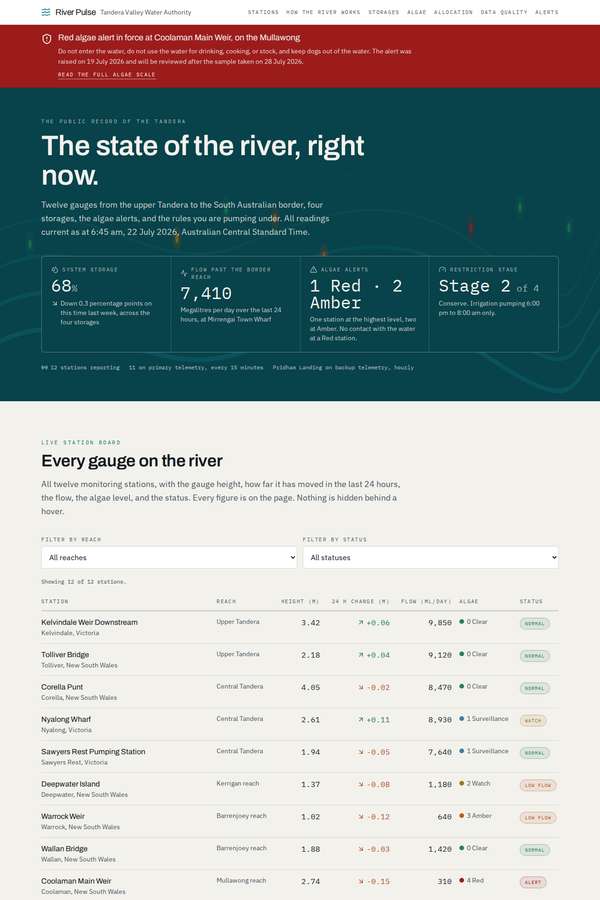
Composite 90.6%Judge 4.6/5
Judge panelAnthropic 4.3/5OpenAI 5.0/5
single-judge (Claude) 4.3/5 → leave-one-family-out 4.6/5
Anthropic: Every required section is present and correct: dark-teal hero with the full system snapshot (68%, 7,410 ML/day, Red 1 / Amber 2, Stage 2 of 4), a complete twelve-station board with height/change/flow/status, a general-reader explainer, code-drawn seven-day trend charts for the four stations, the four storages as labelled bars with the plain-language note, the full five-level algae scale with current station placements and the Red-alert callout, allocation and restriction stages, a thorough methodology note, and a subscribe form plus contact details in the red footer. The palette is a restraine
OpenAI: The screenshot visibly includes all required sections and data: system snapshot, twelve-station board, trends, health explainer, storages, algae scale and current advice, allocations/restrictions, methodology, signup, and contact details. The design is highly coherent and public-sector appropriate, with strong hierarchy, restrained colour, dense but readable data presentation, and polished details throughout. It feels distinctive and premium without sacrificing clarity or authority.
Ingrid Kessler (kimi-k3)
default reasoning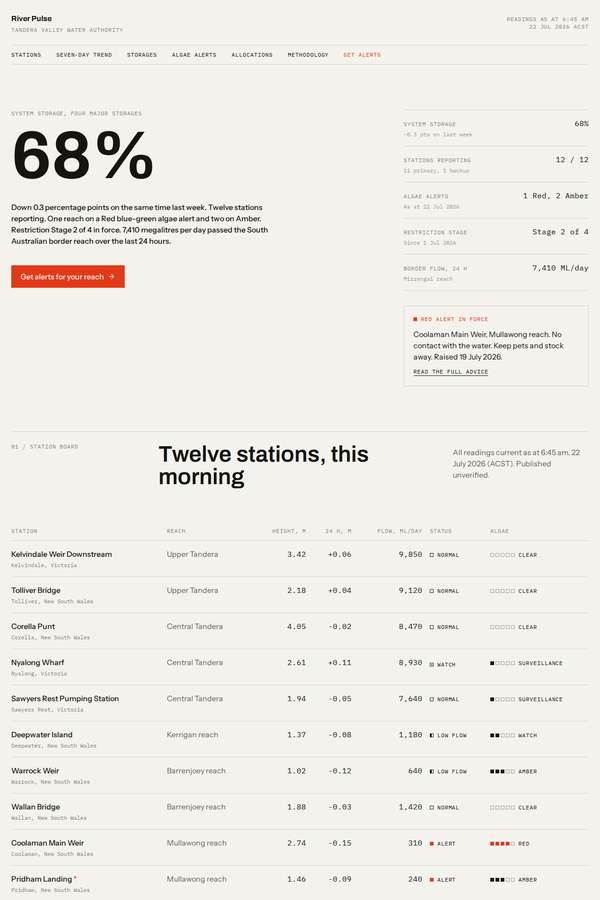
Composite 90.6%Judge 4.6/5
Judge panelAnthropic 4.5/5OpenAI 4.8/5
single-judge (Claude) 4.5/5 → leave-one-family-out 4.6/5
Anthropic: Every required section is present and correct: hero snapshot (68%, Stage 2/4, 7,410 ML/day, Red+2 Amber banner), the full twelve-station board with heights/change/flow/status, four in-code seven-day trend charts, the plain-language river explainer, four storages with percentage bars (84/71/62/28), the five-level algae scale with current stations plus the Coolaman red advice, allocation and restriction stages (97%/38%, Stage 2 detail), a full methodology note, and the subscribe form with station checkboxes and contact details. The visual language is a coherent, confident cream-and-red editorial
OpenAI: The screenshot includes every required section with the supplied station, storage, algae, allocation, methodology, signup and contact information, and the red alert is clearly surfaced. The restrained editorial grid, strong typography, and monochrome/red palette feel coherent and authoritative, with charts and tables consistently finished. Its austerity is premium and distinctive, though the very small mono labels and minimal visual variation slightly reduce its immediate impact.
Noor El-Amin (kimi-k3)
default reasoning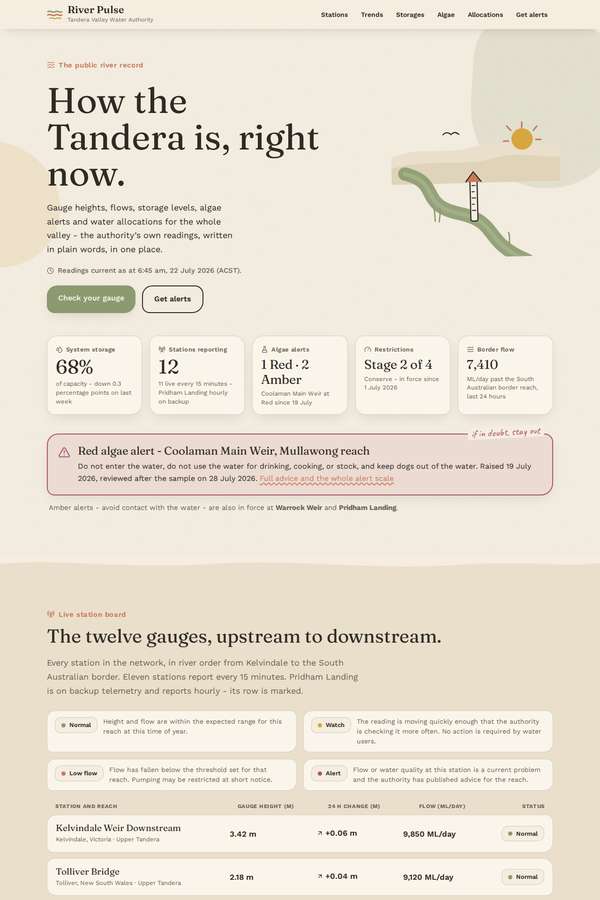
Composite 90.6%Judge 4.6/5
Judge panelAnthropic 4.3/5OpenAI 5.0/5
single-judge (Claude) 4.3/5 → leave-one-family-out 4.6/5
Anthropic: All required sections are present and correct: hero snapshot (68%, 12 stations, 1 Red/2 Amber, Stage 2 of 4, 7,410 ML/day), the full twelve-station board, four in-code seven-day trend charts, the river-health explainer, four storages, the five-level algae scale with per-level stations, allocation/restriction stages, methodology, and a subscribe form with contact details. The warm cream/olive/sage editorial palette, serif display headings, iconographed section dividers, and clean status pills read as coherent, modern, and finished with no obvious broken elements. It is a distinctive, premium tr
OpenAI: The page appears to include every required section with the supplied data, station lists, alert levels, methodology notes, glossary explanations, subscription form, and contact details all visible and correctly structured. The visual system is polished and distinctive, with excellent hierarchy, warm authoritative colour, strong typography, carefully composed cards and charts, and consistent craft throughout. It feels premium while remaining clear and public-service appropriate, with alerts and operational numbers easy to find.
Mara Vieira (Opus 4.8)
High reasoning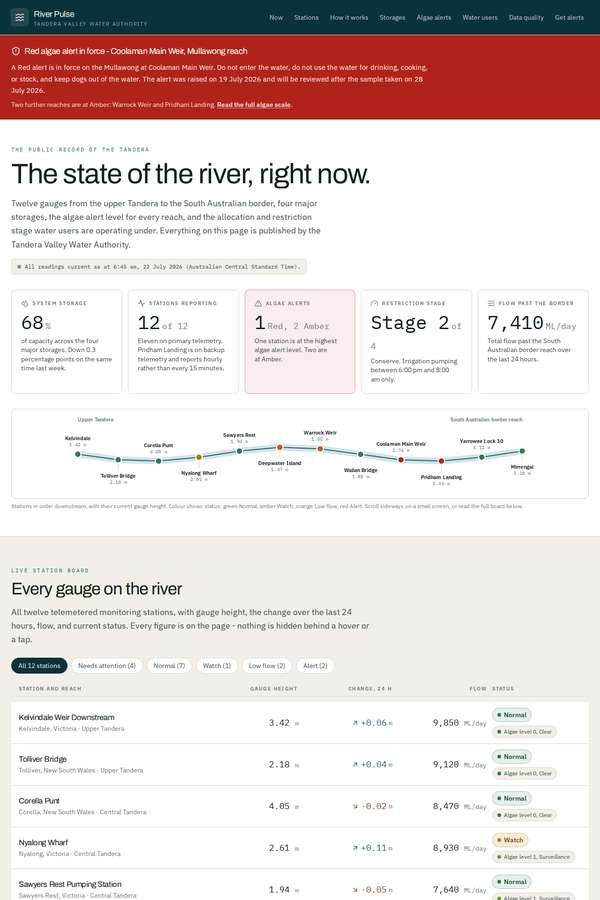
Composite 87.5%Judge 4.5/5
Judge panelAnthropic 4.3/5OpenAI 4.8/5
single-judge (Claude) 4.3/5 → leave-one-family-out 4.5/5
Anthropic: Every required section is present and correct: a red-alert hero with the 68%/Stage 2/7,410 ML snapshot, a full twelve-station board with towns, reaches, heights, changes, flows and statuses, code-drawn seven-day trend line charts for the four stations, the four storages with their percentages, the five-level algae scale with current station placements and the Coolaman Red advice, allocation (97%/38%) and the four restriction stages, a detailed methodology note, and a subscribe form plus contact details. The visual language is a coherent, restrained government-record editorial style with monosp
OpenAI: The page visibly includes all required sections, stations, storages, alert levels, allocation/restriction details, methodology notes, glossary explanations, signup, and contact information with the supplied figures preserved. The design is polished, highly legible, and well-structured for a dense public data product, with strong civic colour use and careful chart/table treatment. Its impact is strong and professional, though more restrained than truly distinctive or show-stopping.
Noor El-Amin (Opus 4.8)
High reasoning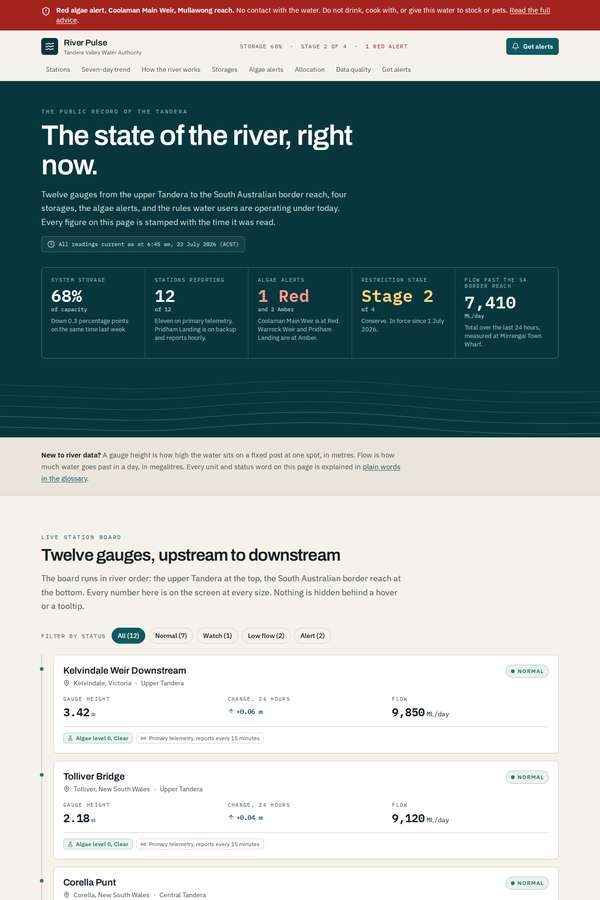
Composite 87.5%Judge 4.5/5
Judge panelAnthropic 4.3/5OpenAI 4.8/5
single-judge (Claude) 4.3/5 → leave-one-family-out 4.5/5
Anthropic: Every required section is present and correct: hero snapshot (68%, 12 stations, 1 Red, Stage 2, 7,410 ML/day), the full twelve-station board with heights/change/flow/status, code-drawn seven-day trend charts for the four stations, a plain-language river-gauge explainer, the four storages, the five-level algae scale with each station's current level and the Coolaman Red advice, allocation/restriction stages, a methodology note, a full glossary, and the subscribe form plus contact block. The muted teal-and-cream palette is calm, editorial, and appropriate to a public water authority, with clear
OpenAI: The page includes nearly every required section with the mandated data, advice, glossary, methodology, subscription form, and contact details presented clearly; the only visible fidelity gap is that the seven-day flow series appears hidden behind a toggle rather than shown in the static screenshot. The visual system is polished, coherent, and highly legible for a dense public-data dashboard, with excellent hierarchy, colour coding, cards, charts, and alert treatment. Overall it feels finished, authoritative, and distinctive enough to read as a premium government information product.
Mara Vieira (kimi-k3)
default reasoning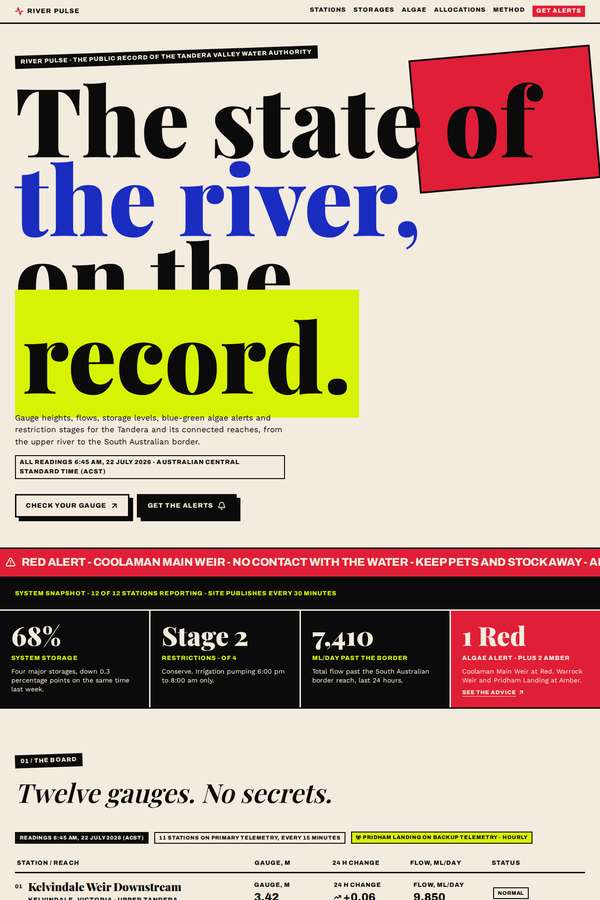
Composite 87.5%Judge 4.5/5
Judge panelAnthropic 4.3/5OpenAI 4.8/5
single-judge (Claude) 4.3/5 → leave-one-family-out 4.5/5
Anthropic: Every required section is visibly present and correct: the hero snapshot (68%, Stage 2, 7,410 ML/day, 1 Red), a full twelve-station board with height/change/flow/status, the four seven-day code-drawn charts, the plain-language explainer, all four storages (84/71/62/28%), the five-level algae scale with current stations, allocation (97%/38%) and four restriction stages, the methodology note, the subscribe form, and contact details. The execution is a confident, cohesive editorial-brutalist system - big Archivo display type, a disciplined red/blue/yellow accent language, and dense but well-align
OpenAI: The page appears to include every required section with the specified stations, storages, algae levels, restrictions, methodology, signup and contact details, and it makes the Red alert highly visible. The visual direction is distinctive and coherent, with a strong civic-editorial identity, excellent hierarchy, and memorable colour use. Craft is very high, though some dense microcopy, tiny labels, and a few compressed/overflow-prone areas slightly reduce polish and daylight legibility.
Elias Byrne (Opus 4.8)
High reasoning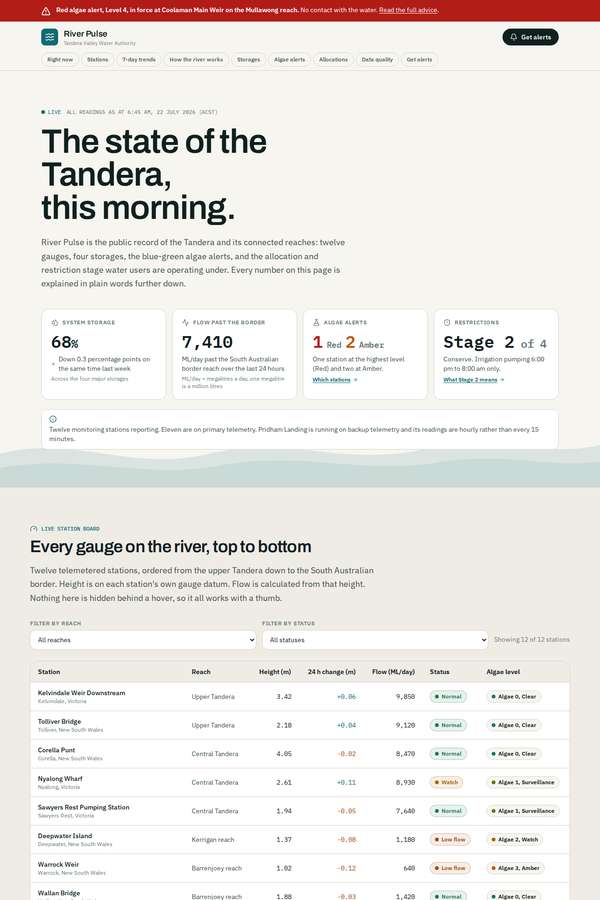
Composite 84.4%Judge 4.4/5
Judge panelAnthropic 4.3/5OpenAI 4.5/5
single-judge (Claude) 4.3/5 → leave-one-family-out 4.4/5
Anthropic: Every required section is present and correct: a snapshot hero with the four headline figures (68%, 7,410 ML/day, algae, Stage 2 of 4), a full twelve-station board as a dense table, four code-drawn seven-day trend charts, a plain-language river-health explainer, the four storages with percentage bars, the five-level algae scale with stations mapped and a Red-alert callout, allocation and restriction stages, a methodology note, and a subscribe form with full contact details including the incident line. Visual design is coherent and modern: restrained editorial palette with teal accents, clear t
OpenAI: The page covers nearly all required sections with the specified figures, station board, algae scale, restrictions, methodology, signup, and contact details clearly visible, but the seven-day flow trend series appears hidden behind a tab and is not visible in the screenshot. The visual system is highly coherent and polished, with strong hierarchy, readable data cards, excellent colour coding, and a credible public-authority tone. It feels premium and complete, though more refined and trustworthy than truly surprising or distinctive.
Cass Werner (Opus 4.8)
High reasoning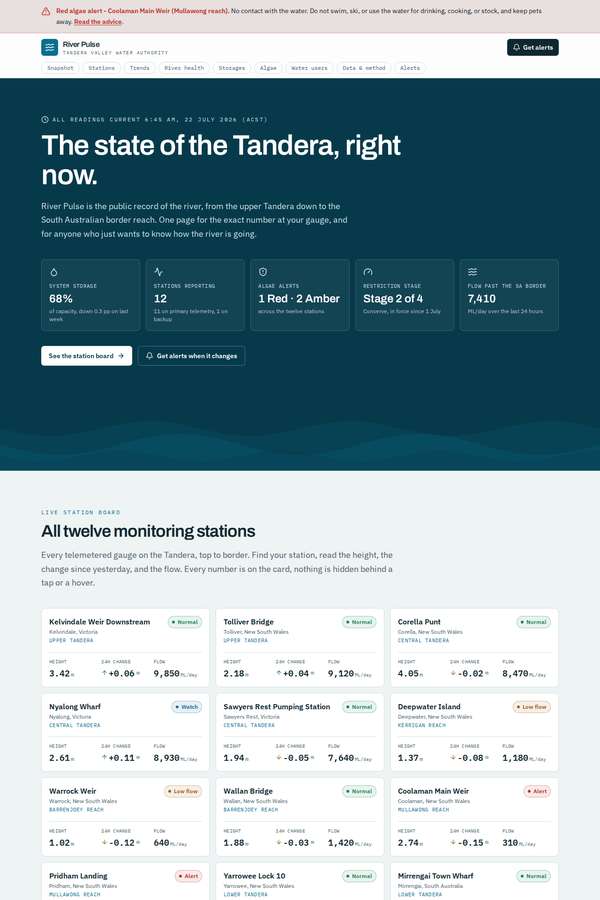
Composite 81.3%Judge 4.3/5
Judge panelAnthropic 4.3/5
single-judge (Claude) 4.3/5 → leave-one-family-out 4.3/5
Anthropic: Every required section is present and correct: a dark hero carrying the full system snapshot (68%, 12 stations, Stage 2 of 4, 7,410 ML/day), a complete twelve-station board with heights/changes/flows/status pills and a status legend, four code-drawn seven-day trend charts, a river-health explainer with a plain-language glossary, four storage bars with the note, the five-level algae scale with current-station assignments and the Coolaman Red advice, allocation and restriction stages, a methodology note, and a subscribe form with full contact block. Visual design is coherent and modern with a re
Sol Kepler (Opus 4.8)
High reasoning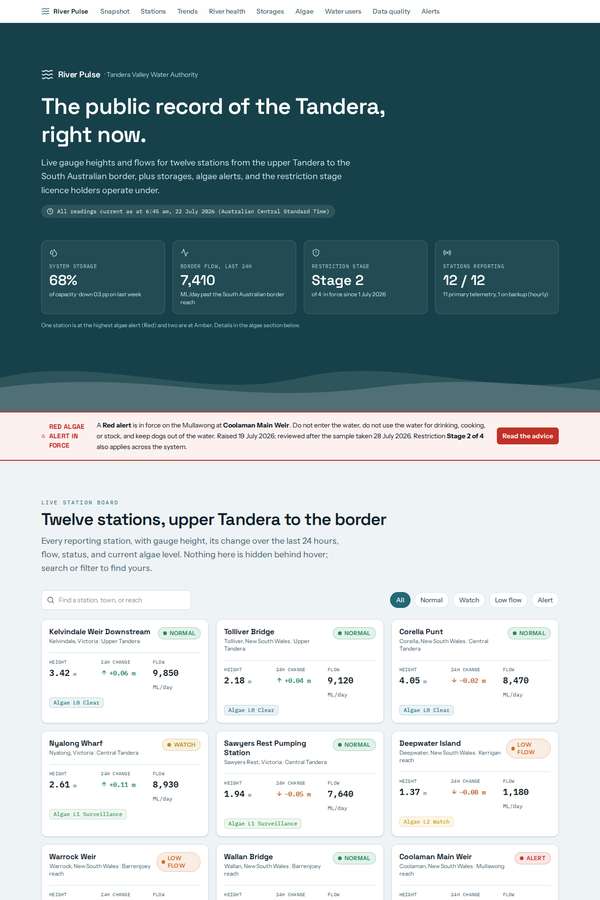
Composite 81.3%Judge 4.3/5
Judge panelAnthropic 4.3/5
single-judge (Claude) 4.3/5 → leave-one-family-out 4.3/5
Anthropic: Every required section is present and correct: dark river hero carrying the 68%/7,410/Stage 2/12-of-12 snapshot, a red alert banner, all twelve stations on the board with heights/change/flow/status, four coded trend charts, a plain-language explainer, four storage bars (84/71/62/28%), the full five-level algae scale with current stations, allocation and Stage 2-of-4 restriction detail, a thorough methodology note, and a subscribe form plus contact/incident numbers. The layout is coherent and modern with a confident dark-to-light rhythm, restrained government-data palette, tidy cards and legibl
Ingrid Kessler (Opus 4.8)
High reasoning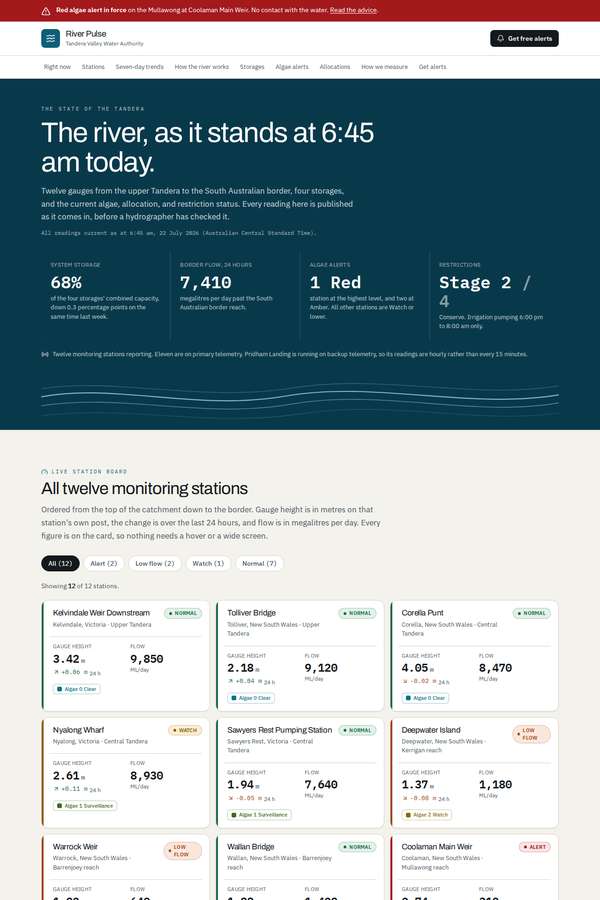
Composite 79.2%Judge 4.2/5
Judge panelAnthropic 4.3/5OpenAI 4.5/5Google 3.8/5
single-judge (Claude) 4.3/5 → leave-one-family-out 4.2/5
Anthropic: Exceptionally complete against the brief: the dark hero carries the full snapshot (68%, 7,410 ML/day, 1 Red, Stage 2/4), all twelve stations appear as a dense, unit-labelled board, the four-station code-drawn trend charts, four storage bars with the plain-language note, the full five-level algae scale with station assignments and the Coolaman Red advice, allocation figures (97%/38%) and four restriction stages, a thorough methodology note, and subscribe plus contact details with the incident line. Visual language is coherent and editorial - muted cream/navy palette, restrained type hierarchy,
OpenAI: The page includes nearly every required section with the correct figures, statuses, explanations, alert advice, methodology, signup, and contact details, though the seven-day flow series appears hidden behind a tab and is not visible in the static screenshot. The design is polished, legible, and highly coherent for a public water dashboard, with strong hierarchy, tasteful colour coding, and consistent card/chart treatment. It feels authoritative and premium, though more quietly utilitarian than truly distinctive.
Google: The design effectively translates dense data into a clear, trustworthy interface with strong typography and consistent layout. It meets all brief requirements seamlessly while maintaining a professional, highly readable aesthetic.
Yuki Tanabe (kimi-k3)
default reasoning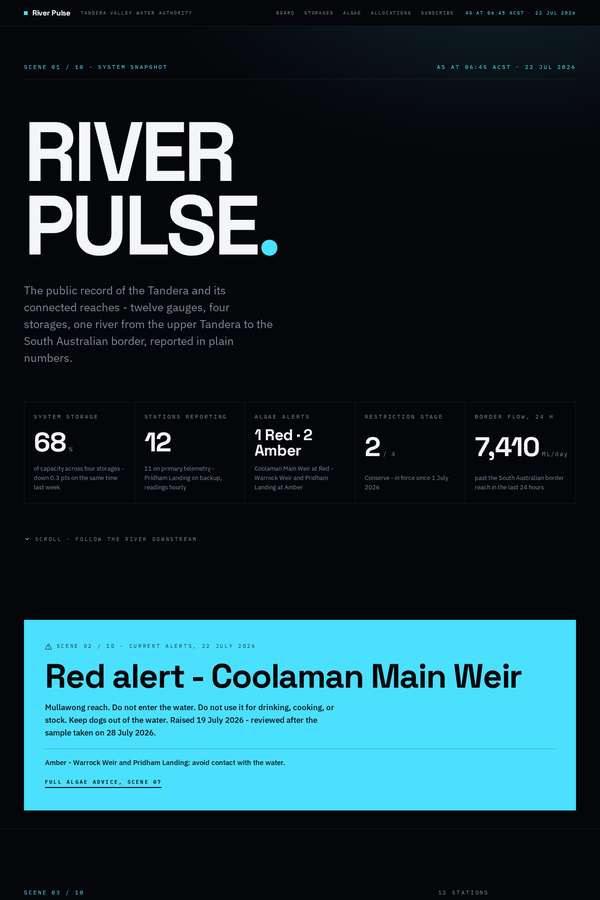
Composite 75.0%Judge 4.0/5
Judge panelAnthropic 3.8/5OpenAI 4.3/5
single-judge (Claude) 3.8/5 → leave-one-family-out 4.0/5
Anthropic: All required sections are present and correct: the big "RIVER PULSE." hero carries the snapshot stats (68%, 12 stations, Red/Amber, Stage 2, 7,410 ML/day), a full twelve-station board, code-drawn seven-day line charts, the river-health explainer, storage bars, the five-level algae scale with the Red Coolaman advice, allocation and restriction stages, a methodology note, and subscribe/contact. The dark palette with cyan accent and heavy Archivo-Expanded hero type is coherent and modern, and spacing is disciplined. Two things hold it back: the top "Red alert" banner is rendered on a cyan field r
OpenAI: All required sections and data appear to be present: snapshot, 12-station board, trends, explainer, storages, algae levels/advice, restrictions, methodology, signup, and contact details. The dark editorial/technical visual system is cohesive and striking, but the very small low-contrast microtype and cyan-only alert treatment weaken public-information clarity, and the chart grid has an awkward empty block that feels slightly unfinished.
Cass Werner (kimi-k3)
default reasoning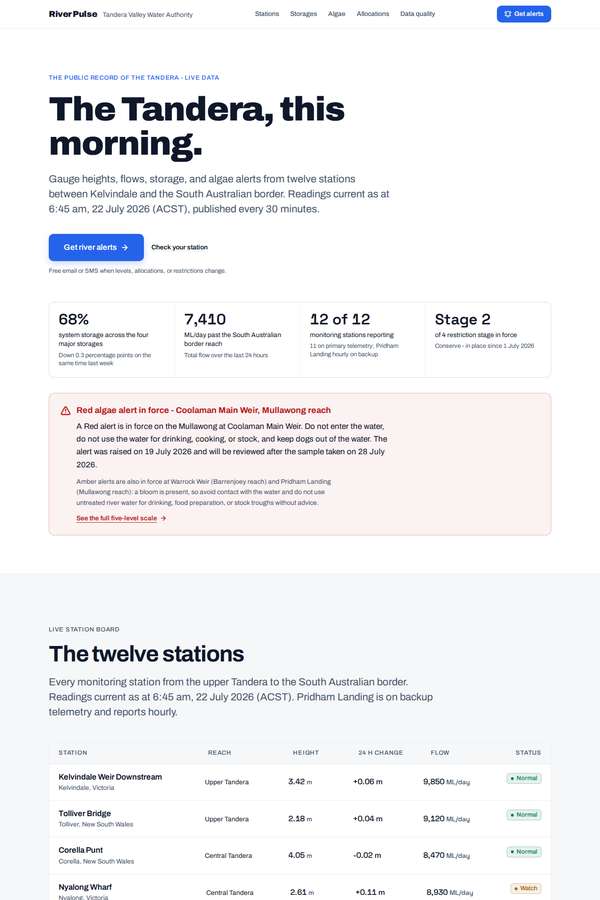
Composite 75.0%Judge 4.0/5
Judge panelAnthropic 4.0/5
single-judge (Claude) 4.0/5 → leave-one-family-out 4.0/5
Anthropic: All required sections are present and correct: hero snapshot (68%, 7,410 ML/day, 12/12 stations, Stage 2), a red alert banner, the full twelve-station table with heights/changes/flows/statuses, code-drawn seven-day trend charts for the four stations, a plain-language river explainer, the four storages with a savings-account framing, the five-level algae scale with current stations, allocation and restriction stages, a methodology note, a dark subscribe block, and full contact details. Visually it is clean, coherent and well-spaced with a restrained neutral palette and a blue/red accent system
Sol Kepler (kimi-k3)
default reasoning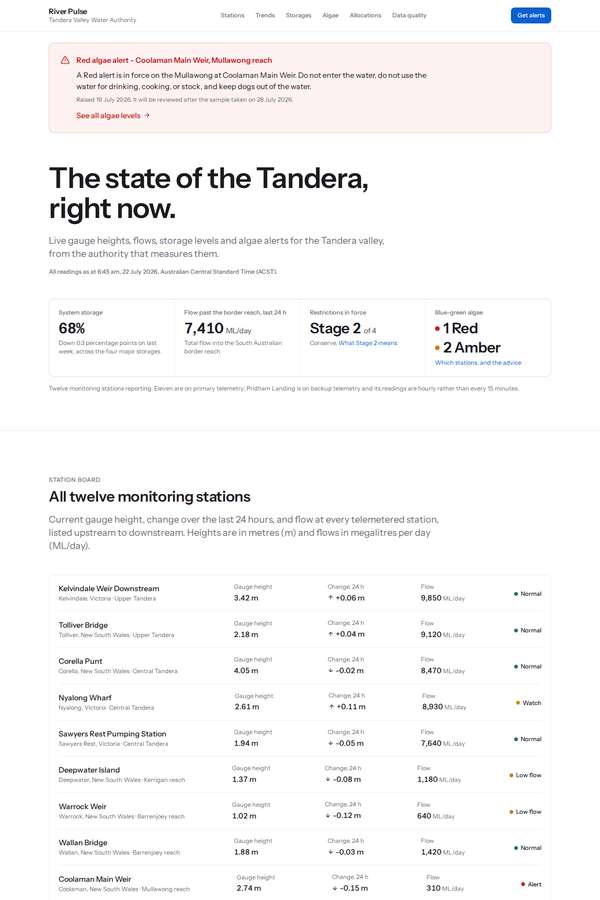
Composite 75.0%Judge 4.0/5
Judge panelAnthropic 4.0/5
single-judge (Claude) 4.0/5 → leave-one-family-out 4.0/5
Anthropic: Coverage is exemplary: hero snapshot (68%, 7,410 ML/day, Stage 2, 1 Red/2 Amber), a full twelve-station board, four seven-day trend charts, the storage bars (84/71/62/28), the full five-level algae scale with station assignments, allocation/restriction stages, a plain-language "how to read this page" glossary, methodology, subscribe form, and contact block, plus a persistent Red-alert banner up top. The execution is a clean, restrained editorial system with generous whitespace, sound type hierarchy and blue accents that suits a government data record and is well crafted with no visible broken
Cass Werner (deepseek-v4-pro)
default reasoning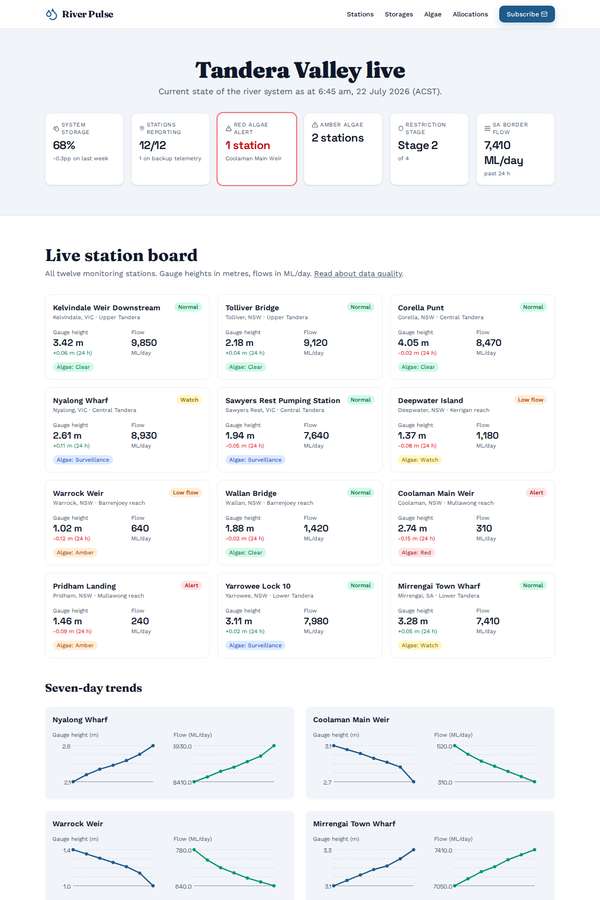
Composite 75.0%Judge 4.0/5
Judge panelAnthropic 4.0/5
single-judge (Claude) 4.0/5 → leave-one-family-out 4.0/5
Anthropic: All required sections are present and accurate: hero snapshot (68% storage, 12/12 stations, 1 Red / 2 Amber, Stage 2, 7,410 ML/day border flow), a complete 12-station board with status badges, four seven-day trend charts drawn in code, all four storages with fill bars, the full five-level algae scale plus current per-station readings and the Coolaman Red advice, allocations/restrictions, the methodology note, and a subscribe form with contact footer. The visual language is coherent and appropriate to a government water record: calm teal/navy palette, tidy card grids, clear status colour-coding
Ingrid Kessler (deepseek-v4-pro)
default reasoning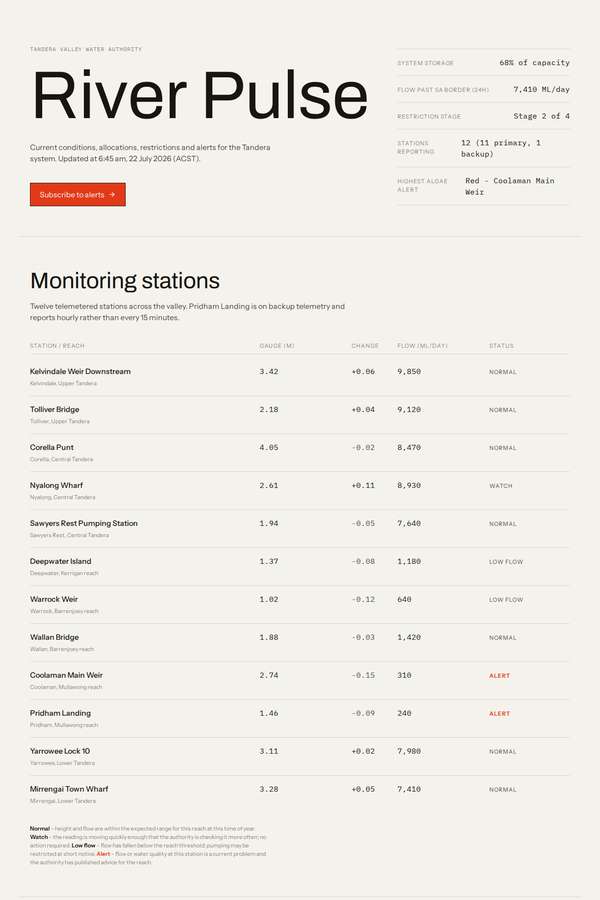
Composite 71.9%Judge 3.9/5
Judge panelAnthropic 4.0/5OpenAI 3.8/5
single-judge (Claude) 4.0/5 → leave-one-family-out 3.9/5
Anthropic: All required sections are present and correct: hero snapshot (68% storage, 7,410 ML/day, Stage 2 of 4), the full twelve-station board with heights/change/flow/status, the river explainer, four storages, the five-level algae scale with current placements and the Red advice, allocation/restriction stages, methodology, subscribe form with station checkboxes, and contact details, plus four code-drawn trend line charts. The design is a coherent, restrained editorial/document system with a strong Fraunces-style display headline, monospace figures, and disciplined red accent for alerts, which reads c
OpenAI: The page includes nearly all required sections and data, with all twelve stations, storages, algae scale, restrictions, methodology, signup, contact details, and trend charts visible, though some snapshot details and unit explanations are understated or missing. The visual system is clean, readable, and consistent, but the presentation is quite austere and the critical alert treatment is not especially unmissable, limiting its overall impact.
Elias Byrne (kimi-k3)
default reasoning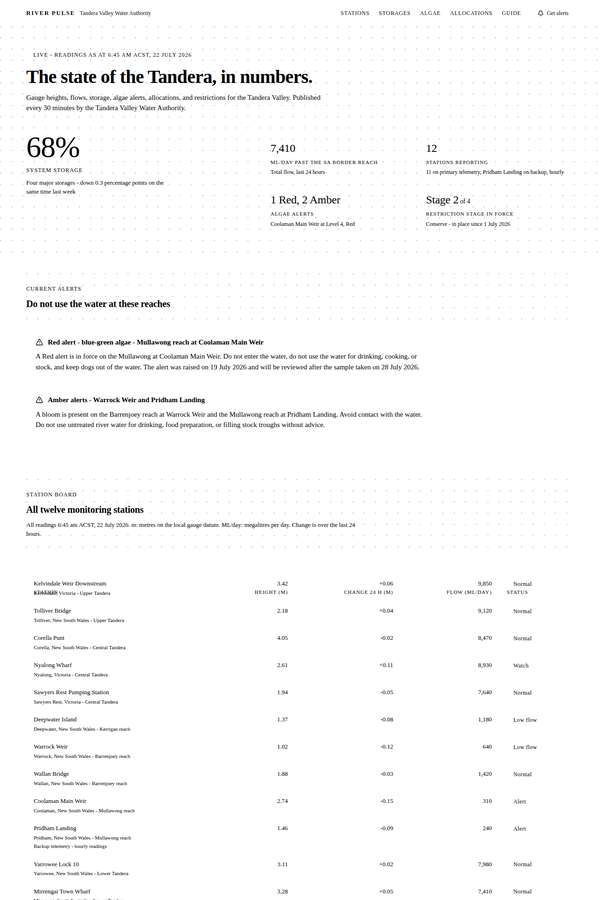
Composite 68.8%Judge 3.8/5
Judge panelAnthropic 3.8/5OpenAI 3.8/5
single-judge (Claude) 3.8/5 → leave-one-family-out 3.8/5
Anthropic: Brief fidelity is excellent: the hero snapshot (68%, 7,410 ML/day, 12 stations, Stage 2), current Red/Amber alerts, the full twelve-station board, storages (84/71/62/28%), the five-level algae scale, allocations (97%/38%), restriction stages, methodology note, and subscribe/contact are all present and correct. The visual language is a coherent, restrained editorial-broadsheet treatment with serif display headings, hairline rules, and generous whitespace that reads calm and authoritative. Craft is pulled down by the seven-day trend "charts," which render as sparse floating dots with no connecti
OpenAI: The page includes nearly all required sections and data, including all stations, alerts, trends, storages, allocations, methodology, glossary, and contact/signup content, though the alert signup input is not clearly visible and the safety alert treatment is visually understated. The editorial monochrome system is coherent and distinctive, but tiny text, sparse charting, and lack of colour or stronger hierarchy reduce clarity and urgency for a public water-alert page.
Yuki Tanabe (deepseek-v4-pro)
default reasoning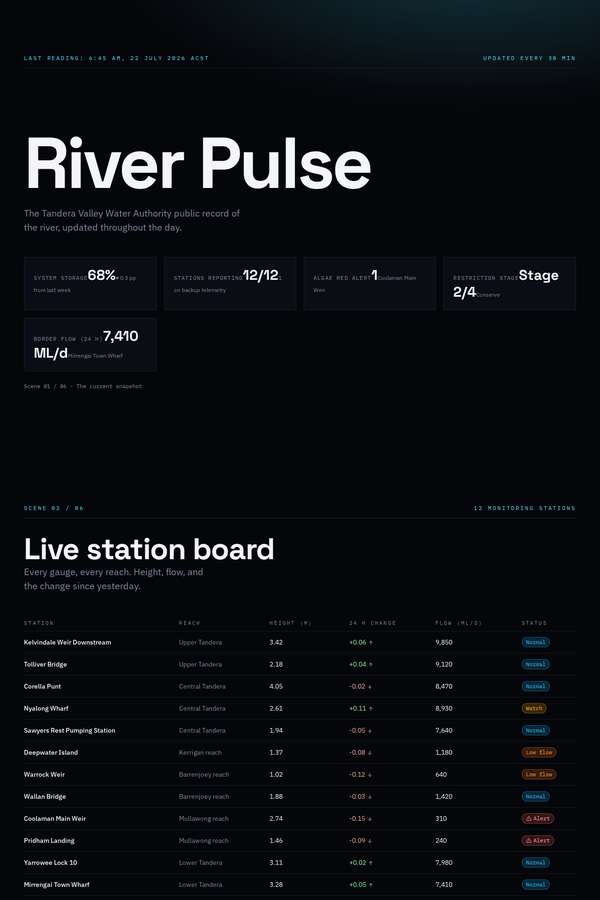
Composite 56.3%Judge 3.3/5
Judge panelAnthropic 3.0/5OpenAI 3.5/5
single-judge (Claude) 3.0/5 → leave-one-family-out 3.3/5
Anthropic: Nearly all required content is present and accurate: the snapshot hero, all twelve stations in a dense legible board with colour-coded statuses, the five-level algae scale with the red Coolaman alert, four storages, allocation/restrictions, methodology, subscribe and contact. The major fidelity/craft flaw is that the mandated seven-day trend charts render as blank cards showing only endpoint labels (e.g. 2.15m...2.61m, 8410...8930) with no visible line or sparkline. Visually it is a coherent, utilitarian dark dashboard with decent mono-accented typography, but it reads as competent-and-plain r
OpenAI: The page includes the main required sections and most headline data, with a strong dark, editorial dashboard aesthetic. However several brief details are missing or under-explained, including station towns, status definitions, storage capacities, full restriction-stage definitions, and some allocation/metering copy; the trend chart panels also appear essentially blank or too faint. The composition is distinctive and polished in places, but cramped hero cards, tiny text, excessive empty space, and weak chart execution reduce overall craft.
Noor El-Amin (deepseek-v4-pro)
default reasoning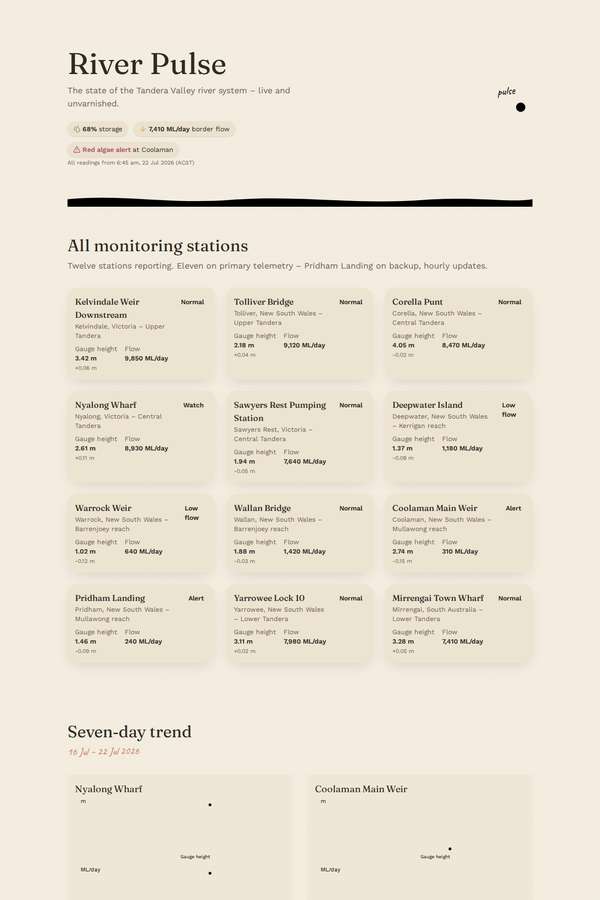
Composite 50.0%Judge 3.0/5
Judge panelAnthropic 2.8/5OpenAI 3.3/5
single-judge (Claude) 2.8/5 → leave-one-family-out 3.0/5
Anthropic: All required sections are present and the fixed content is faithfully reproduced: hero snapshot, twelve-station board, storage levels, the five-level algae scale with current stations, allocations/restrictions, methodology, and subscribe/contact, so brief fidelity is strong. However the seven-day trend charts are effectively broken - each panel shows axis labels but only a single stray dot instead of a rendered line, a conspicuous janky failure that undercuts craft. The warm cream palette with serif headings reads coherent and calm but is very plain and document-like, with weak visual hierarch
OpenAI: The page includes most required sections and the core station, storage, algae, allocation, methodology, subscription, and contact content, but several brief details are incomplete: the trend charts are essentially non-functional, station status definitions and subscriber station choices are missing, and some mandated copy is compressed. The visual system is coherent and attractive with strong typography and calm spacing, but the muted alert treatment and broken chart craft keep it from feeling like a fully reliable public water observatory.
Noor El-Amin (claude-fable-5)
High reasoning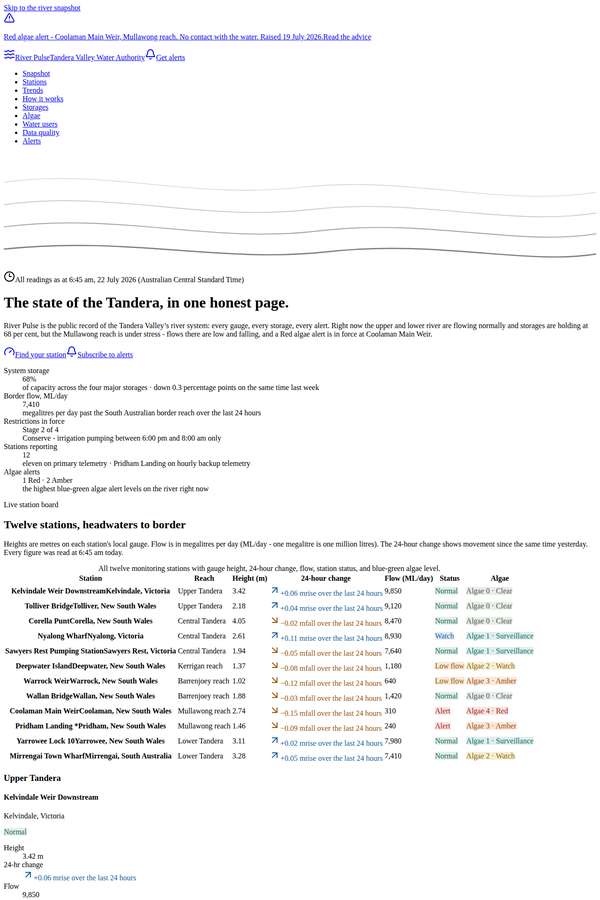
Composite 37.5%Judge 2.5/5
Judge panelAnthropic 2.5/5OpenAI 2.5/5
single-judge (Claude) 2.5/5 → leave-one-family-out 2.5/5
Anthropic: Content coverage is strong: the station board, the four coloured trend charts (height and flow drawn in code with markers, axis dates and value labels), storages, the five-level algae scale, allocation/restriction, methodology and contact all appear to be present. But visually it reads as a near-unstyled document dump: a single cramped left-aligned column of default-weight body text stacked endlessly, minimal hierarchy, no cards or grid structure, and only the mid-page charts show any real design intent. Spacing, type scale and composition are flat and janky throughout, so despite the honest "
OpenAI: The build appears to include all required sections, data, definitions, charts, alert signup, methodology, and contact details with largely correct figures. However the visual execution is extremely plain and cramped, with default-looking typography, visible skip links/navigation artifacts, duplicated station presentations, and little hierarchy beyond basic headings and charts. It functions as a content dump rather than a polished public observatory, so it has very limited premium impact.
Cass Werner (claude-fable-5)
High reasoning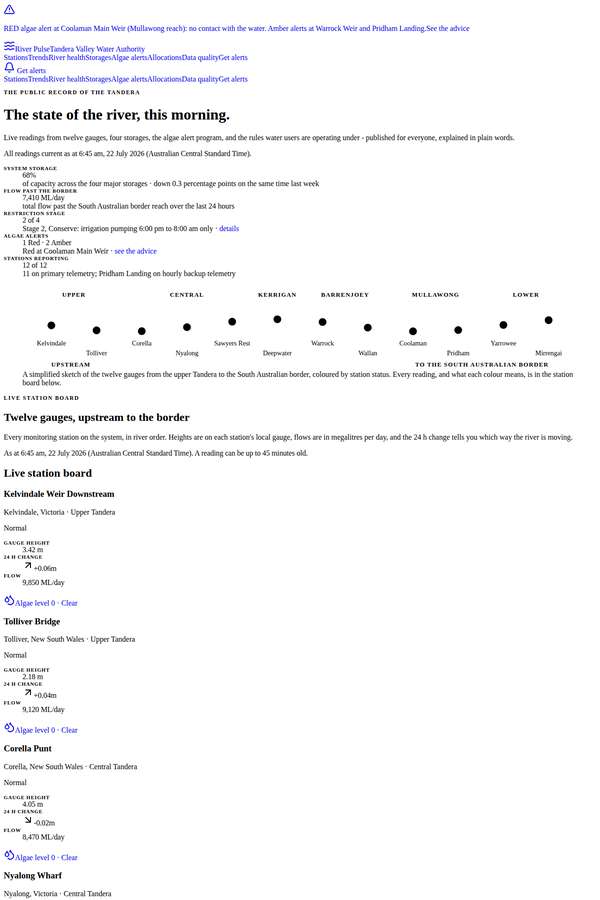
Composite 37.5%Judge 2.5/5
Judge panelAnthropic 2.5/5
single-judge (Claude) 2.5/5 → leave-one-family-out 2.5/5
Anthropic: Content coverage is strong: the hero snapshot, a full station board, the seven-day trend charts, storage levels, the five-level algae scale, allocation/restriction status, methodology and subscribe/contact all appear, so brief fidelity is largely met. But the visual execution is bare and near-monochrome: plain black text on white with weak hierarchy, minimal spacing rhythm, and no colour system to differentiate statuses or alert levels. The trend charts render as heavy solid-black filled blobs with no axes, gridlines, or labels beyond start/end dates, which reads as crude and unfinished, and t
Sol Kepler (claude-fable-5)
High reasoning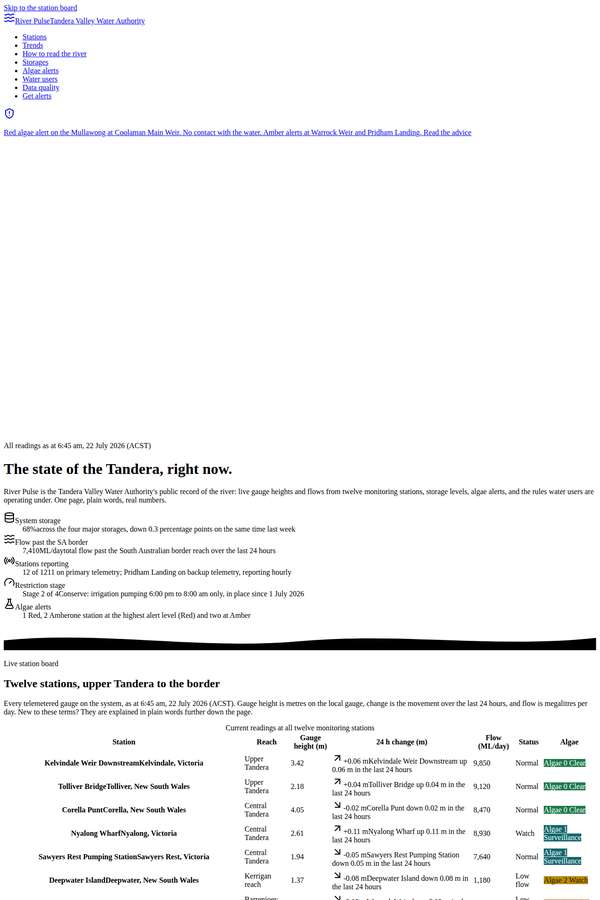
Composite 31.3%Judge 2.3/5
Judge panelAnthropic 2.3/5
single-judge (Claude) 2.3/5 → leave-one-family-out 2.3/5
Anthropic: Content coverage is strong: the hero snapshot, twelve-station board, four hand-drawn trend charts (which are the one polished element, with teal/tan lines, area fills and large value labels), storages, the five-level algae scale, allocation/restriction stages, methodology and contact all appear to be present. But the page renders essentially unstyled - default serif/sans body type, plain blue underlined anchor links stacked at the top, bare document-flow tables and thin orange/green status bars - so the Tailwind theme largely failed to take hold. The result reads like a raw spec dump rather th
Yuki Tanabe (claude-fable-5)
High reasoning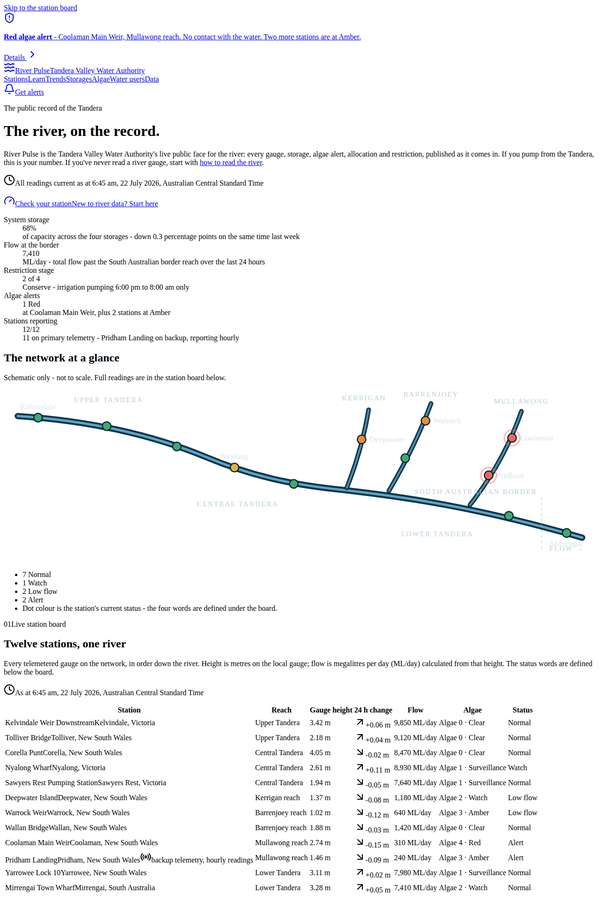
Composite 28.1%Judge 2.1/5
Judge panelAnthropic 2.0/5OpenAI 2.3/5
single-judge (Claude) 2.0/5 → leave-one-family-out 2.1/5
Anthropic: The content appears substantially complete - hero snapshot, twelve-station board, four code-drawn trend charts, storages, the five-level algae scale, allocation/restriction stages, methodology, and contact all present - so brief fidelity is reasonable. But the page renders as essentially unstyled browser-default HTML: blue underlined links, default fonts, no colour system, no layout, no cards, no spacing hierarchy, plain tables stacked in one long column. The only designed elements are the simple green SVG trend lines; there is no status colour-coding, no visual treatment of the critical Red a
OpenAI: Nearly all required sections and fixed data appear to be present, including stations, trends, storages, algae levels, restrictions, methodology, signup and contact details, but urgent alerts and key numbers are not made unmissable. The page reads mostly like default browser styling with cramped type, weak hierarchy, plain controls and limited composition; the inline charts and map add some utility, but the overall craft and premium impact are low.
Elias Byrne (claude-fable-5)
High reasoning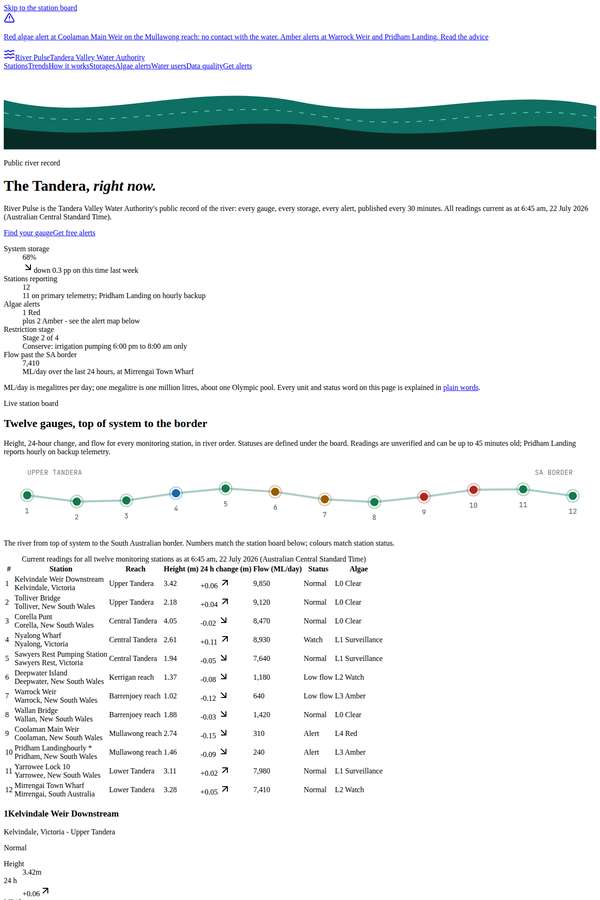
Composite 28.1%Judge 2.1/5
Judge panelAnthropic 2.3/5OpenAI 2.0/5
single-judge (Claude) 2.3/5 → leave-one-family-out 2.1/5
Anthropic: Content coverage looks complete - all required sections, station data, and the four trend series are present, and the charts are genuinely well-drawn inline SVG (area gradients, status-coloured lines, endpoint value labels). But the theme/CSS has almost entirely failed to apply: aside from the green hero band and one lightly styled station table, the whole page renders as default-browser unstyled text - tiny headings, plain bullet lists, no cards, no colour system, no spacing hierarchy. Visual design and craft are poor because the result reads as a broken, near-unstyled document, and there is
OpenAI: The page appears to include most or all required brief content, including stations, trends, storage, algae levels, restrictions, methodology, subscription, and contact details. Visually it reads like an almost unstyled document with default links/forms, weak hierarchy, tiny dense tables, awkward spacing, and oversized/janky charts, so it does not feel polished, modern, or impactful.
Elias Byrne (deepseek-v4-pro)
default reasoning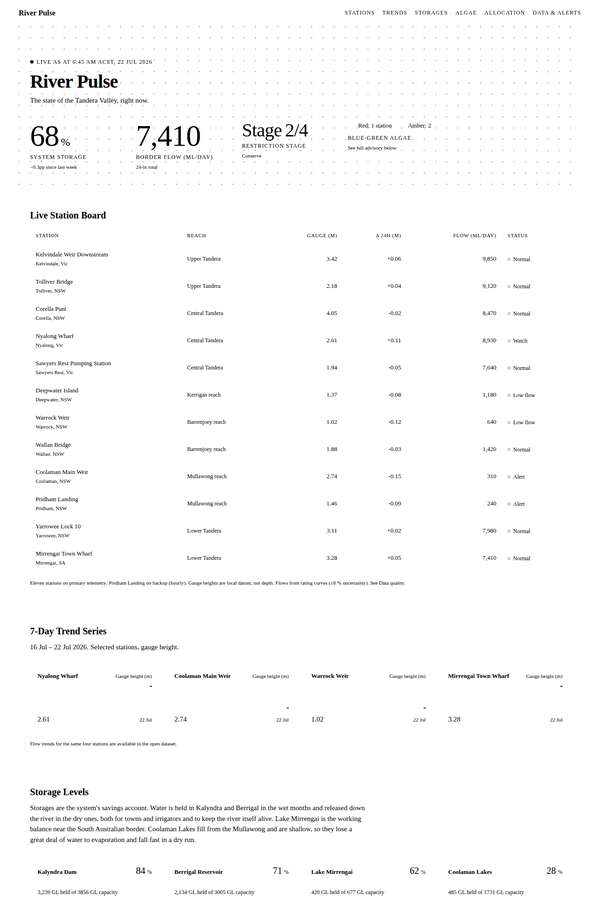
Composite 28.1%Judge 2.1/5
Judge panelAnthropic 2.3/5OpenAI 2.0/5
single-judge (Claude) 2.3/5 → leave-one-family-out 2.1/5
Anthropic: Content coverage is fairly complete - all twelve stations in a clean board, the five-level algae scale with meanings and current stations, storages, allocation/restriction stages, methodology, subscribe form and contact are all present and figures look correct. But the required "7-day trend series, charts drawn in code" section is effectively broken: it shows only station labels and a single number with a stray dash, no actual line/bar charts, and storage levels are bare percentages with no visual. Visually it reads as an almost unstyled black-on-white editorial page with very small type, no c
OpenAI: Most required sections and core station/storage/allocation data are present, but the river-health explainer is essentially missing, the required trend charts are barely visible and omit the flow series, and alerts are not visually unmissable. The page is coherent but extremely plain, with tiny typography, minimal hierarchy, no meaningful colour system, and several details feeling unfinished rather than like a polished public authority site.
Ingrid Kessler (claude-fable-5)
High reasoning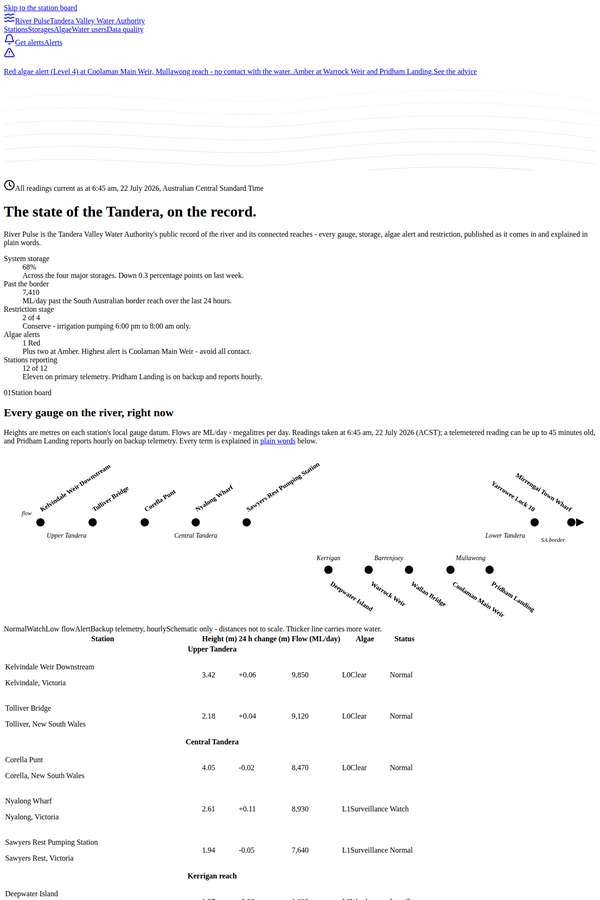
Composite 21.9%Judge 1.9/5
Judge panelAnthropic 1.8/5OpenAI 2.0/5
single-judge (Claude) 1.8/5 → leave-one-family-out 1.9/5
Anthropic: The content coverage is broad - top links, station listings, seven-day trend charts (rendered as inline SVG area charts with large end-point numbers), storages, algae scale, allocation, methodology and contact all appear present, so factual fidelity is moderate. But the page renders essentially as unstyled black-on-white document text with no visible design system: no cards, no colour, no status colour-coding, and no visual hierarchy beyond bare headings, which fails the brief's core demand that current alerts be unmissable and that the record feel like a public-facing water observatory. Visua
OpenAI: The page appears to include nearly all required sections, figures, station data, charts, algae scale, restrictions, methodology, signup, and contact details. However the rendered result is essentially unstyled/default HTML with tiny text, weak hierarchy, awkward spacing, and oversized/janky charts, making it feel unfinished and not suitable for a public government information site. It has very little visual polish or distinctive impact despite reasonable content coverage.
Mara Vieira (claude-fable-5)
High reasoning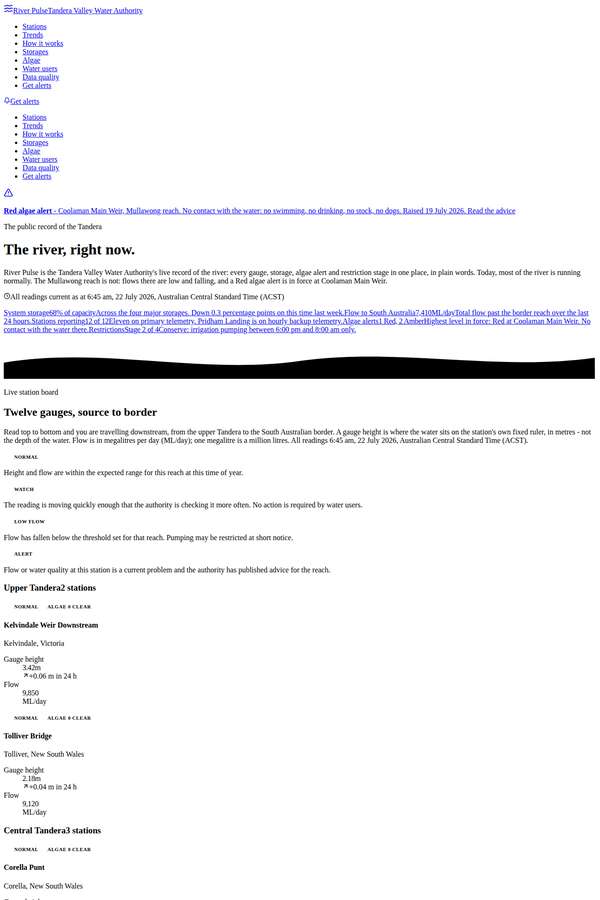
Composite 21.9%Judge 1.9/5
Judge panelAnthropic 1.8/5OpenAI 2.0/5
single-judge (Claude) 1.8/5 → leave-one-family-out 1.9/5
Anthropic: The content is largely present - the twelve stations, seven-day trend charts drawn as inline SVG area charts with date axes, storages, algae scale, allocation, methodology and contact sections all appear, so brief fidelity is moderate. But the page renders as an unstyled document: default browser fonts, blue underlined links stacked as a raw nav, black text on white with no layout grid, colour system, spacing, or component styling - the theme/Tailwind clearly failed to apply. As a result visual design, craft, and impact are very poor; nothing here reads as a finished, distinctive government wa
OpenAI: Most required sections, data, definitions, charts, algae levels, allocations, methodology, subscription form, and contact details appear to be present, though the critical alert is not made visually unmissable and the page is hard to scan for urgent numbers. The visual treatment is essentially unstyled default HTML with tiny text, cramped spacing, default links, and oversized black chart blocks, so it lacks the clarity, polish, and public-information authority the brief calls for.
Mara Vieira (deepseek-v4-pro)
default reasoning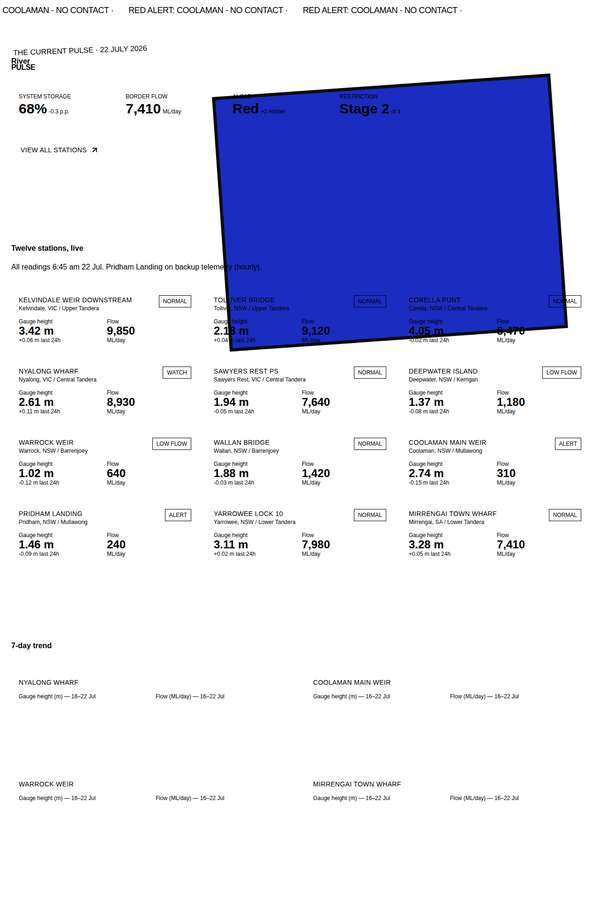
Composite 12.5%Judge 1.5/5
Judge panelAnthropic 1.5/5OpenAI 1.5/5
single-judge (Claude) 1.5/5 → leave-one-family-out 1.5/5
Anthropic: Most required content is present (twelve stations with heights/flows/statuses, four storages, the five-level algae scale with current assignments and the Coolaman Red advice, allocation and Stage 2 restrictions, methodology, subscribe form, and contact block), so fidelity is moderate, but the seven-day trend charts are entirely missing - only empty labels appear where the code-drawn charts should be. Visual design is essentially absent: the page is unstyled black-on-white text with hairline tables, no colour system, hierarchy, or spacing discipline, and the hero is dominated by a broken skewed
OpenAI: Most core datasets and sections are present, but key brief requirements are missing or incomplete: the seven-day trend charts appear blank, the general river-health explainer is not evident, methodology is abbreviated rather than shown in full, and status/unit explanations are incomplete. The visual approach is stark but underdeveloped, with a large rotated blue block obscuring station content and creating a broken, unfinished feel rather than a polished public-information interface.
Sol Kepler (deepseek-v4-pro)
default reasoning
Composite 0.0%Judge 1.0/5
Judge panelAnthropic 1.0/5
single-judge (Claude) 1.0/5 → leave-one-family-out 1.0/5
Anthropic: The screenshot is a completely blank white page with no content whatsoever. None of the required sections (hero snapshot, station board, charts, storages, algae scale, allocations, methodology, subscribe/contact) are visible. There is nothing to evaluate for design, craft, or impact because the build rendered nothing at all.